
PCB Recycling Machine Plant: WOLFU Dry Separation Line
Global e‑waste generation is rising five times faster than documented e-waste recycling, and PCB‑rich fractions make up an increasing share of that stream Global E-waste Monitor 2024 . And gold prices have stayed above USD 2,000/oz for sustained periods, which makes PCB recycling machine plant is no longer a side‑line experiment.
With copper content running 15–30% by weight and gold concentrations of 100–300 g/tonne, the typical tonne of waste circuit board carries more recoverable metal than many gold ores that go into primary production. This article walks through a complete WOLFU PCB recycling machine plant – from motherboard enters the feed hopper to the 99%‑purity copper powder rolls out the discharge end.
🔵 View WOLFU Precious Metal Refining Plant
What comes out of a PCB recycling plant
- Copper (Cu) — 15–30% of feed weight; primary commercial output; 99% purity.
- Gold (Au) — 100–300 g/tonne feed.
- Silver (Ag) — 200–500 g/tonne.
- Palladium (Pd) — 50–100 g/tonne.
- Aluminum and iron — removed upstream by magnetic and eddy‑current separation.
Resin and fiberglass powder — sold as filler for construction materials, or as a low‑calorific fuel.
What Goes Into a PCB Recycling Machine Plant
A complete WOLFU PCB recycling machine plant is not a single machine. It is a coordinated system, each performing one stage of the separation task.
- Screw feeder — meters material into the shredder at a controlled rate.
- Double‑shaft shredder — primary size reduction.
- Hammer crusher + pulverizer — secondary size reduction; and >95% metals are liberated from the resin substrate.
- Magnetic separator — pulls ferrous contamination out of the powder.
- Air classifier (gravity separator) — performs an initial density‑based cut between lighter resin and heavier particles.
- Vibrating screen — classifies particles by size.
- Electrostatic separator — splits metal and non‑metal in the fine fraction, metal purity up to 99%.
- Pulse dust collector — captures >99.5% of airborne dust.
- PLC control cabinet— sequences the line, interlocks safety, and logs throughput.
🔵 Request a Quote for WOLFU Precious Metal Refining Plant
The Process, Step by Step
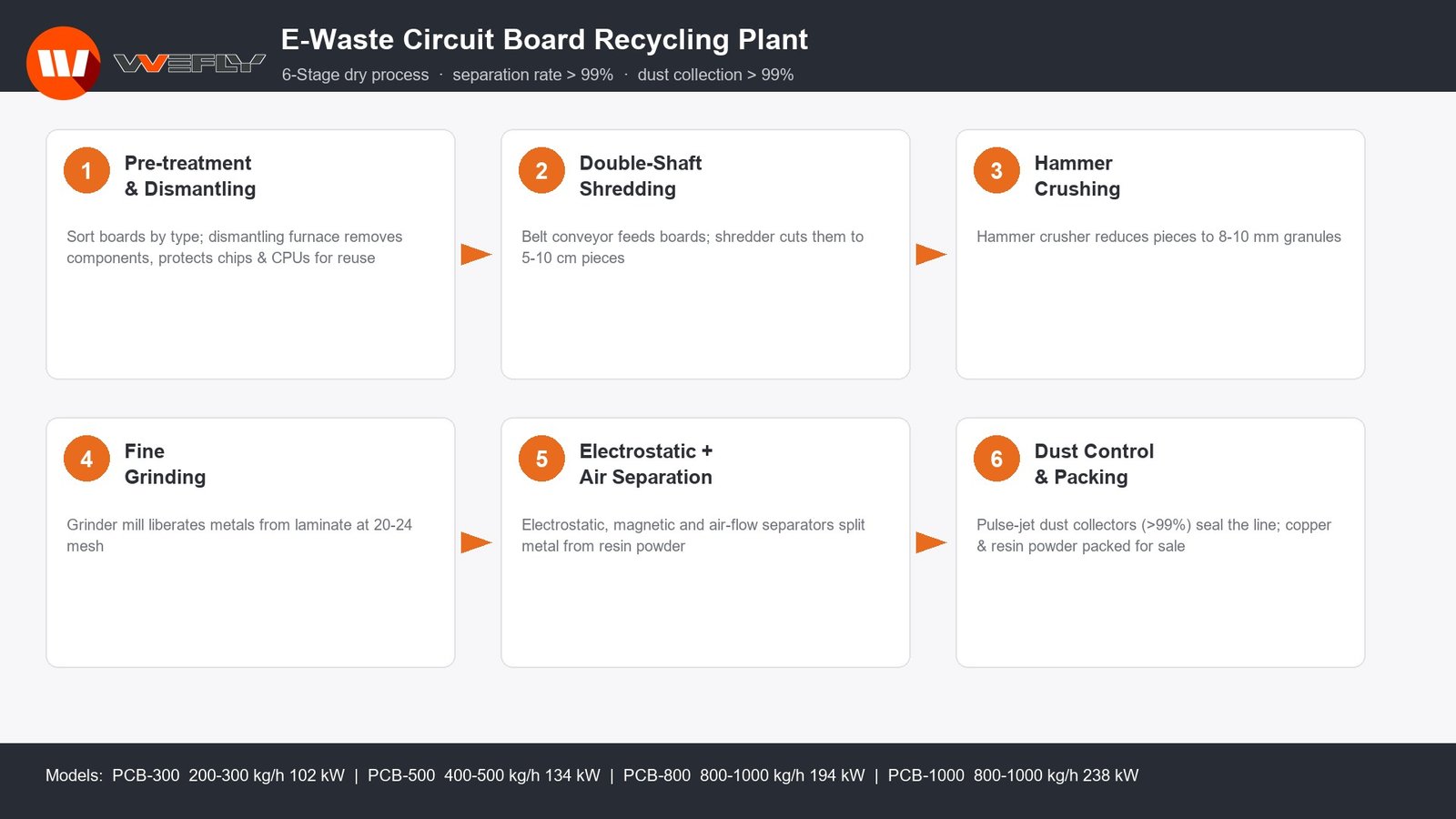
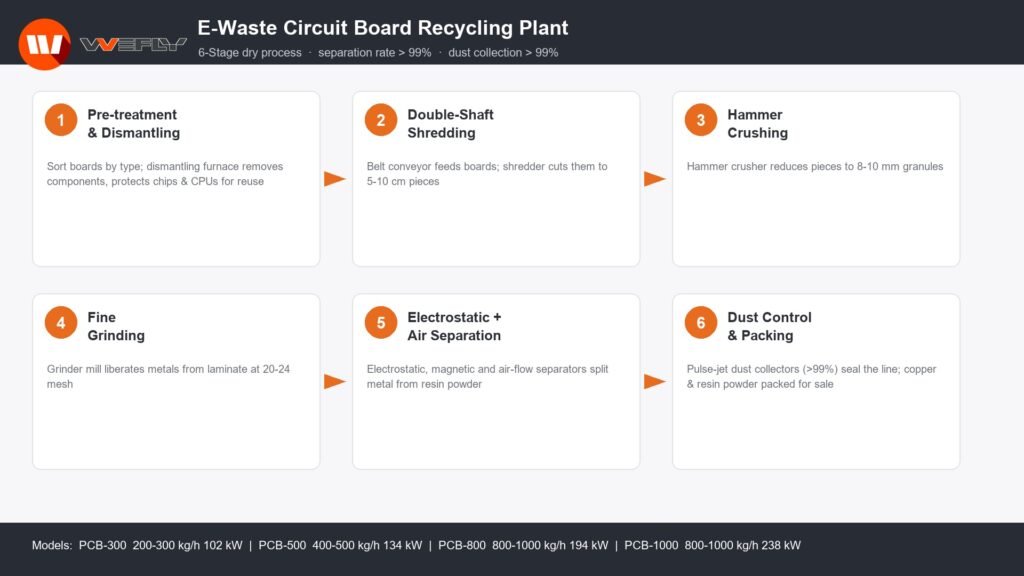
Step 1 — Pre‑processing and dismantling. Whole boards arrive at the gate. Before any mechanical processing begins, large components — capacitors, batteries, heat sinks, RAM modules, CPUs — are removed. This is done manually or on a dedicated de‑soldering station.
Step 2 — Shredding. The bare boards enter a double‑shaft shredder, and then be discharged onto a conveyor that meters it into the hammer crusher.
Step 3 — Crushing and pulverizing. Inside the hammer crusher, impact forces break the pieces down further. A well‑designed pulverizer can liberate >95% metals in a single pass.
Step 4 — Separation: air classifier and electrostatic separator. The mixed powder enters the air classifier first. Exploiting density difference, the air classifier pulls 95–97% metal into a heavy stream and discharges the light fraction . The remaining 3–5% of fine metal is captured by the electrostatic separator. The combined cut achieves 99% or higher metal purity.
Step 5 — Collection and dust control. The metal fraction falls into sealed drums. The non‑metal fraction falls into another separate bin. A pulse dust collector runs throughout the entire process of the production line.
Recovered Materials and Their Markets
The economics of a PCB recycling machine plant are driven by what comes out, not what goes in. Below is a typical output mix from a WPCB-500 line.
| Output stream | Typical yield | Purity (WPCB) | Market |
| Copper powder | 15–30% of feed weight | ≥99% | Copper refiners and smelters |
| Gold‑rich fraction | 100–300 g/tonne | Captured in metal concentrate | Precious‑metal refineries |
| Silver + Palladium | 200–500 g/t Ag; 50–100 g/t Pd | Captured in metal concentrate | Precious‑metal refineries |
| Aluminum / Iron | 5–10% of feed | Sorted upstream | Secondary smelters |
| Resin + fiberglass powder | 50–65% of feed | Clean separation | Composite manufacturers, cement kilns |
WOLFU PCB Recycling Machine Plant Specifications
| Model | Capacity | Power | Footprint (L×W×H) | Recommended for |
| WPCB-100 | 100 kg/h | ~85 kW | 8 × 3 × 4 m | Pilot lines, urban-collection hubs |
| WPCB-300 | 300 kg/h | ~180 kW | 14 × 5 × 5 m | Mid-size recyclers, regional e-waste plants |
| WPCB-500 | 500 kg/h | ~280 kW | 18 × 6 × 5 m | Industrial plants, urban-mining investors |
| WPCB-1000 | 1,000 kg/h | ~520 kW | 24 × 8 × 6 m | Hub facilities, integrated e-waste centers |
All models are 99%+ metal purity on the final copper concentrate, 98–99% overall recovery rate, and 99.5% dust-collection efficiency. WOLFU ships PCB recycling machine plant in standard 40‑foot containers and provides on‑site commissioning.
Dry vs. Wet Separation: Choosing the Right System
Not every PCB recycling machine plant uses dry separation. Some choose water-based wet separation.
- Dry process: No wastewater; lower operating cost; ideal for sorted, clean PCB scrap; easier to permit in water-scarce regions.
- Wet process: Better fine-particle recovery; handles more complex feedstock; requires a water-treatment system and discharge permit.
WOLFU manufactures both. Most buyers evaluating their first commercial line or buyers in tight water-discharge regulation regions — choose dry. When the feedstock mix is unusually dirty or the line is integrated into an existing hydrometallurgical refinery downstream — choose wet.
Field Example: A PCB Recycling Plant in Operation
A recent reference installation — posted on LinkedIn new-style-pcb-recycling-machine-plant — shows a WOLFU PCB recycling machine plant in continuous operation.
The design that in this video is exactly what a serious commercial operation should look like: closed-loop air handling, sealed discharge, PLC-coordinated sequencing, and a footprint that fits inside a single industrial building.
FAQ
Q: What is the smallest viable PCB recycling machine plant?
A: A 100 kg/h WPCB-100 pilot line is the typical entry point..
Q: Can one line handle both populated boards and bare boards?
A: Yes, provided the components are removed upstream (either manually or with a de-soldering station). Pre-processing is the gate that lets a single line accept both feedstocks.
Q: What purity of copper powder does the line produce?
A: 99% or higher on the final concentrate. This is the purity typically required by copper smelters.
Q: What does a WPCB-500 PCB recycling machine plant cost?
A: Depending on configuration (with or without shredder, level of automation, regional voltage, optional eddy-current separator, etc.). Shipping, installation, and on-site commissioning are quoted separately.
Q: How is dust controlled in a PCB recycling machine plant?
A: A pulse dust collector runs continuously through shredding, crushing, and separation.
Q: Does the line need a water supply?
A: For dry process (WPCB default), no need process water. Just a small service-water supply for housekeeping and dust-suppression misting is enough. A process-water loop and a discharge permit is required for wet.
Conclusion
A PCB recycling machine plant is the modern expression of urban mining: a closed-loop industrial facility that turns yesterday’s smartphones and servers back into the copper, gold, silver and palladium that built them. The technology is mature, and economics are compelling. The PCB recycling machine plant is a sound investment. Buyers who move now — lock in both the feedstock supply and the metal-concentrate offtake.
WOLFU engineers PCB recycling machine plant from process consultation through installation and operator training. The right configuration depends on your feedstock mix, target capacity, and downstream offtake. Get in touch for a tailored design and quotation.
🔵 Get a Quote for WOLFU Precious Metal Refining Plant
Related WOLFU Equipment
For small gold melting after refining, review:
For automatic precious metal melting and casting, review:
🔵 WOLFU Automatic Medium Frequency Induction Melting Furnace
For industrial metal melting, review: