
What Happens to Materials Recovered from Solar Panels? A Guide to Recycling Value and Reuse
As solar energy installations expand worldwide, the question of what happens to photovoltaic (PV) panels at the end of their service life is becoming increasingly important.
Solar panel recycling is often discussed in terms of waste reduction and environmental protection. However, there is another important consideration for recycling companies: What happens to the materials after they are recovered, and how much commercial value can they retain?
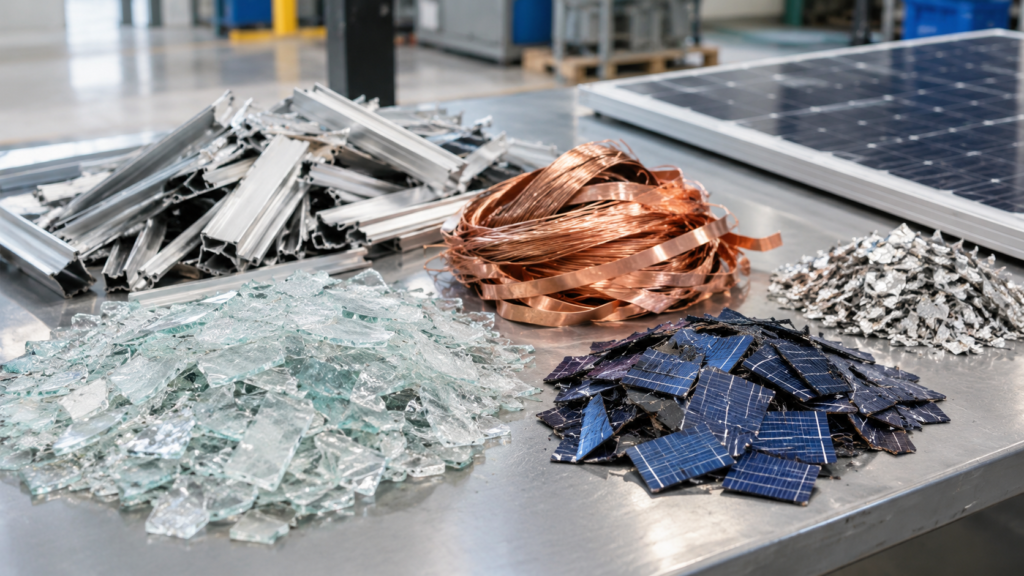
A typical crystalline-silicon solar panel contains glass, aluminum, silicon, copper, and small quantities of silver. Each material has different recovery requirements, quality standards, and potential downstream applications.
For recycling plant operators, understanding these differences is essential when planning equipment investments, evaluating operating costs, and developing markets for recovered materials.
1. What Materials Can Be Recovered from Solar Panels?
Crystalline-silicon PV modules contain several materials that can potentially be recovered through mechanical, thermal, chemical, or combined recycling processes.
The main recoverable materials include:
- Glass: The largest component by weight in many conventional modules.
- Aluminum: Commonly used in the structural frame.
- Copper: Found in electrical connections, cables, and conductive components.
- Silicon: Used in photovoltaic cells.
- Silver: Present in small quantities in the conductive contacts of many crystalline-silicon cells.
Polymers, junction boxes, and other components also require appropriate handling.
The recovery potential depends on panel design, material composition, processing technology, and the quality of separation.
Importantly, recovering a material does not automatically mean it is ready for high-value industrial reuse.
The recovered product must meet the specifications of its intended downstream application.
2. Recycled Solar Panel Glass: High Volume, Different Value Opportunities
Glass represents a substantial portion of the total weight of many solar panels.
This makes it an important material stream for recycling operations, even though its commercial value per ton may be lower than that of recovered metals.
Where Can Recovered Glass Be Used?
Depending on its composition, cleanliness, particle size, and local market requirements, recovered glass may be suitable for:
- Selected glass manufacturing applications
- Construction and building materials
- Industrial fillers and aggregates
- Other approved secondary material applications
However, not all recovered PV glass can be returned directly to high-quality glass production.
Why Glass Purity Matters
Solar panels contain encapsulation materials and other components that can remain attached to the glass during processing.
Residual polymers, coatings, metals, and other contaminants may limit downstream applications.
For recycling companies, producing a consistent glass fraction can improve the range of potential buyers.
Transportation costs also matter. Because glass is relatively heavy, the distance between the recycling facility and the end user can significantly affect its commercial value.
The economic value of recycled PV glass depends on both material quality and access to suitable downstream markets.
3. Aluminum Frames: From Recovered Scrap to Reusable Metal
Aluminum frames are among the more straightforward components to separate from many conventional solar panels.
After dismantling, the frames can enter established aluminum scrap recycling channels.
How Is Recovered Aluminum Processed?
A typical downstream process may involve:
- Removing attachments and non-aluminum components.
- Sorting the material according to alloy composition.
- Preparing the scrap for melting.
- Melting and applying any necessary melt treatment.
- Casting the metal into suitable intermediate products.
The resulting aluminum may be used in new industrial products, depending on its composition and quality.
What Determines Aluminum Recovery Value?
Several factors influence the value of recovered aluminum:
- Alloy identification and consistency
- Contamination from fasteners and other metals
- Surface coatings and residual materials
- Scrap preparation costs
- Local secondary aluminum market demand
Clean, properly separated aluminum frames may be more attractive to downstream processors than mixed or contaminated scrap.
For recycling plant operators, effective dismantling and sorting can therefore be just as important as the final melting stage.
4. Copper Recovery: Small Quantities With Industrial Applications
Copper is used in solar panel electrical connections, cables, and conductive components.
Although its total weight is generally much smaller than that of glass or aluminum, copper can represent a commercially relevant recovered material.
From PV Components to Copper Scrap
Copper-containing components may require mechanical dismantling, cable processing, or separation from other materials.
After preparation, suitable copper scrap can be directed to secondary copper processing facilities.
Industrial copper recycling commonly involves sorting, melting, melt treatment where required, and casting.
However, the suitability of recovered copper for a particular application depends on its chemical composition and impurity levels.
Copper intended for demanding electrical applications may require additional refining and testing.
For facilities processing copper scrap, appropriate melting equipment can support the conversion of prepared materials into reusable metal products.
Explore the WOLFU medium-frequency furnace equipment for related industrial melting applications.
5. Silicon Recovery: Why Material Purity Is Essential
Silicon is one of the most technically challenging materials to recover from crystalline-silicon solar panels.
Unlike aluminum frames, silicon cells are integrated into a multilayer structure that includes glass, encapsulation materials, conductive contacts, and other components.
Recovering silicon requires suitable separation and treatment technologies.
Recovered Silicon Is Not Automatically Solar-Grade
This distinction is especially important for recycling investors.
Silicon recovered from end-of-life photovoltaic modules may contain:
- Metallic impurities
- Residual coatings
- Encapsulation residues
- Other processing contaminants
The recovered material may require additional cleaning, refining, and quality testing before it can be used in a new industrial application.
Silicon suitable for certain metallurgical applications does not necessarily meet the purity requirements of photovoltaic or semiconductor manufacturing.
Therefore, recycling companies should evaluate their intended downstream market before investing in silicon recovery equipment.
Downstream Silicon Processing
Depending on feedstock characteristics and the required final product, recovered silicon may undergo further thermal or metallurgical processing.
WOLFU offers industrial silicon melting equipment for suitable silicon processing applications.
However, melting alone does not guarantee the production of high-purity photovoltaic-grade silicon.
Additional refining technologies may be necessary.
6. Silver Recovery: High Potential Value, Complex Processing
Silver is present in relatively small quantities in the conductive contacts of many crystalline-silicon solar cells.
Although the amount per module is limited, silver can be an economically interesting recovery target when processing sufficient material volumes.
However, silver recovery is more complex than simply separating large mechanical components.
Why Is Silver Recovery Challenging?
Silver is incorporated into cell metallization structures rather than existing as a large, easily removable component.
Recovering it may require specialized treatment of separated cell materials.
Depending on the process, this can involve chemical or other refining technologies.
Recycling operators must evaluate:
- Silver concentration in incoming modules
- Material recovery efficiency
- Processing and chemical costs
- Waste treatment requirements
- Final silver product specifications
Not every recycling facility needs to recover silver directly.
In some cases, selling suitable intermediate materials to specialized refiners may be more practical than installing an additional refining system.
7. What Determines the Commercial Value of Recovered Materials?
For industrial recycling businesses, material recovery volume is only one part of the economic equation.
The commercial value of recovered solar panel materials depends on several interconnected factors.
| Factor | Why It Matters |
|---|---|
| Material Purity | Cleaner fractions may qualify for more demanding downstream applications. |
| Recovery Yield | Higher usable output can improve the amount of saleable material. |
| Material Composition | Different module designs and material grades affect processing requirements. |
| Processing Costs | Energy, labor, maintenance, consumables, and waste treatment affect operating costs. |
| Transportation | Heavy or low-value materials can be sensitive to shipping distances. |
| Market Demand | Buyer requirements and local demand influence achievable selling prices. |
| Product Consistency | Stable quality can support longer-term relationships with downstream processors. |
A recycling plant may achieve high material separation rates without necessarily producing high-value outputs.
For example, recovering a large quantity of contaminated glass does not guarantee strong revenue if suitable buyers are unavailable.
Similarly, recovering silicon fragments does not automatically create a high-value product unless their composition and quality match downstream requirements.
Successful recycling operations must balance recovery efficiency, product quality, processing cost, and market demand.
8. How Recycling Plants Can Improve Material Value
Improving the value of recovered materials requires a coordinated approach to equipment selection and process management.
Focus on Material Separation Quality
Effective dismantling and separation help reduce cross-contamination between glass, metals, and silicon-containing fractions.
Match Equipment to the Feedstock
Solar panel designs vary by manufacturer, technology, and production period.
Recycling systems should be evaluated according to the actual module types and material conditions expected at the facility.
Understand Downstream Buyer Requirements
Before establishing a production line, operators should identify potential buyers and their material specifications.
This can help determine the required separation quality and whether additional processing is economically justified.
Evaluate the Complete Operating Cost
Equipment purchase price is only one part of a recycling project.
Electricity, maintenance, labor, consumables, transportation, and environmental controls should also be included in the economic assessment.
Consider Modular Processing Strategies
Depending on project scale, some facilities may benefit from focusing on mechanical separation while sending selected materials to specialized downstream processors.
This approach can reduce the need to install every refining technology within a single facility.
9. WOLFU Solar Panel Recycling Solutions
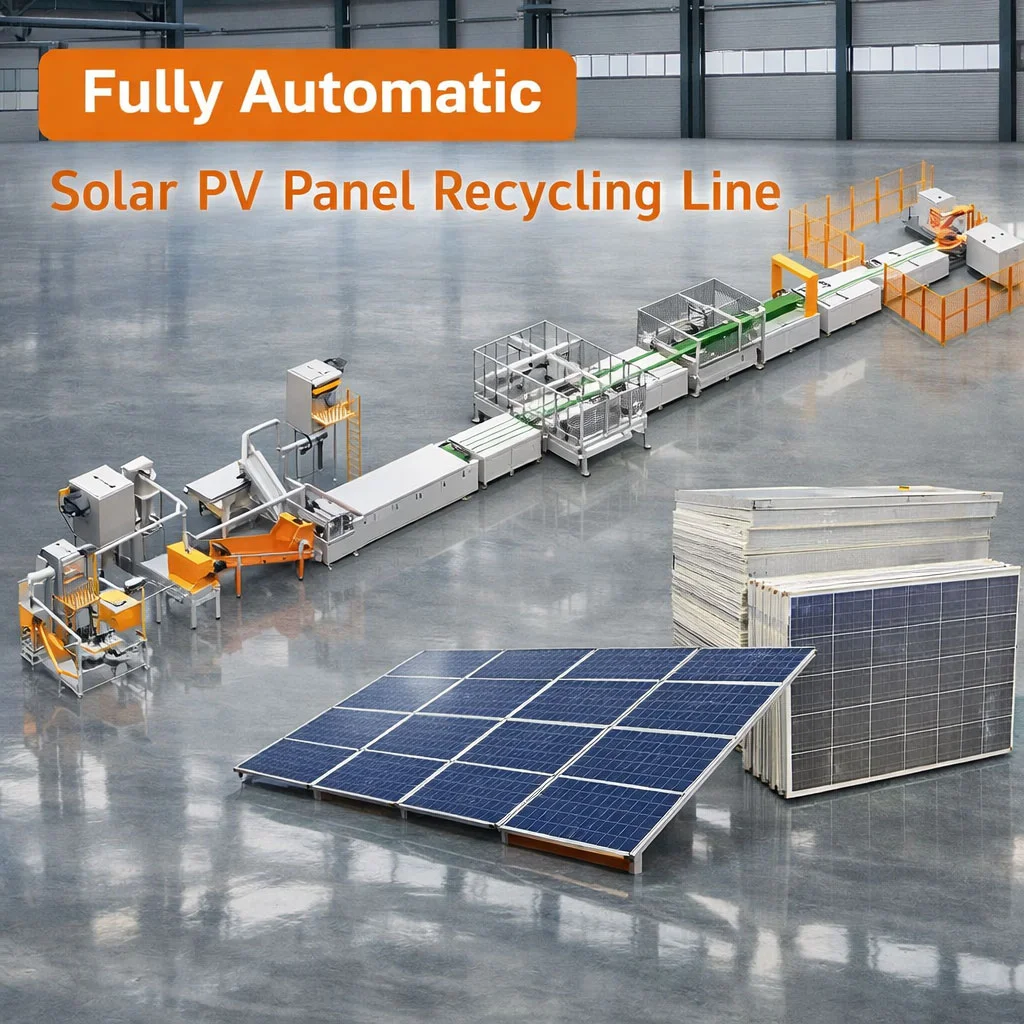
WOLFU provides industrial recycling equipment and production line solutions for photovoltaic module processing.
Its solar panel recycling systems are designed to support the separation and recovery of material fractions from end-of-life PV modules.
Depending on the project configuration, processing equipment may include dismantling, crushing, grinding, screening, and material separation systems.
The recovered fractions can then be directed toward appropriate downstream recycling or refining operations.
WOLFU also supplies related metallurgical equipment for selected metal and silicon processing applications.
For recycling companies, the most suitable equipment configuration depends on:
- Solar panel type and condition
- Required processing capacity
- Target recovered materials
- Available workshop space and utilities
- Downstream product specifications
- Environmental and operating requirements
Explore WOLFU’s recycling and industrial equipment solutions to learn more about available processing technologies.
10. Looking Ahead: Turning Solar Panel Waste Into Industrial Resources
As more photovoltaic installations reach the end of their operating lives, recovering useful materials from retired panels will become an increasingly important part of the solar industry’s circular economy.
However, the long-term success of solar panel recycling depends on more than processing capacity.
Recycling companies must consider the quality, marketability, and downstream applications of each recovered material.
Glass, aluminum, copper, silicon, and silver all present different opportunities and technical challenges.
By selecting suitable separation technologies and establishing reliable downstream material markets, recycling operators can improve resource utilization and build more commercially sustainable operations.
Plan Your Solar Panel Recycling Project With WOLFU
Are you evaluating a new photovoltaic recycling facility or planning to expand an existing processing line?
WOLFU provides industrial recycling equipment and customized processing solutions based on different material types, production capacities, and project requirements.
Visit WOLFU Industry to discuss your solar panel recycling project and equipment needs.