
Pyrolysis Furnace Maintenance and Troubleshooting: The Complete Practical Guide
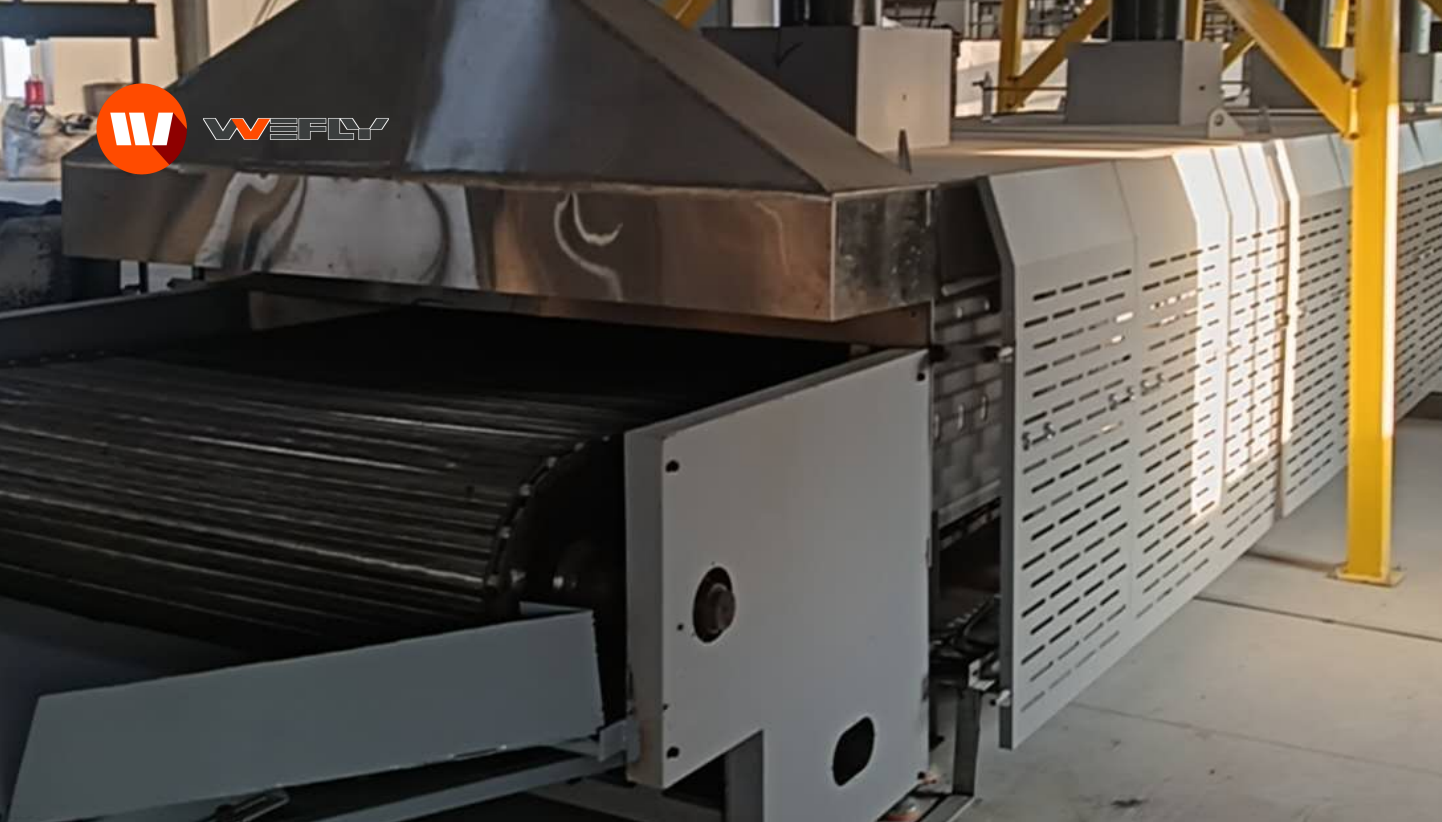
Daily inspection of a continuous mesh-belt pyrolysis furnace maintenancePyrolysis furnaces maintenance and troubleshooting usually starts with one zone running three minutes behind, then a thermocouple drifting six degrees, then the belt edge starting to curl. By the day the stack starts smoking, several months of data has already been telling you exactly what was wrong.
01. Why pyrolysis furnace maintenance needs a tighter window than most industrial furnaces
An annealing furnace or a sintering furnace processes relatively clean workpieces — what happens inside is mostly just heat. A pyrolysis furnace is different. The material it processes carries EVA encapsulant, fluoropolymer backsheets, glass fines and silicon powder in with it. Three things happen in the chamber simultaneously: organic thermal decomposition, release of HCl and fluorides, and dust deposition. Each one consumes the equipment in its own way — decomposition ages the heating elements and lining, acid gas attacks the belt and ducting, dust blocks the mesh holes and heat-transfer surfaces.
The economics make it worse. As IRENA’s End-of-Life Management: Solar Photovoltaic Panels sets out, global volumes of retired PV modules move into a steep growth curve after 2030. Recycling plant economics are built on continuous operation and high uptime, so a single unplanned stop often costs more than an entire year of spare-part budget. Reports from IEA PVPS keep returning to the same point: the bottleneck in PV recycling is shifting from “does the technology exist” to “can it run reliably.”
So the goal of pyrolysis furnace maintenance is not to repair the furnace. It is to prevent the furnace from ever developing a fault that needs repairing. That requires a cadence triggered by data, not by the calendar.
02. Step one: turn the spec sheet into a pyrolysis furnace maintenance checklist
Most plants do not maintain poorly because people are lazy. They maintain poorly because nobody has written down what to watch. A datasheet looks like selection information, but behind every number sits an observable degradation signal. Using the WOLFU WDL-T Series continuous mesh-belt pyrolysis furnace as the example:
| Parameter | Value | What it means for pyrolysis furnace maintenance |
|---|---|---|
| Max temperature | 1100 °C; ≤ 1050 °C for long-term operation | This is the life red line for lining and elements. Exceed it once and alumina fibre shrinkage and embrittlement becomes irreversible — energy consumption climbs steadily from that point on. |
| Pyrolysis setting | 450–520 °C, multi-stage (pre-burn → pyrolysis → slow cooling) | Once the three-stage gradient drifts, EVA residue and off-gas composition degrade together. It is the only temperature parameter that has to be read zone by zone. |
| Temperature zones | 5 zones, independent PID | Each zone has its own thermocouple and control loop. First rule of fault isolation: locate the zone, then locate the component. |
| Rated heating power | 200 kW, three-phase 380 V | Phase loss or voltage sag shows up as slow heat-up. Check three-phase voltage and current before you blame the heating elements. |
| Heating element | Ceramic fibre heating plate | Cold-state resistance is your first-hand data on ageing — far more reliable than asking whether it looks broken. |
| Mesh belt | High-temp alloy + pickled passivation, 1500 × 2.0 mm, 5 mm diamond holes, reinforced edge curling | Fluoride corrosion plus edge fatigue are the two killers. Once 5 mm holes blind over with glass fines, the bottom of the bed goes cold. |
| Belt line speed | 1.5–3.0 m/min (VFD), 25–40 min residence | Residence time is the invisible variable behind EVA removal. Raise belt speed first and you have moved the process window, not the throughput. |
| Furnace lining | High-purity alumina fibre; outer wall ≤ ambient + 22 °C | Shell temperature rise is the cheapest lining-health indicator you have. A local hot spot means local fibre loss or a void. |
| Control system | PLC + touchscreen, remote IoT integration supported | Trend curves are more honest than any handwritten inspection sheet. Train the shift to read a 24-hour temperature trend, not an instantaneous value. |
Values taken from published WOLFU WDL-T Series technical specifications. Figures vary by model and configuration — always defer to the documentation shipped with the equipment.
03. The pyrolysis furnace maintenance schedule: five tiers from daily to annual
There is an old rule of thumb in the industrial furnace trade that still holds, provided you refill each tier with the right content for a pyrolysis process. The critical part is that every tier needs an explicit pass/fail criterion — otherwise inspection degenerates into ticking boxes.
Daily: Flame, temperature, belt, shell
Weekly: Tighten, tension, unblock
Monthly: Measure, verify, check water
Quarterly: Calibrate, full belt, insulation
Annual: Lining rebuild, energy benchmark
Cadence assumes three-shift continuous operation. Single-shift lines can fold monthly items into quarterly ones, but the annual lining inspection should not be skipped.
| Tier | Core actions | Criteria / action on out-of-limit |
|---|---|---|
| Daily | ① Check bed profile and flame colour through the sight glass; ② compare all 5 zone actuals against setpoints; ③ visual check of belt edge clearance against the guides; ④ spot-check shell temperature on all four sides; ⑤ off-gas section differential pressure and scrubbing liquid pH; ⑥ log belt speed, current and furnace pressure | Zone deviation within ±5 °C; flame should be an even orange-red. Localised white (over-fired) or black (under-fired) means check zone power and loading first. Shell rise above 22 °C is logged as a hot spot and re-checked the same day. |
| Weekly | ① Tighten heating element terminals, SSRs and terminal blocks; ② inspect thermocouple extension wire and connectors; ③ belt tension, roller and chain lubrication; ④ baghouse pulse valves and differential pressure; ⑤ quench nozzle atomisation | Blackened terminals or arc marks must be dealt with — a loose terminal at temperature always burns out first. Persistently rising bag differential means cleaning failure or condensation blinding. |
| Monthly | ① Cold-state resistance of heating elements, three-phase balance; ② visible lining at sight glasses and inspection ports; ③ over-temperature protection loop function test; ④ PID parameter review; ⑤ cooling water flow, quality and temperature; ⑥ scrubbing liquid and activated carbon replacement judgement | Three-phase resistance spread within 10%; one phase reading high means ageing or a poor contact in that group. Set the over-temperature trip 10–20 °C above the process maximum. |
| Quarterly | ① Reference thermocouple comparison; ② full-circumference belt inspection (curl, hole deformation, pin wear); ③ VFD and contactor cleaning and tightening; ④ earth and insulation resistance; ⑤ secondary chamber refractory and quench section corrosion check | Correct parameters above ±5 °C deviation, replace above ±10 °C. Plan belt replacement once pin wear exceeds 20% of original diameter. |
| Annual | ① Lining rebuild (patch or replace detached / voided fibre); ② full belt replacement assessment; ③ whole-line heat balance test; ④ specific energy consumption benchmark; ⑤ full gas-train leak check and pre-compliance emission test | If specific energy runs materially above the 300 kWh/t baseline, suspect lining and sealing before you suspect insufficient element power. |
04. System-by-system checkpoints of pyrolysis furnace maintenance
What follows is the working core of a pyrolysis furnace maintenance programme: five systems, each with its own failure signature and its own check rhythm.
4.1 Heating system: measure resistance before you strip elements
Ceramic fibre heating plates fail progressively. First local oxidation thins the conductor and resistance rises, so the same power input heats more slowly. Then micro-cracks appear. Only at the end does it go open-circuit. If “is it broken” is your only test, you will always be one step behind.
The pyrolysis furnace maintenance method is simple: at every monthly check, measure the cold resistance of each element group and log it as a trend. When the spread between phases exceeds 10%, or a group has risen more than roughly 8% against the previous quarter, start staging the spare. It takes ten minutes and it is the difference between a planned swap and a 3 a.m. line stop. One hard prerequisite: isolate, verify dead, and let the furnace cool — resistance readings taken hot are meaningless, and so is the safety record.
4.2 Mesh belt and drive: tracking and cracking are two different problems of pyrolysis furnace maintenace
Tracking problems are almost always mechanical: roller parallelism, uneven tension between the two sides, or a biased feed causing one-sided load. Work the diagnosis in that order — check loading, then tension, and only then touch the rollers. A great many tracking faults are created by adjusting.
Edge cracking is chemical plus fatigue. Fluoropolymer backsheets release fluorides that attack the alloy, and the curled edge is the stress concentrator. The WDL-T specification answers both with a high-temperature alloy, pickled and passivated, plus 5 mm diamond holes and reinforced edge curling — but consumables are consumables. The difference between single-glass and double-glass modules also matters: double-glass feed is heavier and more brittle, it hits the edges harder, and belt life on a double-glass line is correspondingly shorter — so the spare ratio has to go up.
One detail of pyrolysis furnace maintenance gets missed constantly: blinded mesh holes. Once the 5 mm diamond holes clog with glass and silicon fines, hot gas cannot reach the underside of the bed and that layer runs cold. The symptom reads as temperature is fine but EVA remains. Cleaning the mesh is therefore not an annual job — brush it through at the weekly pyrolysis furnace maintenance.
4.3 Temperature control: most temperature faults are wiring faults
Temperature faults on a pyrolysis furnace have a very clear diagnostic order. Follow it and roughly eight out of ten problems resolve in the first three steps:
- Read the display. A
----reading or open-circuit alarm points straight at a broken, shorted or badly connected thermocouple. Only if the display looks right but the actual temperature disagrees should you move on to drift and PID. - Check continuity. With power off, measure the thermocouple loop — it should read through. Inspect the extension wire for oxidation and the terminals for looseness. Oxidised extension wire is one of the highest-frequency faults in any hot shop; it fails more often than the thermocouple itself.
- Verify the thermocouple type. K, S and B types are not interchangeable — the instrument setting must match the hardware. Fit the wrong type during a swap and you get the classic case of the display looking right while the actual is off by tens of degrees.
- Check installation position. The sensing tip belongs at the centre of the constant-temperature zone, clear of the wall and inserted deep enough — never touching a heating element, which distorts the reading.
- Inspect the power circuit. Phase loss on three-phase supply, voltage sag, and a welded-shut SSR all present as abnormal heating or over-temperature. These failure modes are well documented in the furnace industry; this troubleshooting walkthrough is a useful practical reference.
Calibrate by comparison quarterly and send instruments out for formal calibration annually. The WDL-T’s five zones run on independent PID loops, which means calibration has to be done zone by zone. Checking only the middle zone is the most common shortcut — and the most effective way to hide a developing problem.
4.4 Lining, sealing and negative pressure: shell temperature is the best free instrument you own
Alumina fibre lining degrades from the inside, where nobody can see it. But heat always escapes. Walking the four sides of the shell once a week with an IR thermometer tells you more than opening an inspection port ever will. The design limit is ambient + 22 °C; once one area runs 8–10 °C above its neighbours, you can safely assume the fibre has collapsed or a void has formed behind it.
The correct response to a hot spot is to schedule a patch, not to raise that zone’s setpoint to make up for it. Raising it accelerates the local degradation and creates a feedback loop.
Sealing and negative pressure are a separate thread. The furnace and the whole gas train should run at slight negative pressure — that is as much a safety feature as a flow feature, because it means hazardous gas does not leak out at sight glasses and flanges. Unstable negative pressure has three usual sources: induced-draft fan belt or VFD problems, dust build-up in ducting, or aged flange gaskets. Feeling the flange temperature and glancing at the gasket during the weekly check catches most of it early.
05. Twelve common faults of pyrolysis furnace maintenance and how to run them down
The table below is organised as symptom → first suspect → how to confirm → what to do. It covers more than 90% of day-to-day faults on a continuous mesh-belt pyrolysis furnace.
| Symptom | First suspect | How to confirm | Action |
|---|---|---|---|
| One zone heats slowly, never reaches setpoint | Aged elements in that zone / phase loss / low supply voltage | Measure cold resistance for that zone and compare with the rest; check three-phase voltage and current | Replace high-resistance elements; trace phase loss at the breaker and main line |
| All zones normal, but EVA residue is high | Bed too thick, belt too fast, mesh holes blinded | Measure bed depth and uniformity; calculate residence time; check light through the belt | Hold bed at 60 mm and uniformity ≥95%; reduce belt speed; clean the mesh |
| Temperature display jumps or open-circuit alarm | Broken thermocouple / oxidised extension wire / loose terminal | Measure loop continuity; verify thermocouple type setting | Replace or re-terminate; tighten; confirm type matches |
| Temperature swings beyond ±5 °C | PID out of tune / degraded SSR / poor door sealing | Read the period of the trend curve; test SSR output; inspect sight-glass seals | Re-run auto-tune; replace SSR; renew gaskets |
| Belt tracking off | Biased loading / uneven side tension / roller parallelism | Run empty and observe; measure tension travel on both sides | Fix loading first, then tension, then rollers |
| Belt edge cracking, short belt life | Fluoride attack / curl fatigue / thermal shock at discharge | Check whether cracks concentrate at the curl; verify fluoropolymer share in feed | Move to fluoride-resistant alloy; raise spare ratio; tune discharge cooling |
| Discharge temperature above 80 °C | Slow-cooling section ineffective / belt too fast / insufficient cooling water | Measure material temperature at the outlet; check cooling water flow and temperature | Restore slow-cooling airflow; reduce belt speed; service cooling system |
| Localised hot spot on the shell | Lining fibre detached or voided | Scan all four sides with a thermal camera and compare to baseline | Schedule a shutdown repair — never compensate with more power |
| Black smoke or odour at the stack | Secondary chamber temperature too low / insufficient residence time / spent carbon | Review secondary chamber temperature trend; check carbon replacement record | Restore secondary chamber conditions; replace activated carbon |
| Unstable furnace pressure, smoke at the sight glass | ID fan fault / duct dust build-up / flange leaks | Measure differential pressure per section; soap-test flanges | Service the fan; clean ducting; replace gaskets |
| Scrubbing liquid pH falling fast | Higher chlorine content in feed / infrequent liquid change | Check batch blend; measure circulating pH and make-up rate | Adjust the blend; increase replacement frequency |
| Touchscreen comms lost, remote offline | Shielding failure / VFD interference / network module | Check shield earthing; isolate VFD sections one at a time | Redo shield earthing; add line filters |
This table gets rewritten in the field. During commissioning of the WOLFU PV pyrolysis furnace project in India, grid fluctuation produced a classic slow heat-up misdiagnosis — the first assumption on site was a heating element problem, when the real cause was low incoming voltage. That is exactly why the first column in any troubleshooting table should always be electrical, not elements.
06. Three traps where a process problem looks like a furnace problem
Maintain a pyrolysis furnace long enough and the hardest part stops being repair. It becomes deciding whether the equipment should be blamed at all.
Trap one: treating a bed problem as a temperature problem
The limits of 60 mm bed depth and ≥95% loading uniformity are not arbitrary. Once the bed runs thick, heat cannot reach the core, EVA decomposition is incomplete and the discharge comes out tacky. The operator sees not burned through and reaches for the temperature setpoint. But raising it over-fires the surface layer, spikes the off-gas load, and still leaves the core under-heated. The correct action is to go back to the loading mechanism, not the temperature setting.
Trap two: raising throughput by moving the process window
Residence time of 25–40 minutes corresponds to the thermal history EVA needs to decompose fully. Take belt speed from 1.5 to 3.0 m/min and you double throughput while halving residence. Nothing shows up for a few weeks. Then downstream sorting starts losing wafer cleanliness and electrostatic separation loses efficiency — and nobody connects it to a belt-speed change made three weeks earlier.
Trap three: running double-glass feed on a single-stage curve
Fluoropolymer backsheets (TPT, TPE, PVF) need a two-stage process: stage one decomposes the fluoropolymer layer, stage two removes the EVA. Force it through a single-stage curve and the result reads as there is always residue and the off-gas is unusually corrosive. That is not an equipment fault; it is a mismatched recipe. The WDL-T implements the two-stage profile automatically through its multi-zone design — but only if the recipe is set correctly for the incoming material. The furnace can execute; it cannot decide for you.
07. Spare parts and shutdown planning
For a continuously running pyrolysis line, the strategy should be: safety stock on critical items, calendar replacement on consumables, assessment-driven replacement on major components. A workable configuration looks like this:
- Safety stock (1 set on hand) — thermocouples (matching the installed type), SSRs, extension wire, spray nozzles, gaskets, filter bags
- Volume stock (~20% of installed count) — ceramic fibre heating plates, belt joints and pins, activated carbon
- Assessment stock (decide 3 months ahead) — complete mesh belt, lining fibre modules, ID fan impeller
The spare ratio for heating elements is the one most often squeezed, because the unit cost is real and they do not fail often. But they fail in groups — a batch of elements running under identical conditions reaches end of life together, so once the first goes you will typically lose three or four groups within a fortnight. That 20% exists for the group failure, not the individual one.
Plan shutdowns around external compliance dates: emission testing, annual reporting under frameworks such as the EU WEEE rules, and local EPR data verification usually cluster in the same period. Schedule lining inspection and the off-gas pre-check about a month before testing and one stop covers both. Cooling system cleaning — for example the closed-loop water cooling tower — belongs in the same window, so you are not forced into an unplanned stop during peak summer temperatures.
One more thing: if the same line handles both lithium battery recycling and solar PV panel recycling, maintenance intervals cannot simply be averaged. Lithium black mass carries a much higher dust load, so baghouse and mesh-hole cleaning frequencies need to be tightened separately.
08. Three safety lines of pyrolysis furnace maintenance that cannot be crossed
No matter how thorough the pyrolysis furnace maintenance programme, crossing one of these lines zeroes it out.
- Never open the furnace hot. Opening a sight glass or inspection door before the furnace has cooled to the safe range thermally shocks the alumina fibre lining and oxidises the elements rapidly. This is not a be careful item — it can halve lining life in a single event.
- Never work the gas train under positive pressure. The off-gas carries CO, CH₄, H₂ and tars. Positive-pressure leakage risks both poisoning and fire. Before any gas-side work, confirm the ID fan is running, negative pressure is established, and gas detection reads clear.
- Never bypass a safety interlock. Safety requirements for electroheating installations are clearly defined in national and international standards — IEC 60519-1:2015, Safety in installations for electroheating and electromagnetic processing – Part 1: General requirements, adopted identically as China’s GB/T 5959.1-2019 — which specifies requirements for over-temperature protection, door interlocks, earthing and insulation. Jumping out an interlock is the most common, and most dangerous, temporary measure in the trade.
09. Frequently asked questions about pyrolysis furnace maintenance
How often should pyrolysis furnace maintenance be carried out?
Use a five-tier cadence: daily walkdown, weekly tightening, monthly resistance measurement and protection checks, quarterly calibration and deep inspection, and an annual lining and belt rebuild assessment. On three-shift lines the monthly pyrolysis furnace maintenance items belong on a fixed 30-day cycle rather than being triggered by failure.
What does a pyrolysis furnace maintenance checklist actually cover?
Five systems. Heating: cold resistance per element group, three-phase balance. Belt and drive: tracking, tension, hole blinding, edge condition. Temperature control: thermocouple continuity, type verification, PID tuning, over-temperature trip test. Lining and sealing: shell temperature scan, gasket condition, negative pressure stability.
Temperature readings look normal but EVA removal has dropped. Why?
Check three non-instrument causes first: bed depth above 60 mm or uniformity below 95%; belt speed too high, pushing residence time under 25 minutes; or fluoropolymer backsheets on a single-stage curve rather than a two-stage profile. All three stop heat reaching the core of the bed while the panel display stays perfectly normal.
Why does the mesh belt keep tracking off or cracking at the edges?
Tracking is usually mechanical — roller parallelism, uneven tension between sides, or a biased feed load. Edge cracking is chemical plus fatigue: fluoride from backsheets attacks the alloy while the curled edge concentrates stress. Inspect edge curl and diamond hole condition after every feed batch change.
How often should furnace thermocouples be calibrated?
Compare against a reference thermocouple quarterly and send for formal calibration annually. Correct instrument parameters above ±5 °C deviation, replace above ±10 °C, and always confirm the thermocouple type matches the instrument setting — K, S and B are not interchangeable.
What is a normal outer shell temperature for a pyrolysis furnace?
Up to 22 °C above ambient. A localised hot spot usually means fibre has detached or a void has formed behind it — scan it, schedule a repair, and never compensate by raising the zone setpoint.
Need a pyrolysis furnace maintenance plan built for your line?
WOLFU provides process consultation, equipment selection, installation and commissioning, operator training and lifetime pyrolysis furnace maintenance support.
Send us your material type, target throughput and existing equipment model, and our engineering team will return a tailored inspection sheet and spare-part list.Talk to the WOLFU engineering team →
Related reading
- WOLFU Continuous PV Pyrolysis Furnace: From Crushing to Sorting
- Pyrolysis Off-Gas Treatment System: The Compliance Backbone of PV Recycling
- The Core Technology of Solar Panel Pyrolysis Recycling
- Solar Panel Recycling Equipment FAQ
- PV Silver Recovery Equipment: The Complete Hydrometallurgy Line
- Induction Furnace PV Recycling: Complete Application Guide
- Solar Panel Aluminum Frame Removing Machine
- Case Studies · About WOLFU · FAQ · 中文站
10. One last thing of pyrolysis furnace maintenance
The quality of a pyrolysis furnace maintenance programme shows up in one unglamorous number: unplanned stops per year. And that number depends on two small things — whether the pass/fail criteria are actually written on the inspection sheet, and whether the shift has authority to stop the line when data goes out of limit.
What the equipment can do is make condition observable: independent PID makes every zone traceable, trend curves surface drift weeks early, and remote diagnostics mean the manufacturer’s engineer does not have to wait for your line to stop before getting involved. The rest is a process somebody is willing to walk every day.