
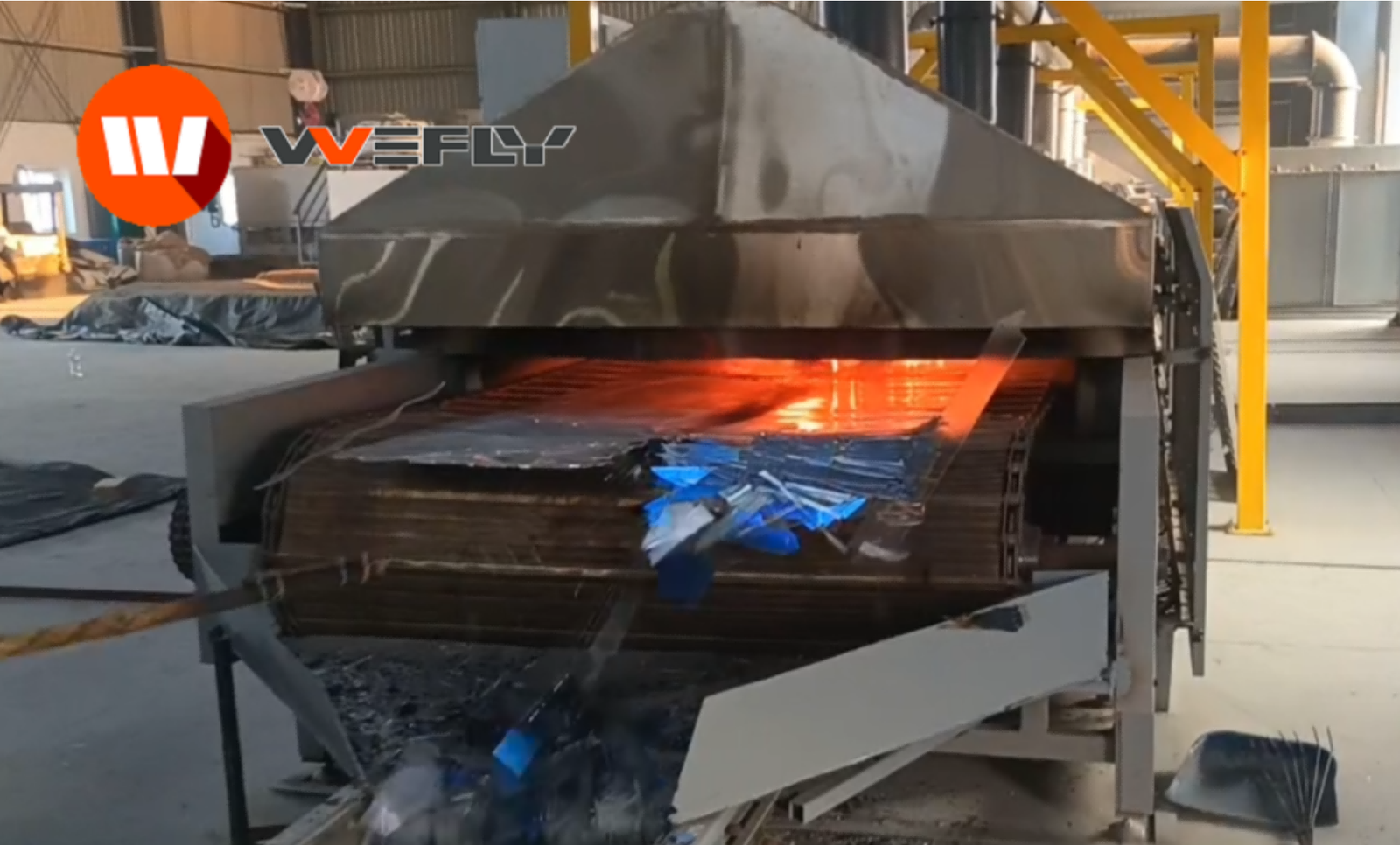
India PV Pyrolysis Furnace in Production — With Silicon, Silver and Tin Recovery Running on the Same Site
PV Pyrolysis Furnace in Production – Indian Solar Panel Recycling PlantA few weeks ago, we reported that our solar panel recycling plant in India was entering trial production — empty-load tests, load tests, and temperature-zone calibration. Today we can confirm the next milestone: the customer’s PV pyrolysis furnace has officially entered production. And the PV pyrolysis furnace in production is not running alone. The silicon recovery equipment and the silver and tin recovery equipment installed on the same site have completed commissioning too — the full chain, from delamination to refined metal, is now in commercial operation.
For recyclers planning their own project, this is the most instructive moment in any plant’s life: the point where process flowcharts become daily tonnage.
From Trial Production to Official Production: What Actually Changed
Trial production and official production are two very different tests of a recycling line. During trial runs, the question is mechanical: does every machine start, does the furnace hold its zone temperatures, does the mesh belt run at rated speed? PV pyrolysis furnace in production asks a harder question: can the line hold output and product quality, shift after shift, without constant engineering attention?
At the Indian plant, the transition between the two came down to four confirmations:
- Continuous thermal stability. The PV pyrolysis furnace in production now runs through scheduled shifts with zone temperatures locked in profile — no drift, no emergency shutdowns.
- Consistent sorted outputs. Glass cullet, silicon-rich fractions, and copper ribbons come off the sorting line at stable purity, batch after batch, so downstream buyers receive a predictable feedstock.
- Downstream lines keeping pace. The silicon recovery and silver/tin recovery circuits absorb material at the rate the front end produces it — the plant is balanced, not bottlenecked.
- Compliance under real load. The sealed exhaust purification system performs within emission limits during continuous operation, not just during test runs — the condition that matters most to India’s State Pollution Control Boards.
That last point deserves emphasis. In India, waste solar panels fall under the E-Waste (Management) Rules, and producers and recyclers work through the Central Pollution Control Board’s Extended Producer Responsibility portal. A plant that cannot demonstrate stable, compliant emissions during full production cannot hold its position in that system. Passing this test at full load is what separates an operating asset from an expensive demonstration.
Three Lines, One Plant: The Full Configuration Now Running
What makes this project worth studying is not any single machine — it is that all three stages of high-value PV recycling are live on one site.
Line 1 — Delamination: the WDL-T continuous PV pyrolysis furnace. Crushed module fragments travel on the PV pyrolysis furnace in production continuous mesh belt through independently controlled temperature zones, where the EVA encapsulant is thermally decomposed and the glass, silicon and metals emerge clean and separable. This is the heart of the plant: as we have covered in detail, pyrolysis is what unlocks clean wafer surfaces and keeps downstream silver recovery high.
Line 2 — Silicon recovery. After pyrolysis and screening, the silicon-rich fraction is concentrated through dry physical separation. Electrostatic separation splits conductors from non-conductors with up to 99.9% separation efficiency and no water, no chemicals — the sorted silicon stream leaves the plant as clean feedstock for remelting, and the metal concentrate moves to line 3.
Line 3 — Silver and tin recovery. This is where the plant’s margin lives. The silver-bearing silicon powder feeds a hydrometallurgical silver recovery line — leaching, solid–liquid separation, electrowinning and refining that delivers silver at 99.99% purity with zero wastewater discharge. The copper ribbon fraction, carrying its tin-lead solder coating, feeds precious metal recovery equipment that recovers commercial-grade tin while upgrading the copper for resale. Nothing high-value leaves the site unrefined.
Why the Downstream Lines Decide the Payback
Most of the industry conversation focuses on delamination — how to take a panel apart. But the plant’s revenue is decided downstream, and the numbers explain why the customer invested in the full chain rather than stopping at sorted fractions:
- Silver is the profit engine. Monocrystalline silicon carries roughly 2–3 kg of silver per tonne.
- Tin turns a liability into a product. The solder coating on copper ribbons discounts their resale value as mixed scrap. Recovering the tin separately upgrades both fractions.
- Silicon closes the loop. Clean recovered silicon flows back to remelting and the PV material chain, instead of being lost into mixed glass-silicon powder as it is in direct-crushing plants.
Industry studies of combined pyrolysis-plus-hydrometallurgy routes — the configuration now running in India. The plant now proving those figures in daily operation is the best answer we can offer to the question “does this chemistry actually work at industrial scale?”
India: The Right Market at the Right Time
The customer’s timing is deliberate. India is one of the fastest-growing solar markets in the world, and the first large wave of retired and defective panels is arriving alongside it. IRENA’s end-of-life solar PV assessments project cumulative PV waste reaching millions of tonnes globally within this decade, and India’s installed solar base keeps setting records year after year — which means a domestic, compliant recycling capacity is becoming a necessity rather than an opportunity.
The policy direction reinforces it. Beyond the EPR portal, international frameworks such as IEA PVPS Task 12 keep pushing recyclers toward high-value, high-purity recovery. Plants that master silver, tin and silicon recovery now will own the most profitable position in the value chain as feedstock volumes grow.
What Other Recyclers Can Take From This Project
Three lessons from the Indian plant apply almost anywhere:
- Buy the chain, not the machine. A PV pyrolysis furnace in production alone produces sorted fractions whose value is set by commodity buyers. A furnace plus recovery lines produces refined silver, tin and silicon — products with pricing power.
- Prove compliance before you chase throughput. The exhaust system that quietly passes audits during month twelve is worth more than an extra hundred kilograms per hour.
- Insist on remote support. This plant runs with PLC control and manufacturer remote diagnostics. On a continent-sized market like India, that is what keeps uptime high between service visits.
We have also written about why continuous, energy-saving operation matters for plant economics — the Indian customer’s PV pyrolysis furnace in production benefits from the same continuous mesh-belt design that cuts energy use by more than 25% versus batch furnaces.
FAQ
Q: What does “officially in production” mean compared with trial production?
A: Trial production verifies machines — startup, temperature calibration, belt speeds. PV pyrolysis furnace in production officially means the line runs continuous commercial shifts with stable output quality, balanced material flow between the delamination, silicon recovery and metal recovery stages, and emissions within permit limits under full load.
Q: Which equipment is now operating at the Indian plant?
A: Three linked systems: the WDL-T continuous mesh-belt PV pyrolysis furnace in production for EVA delamination; silicon recovery equipment concentrating the silicon-rich fraction through dry physical separation; and silver and tin recovery equipment processing the silver-bearing powder and solder-coated copper ribbons hydrometallurgically.
Q: What purity of silver does the plant recover?
A: The hydrometallurgical line — leaching, electrowinning and electrolytic refining, with zero wastewater discharge and compliant off-gas treatment.
Q: Where does the recovered tin come from?
A: From the solder coating on PV copper ribbons. Recovering the tin separately upgrades both the tin product and the underlying copper fraction, instead of selling the ribbons at discounted mixed-scrap prices.
Q: Can WOLFU supply only part of this PV pyrolysis furnace in production, or must it be a complete plant?
A: Either. Some customers start with the pyrolysis and sorting stages and add metal recovery later; others, like this Indian customer, commission the full chain at once. WOLFU engineers configure the scope around your feedstock, capacity and offtake agreements.
Q: Does WOLFU support the plant after production starts?
A: Yes — remote diagnostics through the PLC system, spare parts supply, and ongoing process optimization. This Indian plant will continue to receive support as it ramps toward full capacity.
Conclusion
A PV pyrolysis furnace in production is a milestone. A pyrolysis furnace, silicon recovery line and silver & tin recovery line all producing saleable output on the same site — that is a business. That is what our Indian customer is now running, and it is the clearest demonstration yet of the WOLFU approach to solar panel recycling: pyrolysis-centered delamination, clean physical sorting, and hydrometallurgical refining engineered to work as one system.
If you are planning a solar panel recycling project — in India or anywhere else — WOLFU provides full-process support: process consultation, equipment selection, plant layout, installation, commissioning, operator training and lifetime maintenance. Send us your panel types, target capacity and recovery goals, and our engineers will respond with a tailored configuration.
Contact WOLFU: johnruan123@163.com | +86 151 0379 2578 | wolfu-industry.com