
Copper Electrolysis Machine for PV Recycling: Separating Silver, Tin and Lead from Solar Ribbon
Copper Wire from the PV Pyrolysis Furnace Enters the Electrolysis Cell — WOLFU Customer SiteAfter a solar panel has been through the pyrolysis furnace, most recyclers look at the copper that falls out and see finished goods. It isn’t. That copper wire — the tabbing ribbon and bus wire that used to interconnect the cells — still carries a coating of solder, plus silver picked up from the cell contacts. Sell it as mixed scrap and you take a heavy discount. Run it through a copper electrolysis machine and the same wire yields two products: high-purity copper you can cast, and a silver–tin–lead concentrate worth far more than the penalty you were about to accept.
At Wolfu (Luoyang) Furnace Industry Co., Ltd., we build the copper electrolysis machines for that step. This article explains what PV copper wire actually contains, what happens to it inside the electrolysis cell, what the equipment costs, and how the silver–tin–lead mixture is separated and turned into sellable metal.
What Comes Out of the Pyrolysis Furnace
A crystalline-silicon module is roughly 70% glass and 13% aluminium by weight, but the highest-value metals are the copper ribbons, busbars and junction-box cable. In the PV recycling sorting system, delaminated modules are split into three product streams — silicon powder, copper ribbons and crushed glass — at up to 97% purity, and the electrostatic separator pushes silicon–metal separation to 99.9% with a fully physical process. What reaches the pyrolysis furnace is therefore a reasonably clean metal fraction.
The wire itself is a composite. PV ribbon is a copper core coated in tin–lead solder, typically around 80% copper, 8% tin and 5% lead by weight, according to the International Tin Association — which also reports that tin use in PV ribbon has grown to more than 45,000 tonnes per year globally. Silver enters the picture two ways: as residual paste from the busbars and fingers the ribbon was soldered to, and as a trace constituent of the solder alloy itself.
That combination is the problem. A smelter buying mixed coated wire discounts it heavily for tin and lead, and pays nothing for the silver. The IRENA and IEA-PVPS end-of-life assessment puts the recoverable material value in the coming PV waste wave in the billions of dollars — but only if the metal fractions are actually separated rather than diluted into a mixed melt.
What Happens Inside the Electrolysis Cell
The principle is straightforward, and it is the same one used in industrial copper electrorefining — just applied to a feed with far more tin and lead in it.
Hang the copper wire as the anode in a sulfuric acid / copper sulfate electrolyte, and pass direct current. Three things happen simultaneously:
- Copper dissolves. Cu → Cu²⁺ + 2e⁻ at the anode. The copper ions migrate to the cathode and plate out as dense, high-purity cathode copper.
- Silver does not dissolve. Silver is more noble than copper; it never ionises at the working anode potential. It detaches from the dissolving wire surface as fine metallic particles and drops away.
- Tin and lead precipitate out of the electrolyte. Lead enters solution briefly as Pb²⁺ and immediately precipitates as insoluble lead sulfate (PbSO₄). Tin oxidises to Sn⁴⁺ and hydrolyses into a gelatinous tin(IV) hydroxide, which also reports to the solids.
The published electrochemistry is unambiguous on this point. A study in Recycling (MDPI) notes that during copper electrorefining, “almost all lead, tin, and selenium from the anode is transferred into the bottom slime,” with lead mostly present as insoluble PbSO₄ — see the analysis here. The classic patent literature on electrorefining describes the same behaviour: noble metals remain insoluble, lead falls out as PbSO₄, and tin precipitates as a tin(IV) hydroxide gel that follows the slime.
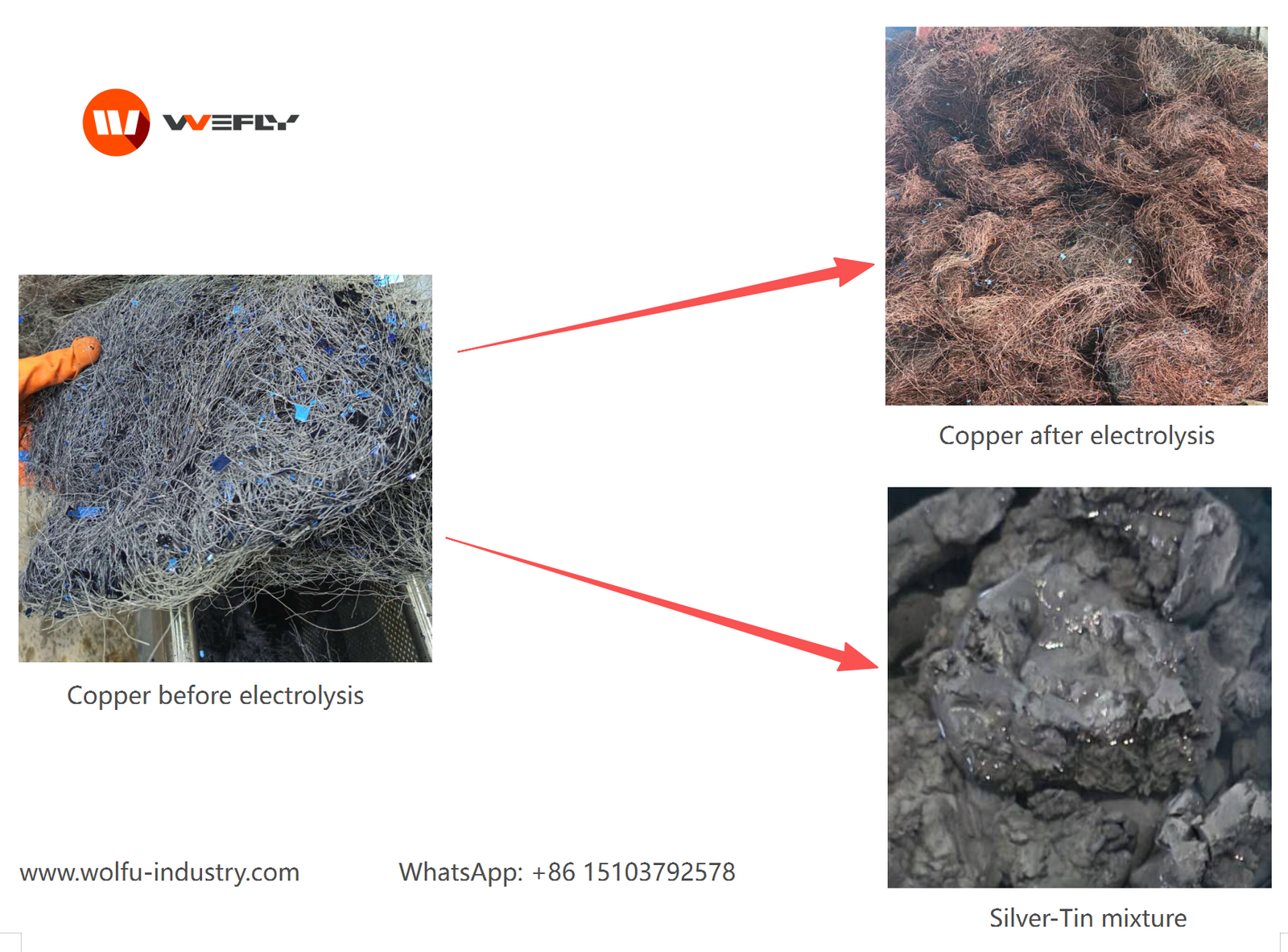
The combined result is exactly what recyclers want: a silver–tin–lead precipitate collecting at the bottom of the cell — anode slime — physically separated from the copper, while the copper itself is rebuilt as a clean cathode.
This isn’t theoretical for PV ribbon. Research on end-of-life PV ribbon has demonstrated the route directly — calcining the panel at 500°C to free the ribbon, stripping the tin–lead coating, then melting the cleaned copper as an anode and electrorefining it in CuSO₄ against a stainless cathode at 0.2 V, producing 99.93% purity copper at 96.11% recovery over 24 hours (Hybrid Recovery of Copper and Silver from Photovoltaic Ribbon and Ag Finger of End-of-Life Solar Panels).
[IMAGE 2 — CUSTOMER SITE PHOTO] Title: Silver–Tin–Lead Precipitate Separated from the Copper Wire — WOLFU Customer Site Alt: Silver-tin-lead precipitate collected at the bottom of a WOLFU electrolysis cell, separated from the copper wire and routed to precious metal refining, photographed at a customer plant
How WOLFU Builds the Copper Electrolysis Machine
The two photographs above are from a WOLFU customer site — the equipment you would receive is built to the same configuration. The engineering details that matter are these:
Cell construction. Corrosion-resistant cell bodies in acid-grade PP / PVC / FRP, sized to your anode load, with a sloped or false bottom that lets precipitate settle into a collection sump instead of re-suspending. Adherent slime is the enemy: if it clings to the anode it raises cell voltage and can passivate the surface, so cell geometry, electrolyte flow and the slime-removal interval are designed together.
Anode and cathode. Copper wire is loaded in anode baskets or on anode bars sized to the ribbon format — loose ribbon, chopped conductor or pressed bundles. Cathodes are starter sheets or reusable stainless blanks. Busbars and contacts are sized for low resistance, because at these voltages contact losses dominate energy consumption.
Electrolyte circuit. A CuSO₄–H₂SO₄ electrolyte is circulated through the cell bank with heating and filtration. Temperature is held in the standard electrorefining window (roughly 55–65°C); copper and acid concentration are held constant by a bleed-and-replenish loop, with the bleed stream treated to recover copper and return acid. This is the same closed-loop principle we use on the PV silver recovery hydrometallurgy line, where water and acid are recycled batch after batch and wastewater discharge is designed to zero.
Power supply. A DC rectifier with constant-current control, sized to your target throughput. Cell voltage in electrorefining is low — fractions of a volt per cell — so the bank is arranged in series and the rectifier specified for current, not voltage.
Control and compliance. PLC control manages current, temperature, circulation and cycle timing, so batch-to-batch consistency does not depend on operator discipline. Acid mist is captured and treated: the same duty our pyrolysis off-gas treatment system handles upstream, engineered in rather than bolted on.
What You Get Out — and Where It Goes
The electrolysis step does not finish the job on its own. It does something more valuable: it splits one discounted, mixed input into two high-value streams.
The copper. Cathode copper from the cell goes straight to melting and casting. On a WOLFU line it feeds the horizontal copper rod continuous casting machine — induction melting at around 1150 °C ±10 °C, water-cooled mould, bright copper rod from Φ12 mm upward — or is remelted in a medium frequency induction furnace for ingot casting. Either way you are selling refined copper product, not coated scrap.
The silver–tin–lead precipitate. This is the higher-value half. It is a concentrate, not a finished metal, and it belongs in a refining circuit. WOLFU routes it to the precious metal refining plant — a PLC-controlled, cyanogen-free hydrometallurgical system available in 100 kg/day and 300 kg/day configurations, with recovery rates of ≥99% and purity up to 99.99%, built to process exactly this kind of anode residue. For plants that prefer a thermal route, the vacuum induction melting furnace separates alloy constituents by vapour pressure under vacuum, without chemical reagents.
If you want the wider picture of how silver and tin move through a complete PV recycling plant, we set that out in Solar Panel Precious Metal Recovery: How to Recover Silver and Tin from Waste PV Panels.
Specifications, Capacity and Shipping Data
Buyers evaluating a copper electrolysis machine usually need the import and utilities data before they can build a project model. Typical configuration ranges for a WOLFU cell bank:
| Parameter | Typical value |
|---|---|
| Throughput | 50 kg/day pilot cells to 100+ t/day cathode copper lines |
| Cell body material | Acid-grade PP / PVC / FRP, or polymer concrete on larger lines |
| Electrolyte | CuSO₄ – H₂SO₄, circulated, heated and filtered |
| Operating temperature | 55–65 °C |
| Cathode output purity | 99.93–99.99% Cu (feed dependent) |
| Power supply | DC rectifier, constant-current, sized to cell bank in series |
| Control | PLC — current, temperature, circulation, cycle timing |
| Off-gas | Acid mist capture and treatment integrated |
One more data point if you are weighing where to source: China is the largest exporter of HS 854330 apparatus, accounting for roughly 40% of world exports in recent UN Comtrade data. Electrolysis cells for metal refining are a mature, high-volume export category — not a bespoke one-off.
What a Copper Electrolysis Machine Costs
This is the first question most buyers ask, and it deserves a straight answer: there is no single number, because cell count, rectifier size and materials of construction all scale with throughput.
Seven variables move you within and between those bands:
- Throughput. Cell count and rectifier rating are the two biggest cost lines, and both scale linearly with daily capacity.
- Anode presentation. Loose ribbon needs baskets; pressed bundles need different handling. Matching the loading system to your actual material costs more up front and saves more in labour.
- Cell material. PP and PVC suit most acid duties; polymer concrete and FRP cost more and last longer on high-duty cycles.
- Rectifier and busbar sizing. Undersized conductors are the most common false economy in this equipment class — contact losses are paid for every hour of every year.
- Automation level. Manual loading and stripping keeps capital down; automated handling and cathode stripping reduces crew size and improves consistency.
- Electrolyte circuit and acid mist treatment. A closed bleed-and-replenish loop with mist capture is not optional in most jurisdictions, and it belongs in the budget from the start.
- Destination. FOB versus CIF, destination port, local voltage and frequency, and the environmental standard your plant has to pass all move the final number.
To turn this into a firm quotation, send us:
- Target capacity (kg/day or t/day)
- Feedstock type — loose ribbon, chopped wire or pressed bundles — with an assay if you have one
- Panel type mix (mono, poly, bifacial)
- Target recovery outputs (copper purity, silver–tin–lead concentrate)
- Destination port
- Local voltage, frequency and applicable environmental standards
Standard cell banks typically ship in 30–60 days; complete lines are engineered to order and quoted with a confirmed delivery schedule.
Six Things That Decide Whether This Step Makes Money
- Feed cleanliness. The better the upstream sorting, the steadier the cell. Mixed glass, EVA char and aluminium in the anode load raise slime volume and drag down current efficiency — which is why the solar panel recycling equipment front end matters to the refining back end.
- Current density versus slime adhesion. Push too hard and the precipitate crusts on the anode instead of settling, raising voltage and risking passivation. Conservative current density with periodic slime removal beats maximum throughput.
- Electrolyte purification. Tin and lead that stay in solution will eventually contaminate the cathode. Bleed, treat and return — don’t run the bath until it fails.
- Temperature control. Dissolution kinetics, acid volatility and energy cost all move with temperature. Hold the window.
- Anode presentation. Loose ribbon behaves differently from pressed bundles. Match basket design and loading density to your actual material, and test it before you buy.
- Energy accounting. Electrorefining is electrically cheap per tonne of copper but runs for many hours. Size the rectifier and the cell bank together, and meter it.
Frequently Asked Questions
What is the copper electrolysis process? Copper electrolysis — electrolytic refining, or electrorefining — dissolves impure copper from an anode and re-deposits it as pure copper on a cathode. The anode and cathode sit in a copper sulfate / sulfuric acid electrolyte and a direct current is passed between them. Copper dissolves as Cu²⁺ at the anode and plates out at the cathode. Everything more noble than copper (silver, gold) does not dissolve and falls to the cell floor; less noble and insoluble-forming metals (lead as PbSO₄, tin as a hydroxide gel) also report to that sludge.
What is anode slime, and why is it valuable? Anode slime is the sediment that collects at the bottom of an electrolytic cell — the insoluble fraction of the anode. In PV ribbon electrolysis that means silver, lead sulfate and tin hydroxide. It is valuable because it concentrates the precious metal content of the feed into a fraction of the original mass, turning a penalty into a second revenue stream. It is also why “anode slime treatment” is a distinct and profitable process step rather than a waste problem.
How do you recover silver from solar panels? Silver sits in two places: the screen-printed paste on the cells (busbars and fingers), and trace amounts in the solder on the ribbon. The cell fraction goes to hydrometallurgical silver recovery — leaching, precipitation and refining. The ribbon fraction goes through the electrolysis route described here, where the silver reports to the anode slime and is then refined. Our PV silver recovery hydrometallurgy line covers the first path; this equipment covers the second.
Can the tin actually be recovered, or is it lost? It is recovered, as part of the silver–tin–lead precipitate. The precipitate is a concentrate, not a finished metal, and is routed either to hydrometallurgical refining or to vacuum thermal separation. Tin is not destroyed in the cell — it simply changes form and location.
Is a copper wire recycling machine different from a copper electrolysis machine? They solve adjacent problems. A copper wire recycling machine (granulator, separator) upgrades scrap wire into clean copper by mechanical means. It cannot remove a metallurgical coating — the tin–lead solder and the silver remain on the copper. Copper electrolysis equipment removes them. Plants running both typically granulate and densify the wire first, then electrorefine the densified material.
Get a customized solution and quotation from our engineering team — tell us your feedstock, target capacity and site conditions, and we will come back with a process proposal, a plant layout and the equipment list.
Wolfu (Luoyang) Furnace Industry Co., Ltd. designs and manufactures recycling production lines and metallurgical equipment from Luoyang, Henan, China — delivering turnkey plants worldwide, from system design and in-house manufacturing to installation, commissioning, and long-term technical support.