
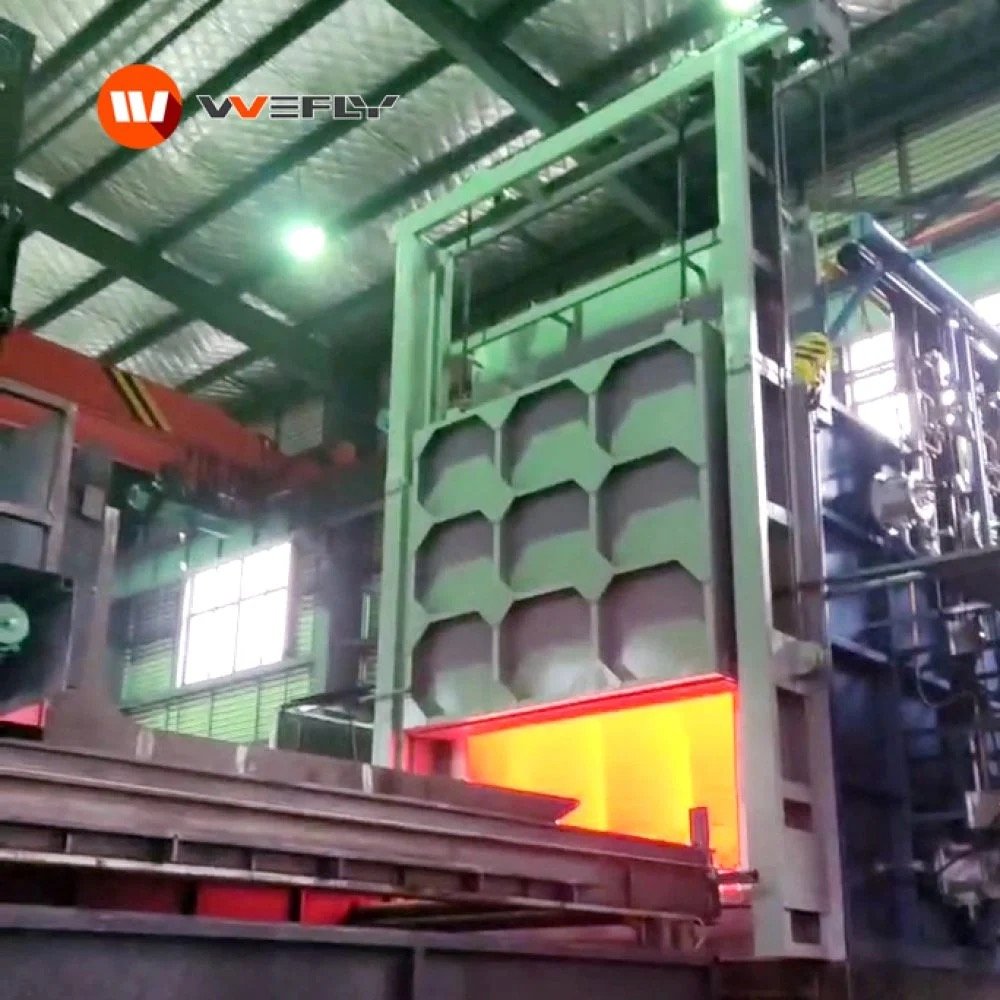
Trolley Annealing Furnace for Large Metal Workpieces
A Trolley Annealing Furnace is an industrial heat treatment furnace designed for large, heavy, or batch-loaded metal workpieces. It is widely used for annealing, tempering, normalizing, stress relieving, and other controlled heating processes in metallurgy, machinery manufacturing, automotive, aerospace, foundry, and heavy equipment industries.
For large metal parts, heat treatment is not only about reaching a certain temperature. The furnace must provide uniform heating, stable insulation, reliable loading, accurate control, safe operation, and enough chamber space for heavy workpieces. Poor temperature uniformity can lead to uneven hardness, residual stress, deformation, cracking, or unstable mechanical properties.
View WOLFU Trolley Annealing Furnace
The WOLFU Trolley Annealing Furnace is designed for industrial metal heat treatment. It can process high manganese steel, stainless steel, rolls, steel balls, 45 steel, and other mechanical parts. With customizable capacity, durable furnace structure, energy-saving insulation, and PLC control, it is suitable for factories that need stable heat treatment performance for large workpieces.
What Is a Trolley Annealing Furnace?
A trolley annealing furnace is a type of industrial heat treatment furnace with a movable trolley or loading car. The workpieces are placed on the trolley outside the furnace, then moved into the heating chamber for thermal processing.
This structure is useful for heavy parts that are difficult to load manually into a fixed furnace. It also improves loading efficiency, supports batch production, and makes the process safer for operators.
The furnace can be used for annealing, tempering, normalizing, and other heat treatment processes. These processes help improve metal structure, reduce internal stress, improve machinability, enhance mechanical properties, and prepare materials for further processing.
Compared with small box furnaces, a trolley type furnace is more suitable for large workpieces, long parts, heavy castings, rolls, steel balls, machine components, and batch-loaded metal products.
Why Trolley Furnaces Are Important for Industrial Heat Treatment
Large metal parts often require controlled heating and cooling after casting, forging, welding, machining, or forming. Without proper heat treatment, the internal structure of the metal may remain unstable.
Annealing can reduce hardness, improve ductility, relieve internal stress, and improve machinability. Tempering can improve toughness and reduce brittleness after hardening. Normalizing can refine grain structure and improve mechanical consistency.
A trolley annealing furnace gives manufacturers a practical way to process large workpieces with better temperature control and easier material handling. The movable trolley design also helps factories reduce crane loading difficulty and improve production workflow.
For industries such as metallurgy, heavy machinery, automotive, aerospace, and equipment manufacturing, stable heat treatment is directly related to product reliability and service life.
How the WOLFU Trolley Annealing Furnace Works
Step 1: Workpiece Loading
The process begins by placing metal workpieces on the trolley. These workpieces may include high manganese steel parts, stainless steel parts, steel balls, rolls, 45 steel components, castings, forgings, welded structures, or heavy mechanical parts.
Correct loading is important. The workpieces should be arranged to allow heat circulation and reduce uneven heating. Overloading or stacking parts too tightly may affect temperature uniformity.
Step 2: Trolley Movement into the Furnace Chamber
After loading, the trolley moves into the furnace chamber. The trolley structure allows large and heavy workpieces to enter the furnace smoothly.
This design is especially useful for production lines that handle heavy parts with cranes or forklifts. It reduces manual loading difficulty and improves workshop safety.
Step 3: Furnace Door Sealing
Once the trolley is positioned inside the furnace, the furnace door closes and seals. The WOLFU furnace door uses a self-weight compression structure to help create a secure seal during operation.
Good sealing helps reduce heat loss, improve energy efficiency, and support stable furnace temperature.
Step 4: Controlled Heating
The furnace heats the workpieces according to the selected heat treatment process. The WOLFU product page lists the furnace as a resistance annealing furnace with a heating system designed for uniform heat distribution.
Temperature control is managed through the control system, which helps operators maintain the required heating curve, soaking temperature, and holding time.
Step 5: Holding and Heat Soaking
After the furnace reaches the target temperature, the workpieces are held at that temperature for a defined period. This soaking stage allows heat to penetrate the entire part.
For large workpieces, holding time is critical. Thick or heavy parts need enough time for the core temperature to reach the required level. Insufficient soaking may cause uneven properties between the surface and center.
Step 6: Cooling and Unloading
After heat treatment is complete, the workpieces cool according to the process requirement. Some applications require furnace cooling, while others may require controlled air cooling or transfer to another cooling process.
Once the temperature is safe, the trolley moves out of the chamber for unloading. The treated parts can then move to inspection, machining, assembly, or downstream production.
Key Advantages of the WOLFU Trolley Annealing Furnace
Suitable for Large and Heavy Workpieces
The trolley structure makes this furnace suitable for large-size and large-batch metal workpieces. It can handle heavy industrial parts that are difficult to process in small fixed chamber furnaces.
Common materials include high manganese steel, stainless steel, rolls, steel balls, 45 steel, and mechanical components used in heavy-duty industrial applications.
Customizable Capacity
WOLFU can customize furnace capacity according to customer production requirements. Available capacity options can include 5 tons, 10 tons, 20 tons, 50 tons, and other project-specific configurations.
Customization is important because every factory has different workpiece size, batch weight, workshop space, and heat treatment process requirements.
Energy-Saving Insulation
The furnace uses ultra-light energy-saving refractory fiber and insulation structures to help reduce heat loss and improve thermal efficiency.
Better insulation can reduce energy consumption, improve temperature stability, and support more economical long-term operation.
Durable Furnace Chamber
The furnace chamber material can use 2520 stainless steel with 6mm thickness. This supports high-temperature resistance and long-term industrial use.
Durability is especially important in heat treatment workshops where furnaces operate under repeated heating and cooling cycles.
Uniform Heat Distribution
The heating system is designed to improve heat distribution inside the furnace chamber. Uniform heating helps reduce differences between workpieces and improves heat treatment consistency.
For large parts, uniformity is one of the most important quality factors. It directly affects hardness, stress relief, dimensional stability, and mechanical performance.
PLC Control System
The WOLFU trolley annealing furnace can be configured with PLC control for more accurate and reliable operation. Operators can manage heating processes, temperature holding, and furnace operation through the control system.
Automation helps reduce manual errors and improves repeatability between different production batches.
Low Maintenance Design
The furnace is designed for reliable operation and lower maintenance demand. WOLFU also provides long-term support, spare parts, remote troubleshooting, and maintenance options.
For industrial users, lower maintenance demand helps reduce downtime and improves production continuity.
Technical Parameters of the WOLFU Trolley Annealing Furnace
The WOLFU Trolley Annealing Furnace is designed as a resistance annealing furnace for industrial heat treatment. It can be used for annealing, tempering, normalizing, and other metal processing applications.
The furnace voltage can be configured as 380V or 660V. The listed power is 50kW, and the control cabinet size is 1.6m × 0.6m × 0.4m.
The furnace chamber can use 2520 stainless steel with 6mm thickness. The capacity can be customized according to project requirements, including 5 ton, 10 ton, 20 ton, 50 ton, and other capacity designs.
Suitable metals include high manganese steel, rolls, steel balls, stainless steel, 45 steel, and other mechanical parts.
Common Applications
Annealing
Annealing is used to soften metal, reduce hardness, improve ductility, relieve internal stress, and improve machinability. It is common after casting, forging, welding, or cold working.
A trolley annealing furnace is especially useful when parts are too large or heavy for small heat treatment equipment.
Tempering
Tempering is often used after hardening to reduce brittleness and improve toughness. It helps balance hardness and strength for steel parts.
Large steel components, tool parts, machine parts, and wear-resistant components may require tempering to achieve the correct performance.
Normalizing
Normalizing improves grain structure and mechanical consistency. It can help reduce internal stress and improve uniformity in steel parts.
For castings, forgings, and large mechanical workpieces, normalizing is an important heat treatment step.
Stress Relieving
Large welded structures and machined components may contain residual stress. Stress relieving heat treatment helps reduce deformation risk during later machining or service.
A trolley furnace can process large stress-relief batches efficiently.
Industries That Use Trolley Annealing Furnaces
Metallurgy companies use trolley annealing furnaces for processing steel parts, castings, rolls, and large metal components. Machinery manufacturers use them for mechanical parts that require improved stability and machinability.
Automotive suppliers may use trolley furnaces for large steel parts, tooling, and heat-treated components. Aerospace manufacturers may need controlled heat treatment for selected metal workpieces where quality and consistency are important.
Foundries, forging plants, steel ball manufacturers, roll manufacturers, and heavy equipment producers can also use trolley furnaces for batch heat treatment production.
How to Choose the Right Trolley Annealing Furnace
The first factor is workpiece size. Buyers should confirm the maximum length, width, height, and weight of the parts before selecting the furnace chamber.
The second factor is batch capacity. A 5-ton furnace may be suitable for smaller batch production, while 20-ton or 50-ton configurations may be better for large industrial plants.
The third factor is heat treatment process. Annealing, tempering, normalizing, and stress relieving may require different temperature ranges, holding times, and cooling methods.
The fourth factor is temperature uniformity. Large workpieces need stable heat distribution, especially when the final product requires consistent mechanical properties.
The fifth factor is loading method. Customers should consider whether the plant uses cranes, forklifts, rails, or other handling systems for loading and unloading.
The sixth factor is control system. PLC control is useful for repeated batch production because it improves process consistency and reduces manual operation errors.
Related WOLFU Equipment and Resources
For customers who need another industrial heat treatment solution, WOLFU also provides the Vacuum Controlled Atmosphere Quenching Furnace , which is suitable for vacuum heat treatment, quenching, annealing, tempering, and brazing applications.
For metal melting and foundry production, the Medium Frequency Induction Melting Furnace can support industrial metal melting, casting, and metallurgical production.
You can also read WOLFU’s related blog article, Annealing Furnace Solutions for Precision Metal Heat Treatment , to learn more about industrial annealing furnace applications and heat treatment process planning.
Why Choose WOLFU?
WOLFU provides industrial furnace systems, recycling equipment, metal processing machines, and customized production solutions. For trolley annealing furnace projects, customers often need more than a standard machine. They need a furnace matched to their workpiece size, process temperature, batch weight, loading method, and workshop conditions.
WOLFU can support customized furnace capacity, chamber dimensions, voltage configuration, heating system, control system, furnace lining, and trolley loading design. This helps customers build a practical heat treatment solution for real production needs.
The company also provides technical consultation, installation support, remote troubleshooting, video assistance, long-term maintenance options, spare parts supply, and operator training.
For factories processing high manganese steel, stainless steel, rolls, steel balls, 45 steel, large castings, forgings, and mechanical parts, WOLFU can provide a customized trolley type heat treatment furnace solution.
Conclusion
A Trolley Annealing Furnace is a practical and efficient solution for large metal workpiece heat treatment. It supports annealing, tempering, normalizing, stress relieving, and other controlled heating processes for metallurgy, machinery manufacturing, automotive, aerospace, foundry, and heavy equipment industries.
The WOLFU trolley annealing furnace offers customizable capacity, durable furnace chamber materials, energy-saving insulation, uniform heating design, PLC control, and strong support for large workpieces such as high manganese steel parts, stainless steel parts, rolls, steel balls, and mechanical components.
If your factory needs a reliable trolley type heat treatment furnace for large or batch-loaded metal parts, WOLFU can recommend a customized solution based on your workpiece size, loading weight, process temperature, voltage requirement, and production capacity.
CTA:
Get a Quote for WOLFU Trolley Annealing Furnace
FAQ
What is a trolley annealing furnace used for?
A trolley annealing furnace is used for annealing, tempering, normalizing, stress relieving, and other heat treatment processes for large or heavy metal workpieces.
What metals can the WOLFU trolley annealing furnace process?
It can process high manganese steel, stainless steel, rolls, steel balls, 45 steel, and other mechanical parts used in metallurgy, machinery manufacturing, automotive, aerospace, and heavy equipment industries.
Can the furnace capacity be customized?
Yes. WOLFU can customize the furnace capacity according to production requirements, including 5 ton, 10 ton, 20 ton, 50 ton, and other project-specific configurations.