
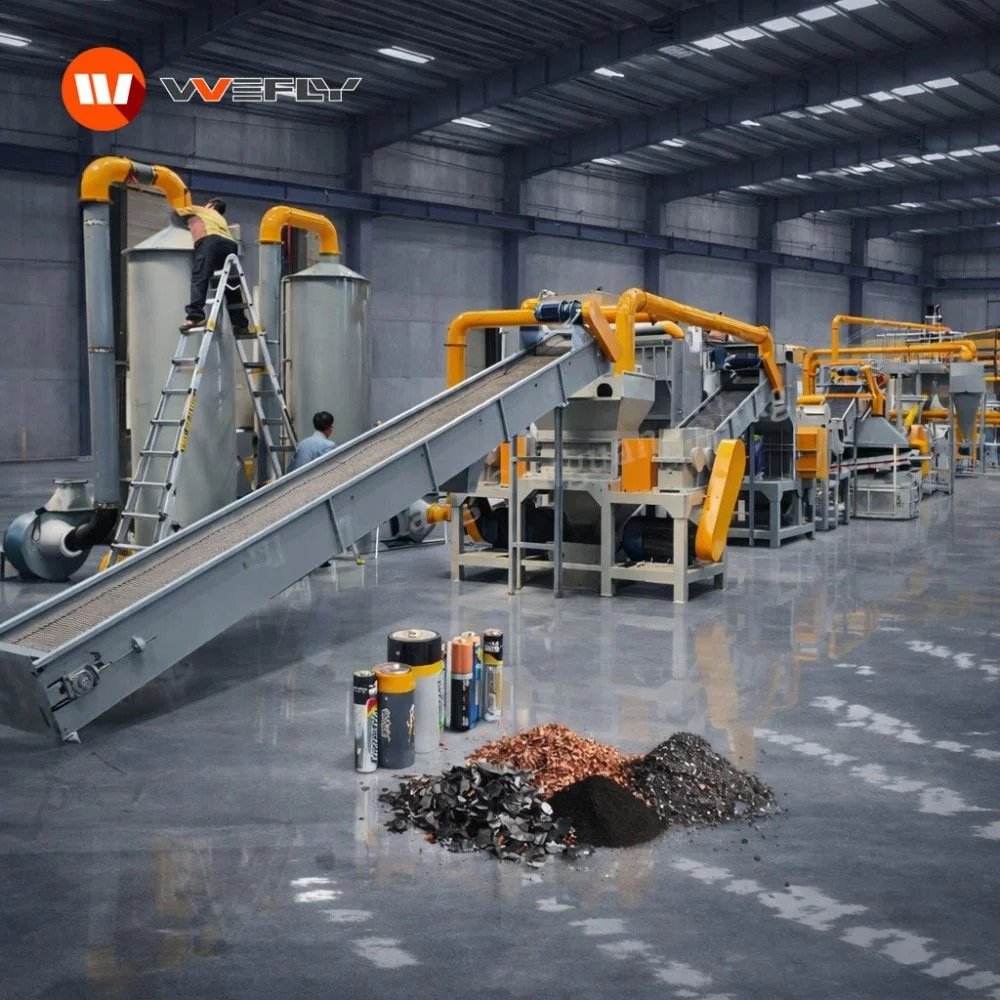
Lithium Battery Recycling Plant for Black Mass and Metal Recovery
A Lithium Battery Recycling Plant is used to recycle waste lithium-ion batteries and recover valuable materials such as black mass, copper granules, aluminum granules, plastics, steel shells, and separator plastics.
For battery recycling companies, the key goal is to separate valuable battery materials efficiently while reducing dust leakage and manual handling.
🔵 View WOLFU Lithium Battery Recycling Plant
The WOLFU lithium-ion battery recycling line uses crushing, grinding, magnetic separation, screening, gravity separation, airflow separation, and dust collection to process different lithium battery waste.
Key Specifications
| Feature | WOLFU-LDC-500 | WOLFU-LDC-1000 | Benefit |
|---|---|---|---|
| Plant Size | 40 m × 11 m × 8 m | 50 m × 12 m × 8 m | Fits different workshop layouts |
| Total Power | 361 kW | 442 kW | Supports industrial recycling |
| Capacity | 500 kg/h | 1000 kg/h | Suitable for medium and larger plants |
| Aluminum Recovery Rate | >98% | >98% | Improves metal recovery value |
| Black Powder Recovery Rate | >98% | >98% | Supports high-value black mass recovery |
| Qualified Rate | 99% | 99% | Stable recycling performance |
| Environmental Protection | Dust collector included | Dust collector included | Cleaner workshop operation |
What Materials Can It Process?
The WOLFU Lithium Battery Recycling Plant can process:
- Cylindrical lithium batteries
- Prismatic lithium batteries
- Pouch lithium batteries
- Mobile phone batteries
- Battery shells
- Cathode materials
- Anode materials
- Other lithium-ion battery waste
🔵 Request a Quote for WOLFU Lithium Battery Recycling Plant
Recycling Process
Step 1: Shredding
Waste lithium batteries are cut into smaller fragments for easier downstream processing.
Step 2: Crushing and Grinding
The materials are crushed and ground to release black mass, copper foil, aluminum foil, plastics, and shell materials.
Step 3: Magnetic Separation
Magnetic separation removes selected magnetic metals and shell materials.
Step 4: Screening and Classification
The grading screen classifies materials by particle size for better separation accuracy.
Step 5: Gravity and Airflow Separation
Density and airflow separation recover black mass, copper granules, aluminum granules, steel shells, and plastics.
Step 6: Dust Collection
The system works under negative pressure and uses dust collection to reduce dust leakage.
Main Advantages
High Recovery Efficiency
The system can achieve over 98% recovery efficiency for black powder and aluminum.
Physical Separation Process
The recycling line mainly uses mechanical and physical separation, reducing chemical pollution risks.
Fully Automated Operation
The complete system integrates multiple machines into one continuous production line.
Negative Pressure Dust Control
Negative pressure and dust collection help improve workshop cleanliness and operation safety.
Flexible Capacity Options
Customers can choose 500 kg/h or 1000 kg/h configurations based on incoming battery volume.
Final Recovered Materials
| Recovered Material | Typical Source | Value |
|---|---|---|
| Black Mass | Cathode and anode materials | High-value battery material recovery |
| Copper Granules | Copper foil and conductors | Recyclable non-ferrous metal |
| Aluminum Granules | Aluminum foil and shells | Reusable aluminum resource |
| Steel Shells | Battery casing | Recyclable metal |
| Separator Plastics | Battery separator layer | Material classification |
| Plastic Particles | Battery structure and packaging | Reduces mixed waste |
Related WOLFU Solutions
For lead-acid battery recycling, review:
🔵 WOLFU Lead Acid Battery Recycling Machine
For copper recovery from waste cables, review:
🔵 WOLFU Scrap Copper Wire Recycling Separator Machine
For solar panel recycling projects, review:
🔵 WOLFU Solar Panel Recycling Line
Why Choose WOLFU?
WOLFU provides recycling production lines, industrial furnaces, metal processing systems, and customized engineering solutions.
For lithium battery recycling projects, WOLFU can recommend equipment based on battery type, plant layout, processing capacity, automation level, dust control requirements, and final material recovery goals.
Conclusion
A Lithium Battery Recycling Plant helps recycling companies recover black mass, copper, aluminum, steel shells, and plastics from waste lithium-ion batteries.
The WOLFU system offers 500 kg/h and 1000 kg/h capacity options, over 98% black powder and aluminum recovery, physical separation technology, automated operation, and negative pressure dust control.
If your company needs an efficient solution for lithium battery crushing, separation, and black mass recovery, WOLFU can provide a customized recycling line based on your project requirements.
🔵 Get a Quote for WOLFU Lithium Battery Recycling Plant
FAQ
What batteries can this recycling plant process?
It can process cylindrical batteries, prismatic batteries, pouch batteries, mobile phone batteries, battery shells, cathode materials, and anode materials.
What materials can be recovered?
The system can recover black mass, copper granules, aluminum granules, plastics, steel shells, and separator plastics.
What is the processing capacity?
The standard capacity options are 500 kg/h and 1000 kg/h.
Is the recycling process chemical or physical?
The system mainly uses physical separation processes such as crushing, grinding, magnetic separation, screening, gravity separation, and airflow separation.
Does the line include dust control?
Yes. The system operates under negative pressure and is equipped with dust collection equipment.