
PV Recycling Sorting System: Three Product Streams at 97% Purity
WOLFU PV Recycling Sorting System Separates Glass, Silicon and Copper After PyrolysisA pyrolysis furnace does the hardest work in solar panel recycling: it frees glass, silicon and metal from the EVA and backsheet that bind them. But what exits the furnace — after cooling — is still a single, mixed stream of material. It has no buyer, no price, and no name.
It becomes a product at the sorting system.
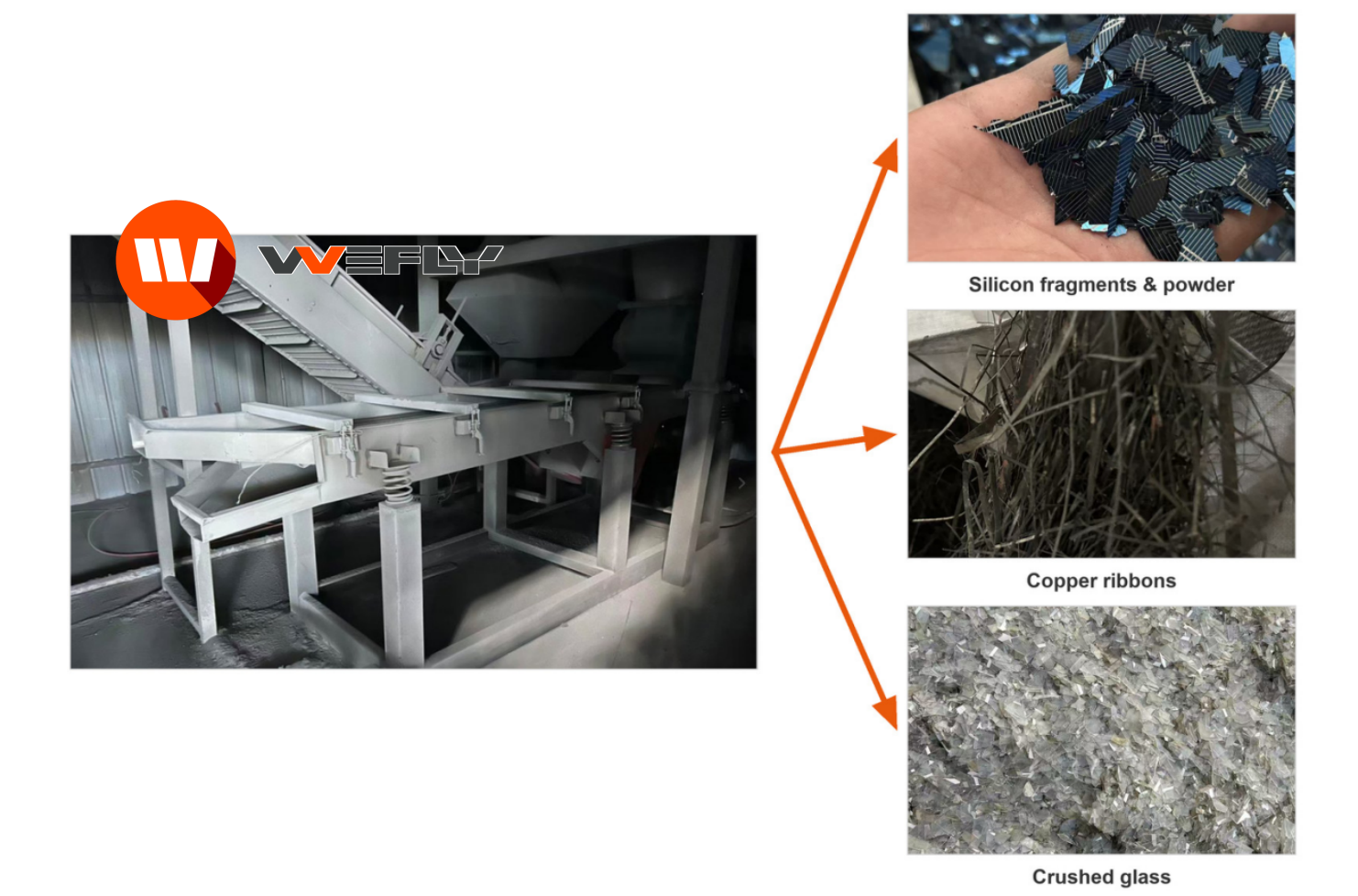
WOLFU’s PV recycling sorting system combines air classification with vibratory screening to divide the cooled material into three product streams — glass, silicon wafers and copper ribbons — at a sorting purity of 97%. This is the stage where tonnes of anonymous laminate turn into three separate invoices.
How the PV Recycling Sorting System Works
Air Classification
The cooled crushed material first passes through the air classification stage, where a controlled air column separates the mix by weight and aerodynamic behaviour. Light fractions are lifted and carried out; dense fractions drop through. This is the same density-driven principle behind our air gravity separator, applied at system scale.
Vibratory Screening
The classified material then moves across vibrating screen decks that split it by size and shape. Silicon wafers break into characteristic flakes and fragments; copper ribbons (busbars) retain their elongated form; glass shatters into uniformly small granules. Because the three materials differ in both size distribution and shape factor, the screen cascade naturally routes them toward separate outlets.
The combination is what makes the 97% figure realistic rather than optimistic: air classification removes the density overlap, screening removes the size and shape overlap. Neither alone is enough; together, they cover each other’s blind spots.
Three Outlets, Three Revenue Streams
1. Silicon Fragments & Powder Outlet
The highest-value stream of the three. The system discharges high-purity silicon fragments and silicon powder — the recovered wafer material that commands the strongest price per tonne in the PV recycling market. This stream feeds directly into silicon melting and remelting furnaces, where it returns to ingot production, and its metal-bearing fines can be further upgraded for silver recovery.
2. Copper Ribbon Outlet
The system recovers copper ribbons — the busbars and tabbing strip that interconnect solar cells. Metal recovery from this stream is high, because intact ribbons are screened out as recognisable shapes rather than lost as mixed fines. Clean copper ribbon is a ready feedstock for copper rod continuous casting, and it is also the stream where residual silver-bearing solder concentrates.
3. Crushed Glass Outlet
The recovered crushed glass discharges as a third, separate product — clean, sized and ready for downstream use, from glass wool and foam glass production to asphalt and cement applications. Glass is the lowest-value stream per tonne, but it is also the heaviest fraction of every panel, so recovering it in sellable grade protects the plant’s overall economics and its waste-accounting balance.
Clean Sorting: Dedicated Dust Collection
Crushing, classifying and screening dry, brittle material generates dust — and dust is lost product, dirty air and a compliance problem. The sorting section of the WOLFU system is therefore equipped with dedicated dust collectors that capture airborne fines at each transfer point and keep the working environment clean.
This matters in three ways:
- Product protection — captured fines return to the process instead of settling on the floor
- Occupational hygiene — operators work in visibly clean air, which inspection authorities increasingly verify
- Plant integration — the dust collectors tie into the same environmental architecture as our pyrolysis off-gas treatment system, so air leaving the plant is treated as deliberately as the air inside it
Where It Sits in the Line
- Aluminium frame removal and junction box dismantling
- Pyrolysis — encapsulant removed, laminate liberated
- Cooling of the pyrolysed material
- Sorting system — this article: one inlet, three products
- Optional upgrading: electrostatic separation takes critical streams from 97% to up to 99.9% purity
- Downstream: silicon remelting · copper casting · silver hydrometallurgy
The 97% → 99.9% architecture deserves a note: the PV recycling sorting system delivers sellable grade immediately, which means the plant generates revenue from day one. The electrostatic stage is then an upgrade, added where a buyer pays a premium for the last two points of purity — not a prerequisite for operating. That staging keeps initial capex manageable and lets purity follow the market.
FAQ
Q: What does “sorting purity of 97%” actually mean? A: Each of the three discharge streams — silicon, copper ribbon, crushed glass — contains at most about 3% foreign material. For most downstream buyers this is directly sellable; for premium grades, our electrostatic separator upgrades the critical streams further.
Q: Why air classification AND vibratory screening? A: The three materials overlap in density alone, and they overlap in size alone. Combining two separation principles — density and size/shape — is what makes a three-way split at 97% purity achievable in a single system.
Q: Does the PV recycling sorting system work on double-glass panels too? A: Yes. Feed composition shifts the stream ratios, but the three-outlet principle holds. We validate on your material mix before sizing.
Q: What happens to the dust that is collected? A: Captured fines are returned to the process — nothing of value is thrown away with the dust.
Turning mixed pyrolysed laminate into three sellable products? Contact WOLFU for a sorting test on your material and a system sized to your line.
📧 johnruan123@163.com | 💬 WhatsApp: +86 151 0379 2578 | 🌐 wolfu-industry.com