
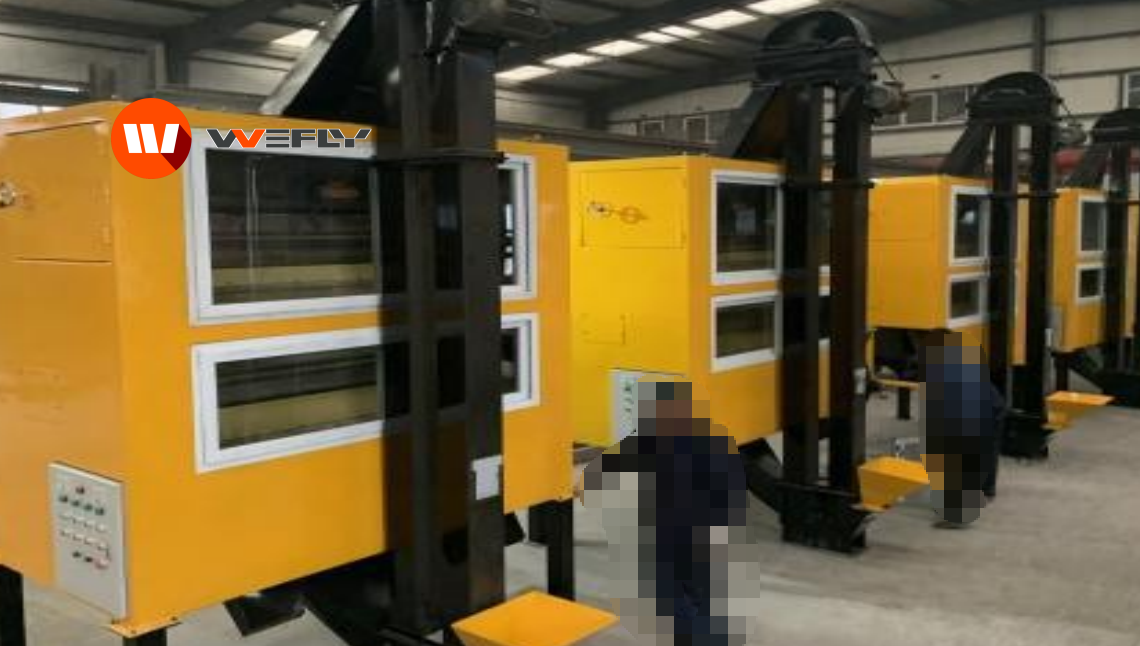
Electrostatic Separator for PV Recycling: 99.9% Silicon–Metal Separation, Completely Physical
After air gravity separation has concentrated the heavy fraction of crushed, pyrolysed solar panel material, one stubborn problem remains: silicon and metal are locked in the same particle-size band. Silicon at ~2.3 g/cm³ and glass at ~2.5 g/cm³ overlap almost perfectly; copper, aluminium and silver-bearing particles ride among them. No amount of further crushing or density sorting splits them cleanly.
The answer is not density. The answer is charge — and that is exactly what an electrostatic separator for PV recycling exploits.
The Principle: Corona Discharge and Capacitance Difference
WOLFU’s corona electrostatic separator for PV recycling works in two moves:
1. Ionisation. A corona discharge device ionises the surrounding air layer, creating a dense field of charged ions. As crushed material feeds through this field on a rotating grounded roll, every particle — conductor or non-conductor — picks up surface charge.
2. Separation by capacitance. The electrostatic separator for PV recycling then exploits the difference in capacitance (permittivity) between materials:
- Conductors (copper, aluminium, silver-bearing particles) release their charge almost instantly through the grounded roll — they fall away early, following a natural trajectory
- Non-conductors (silicon, glass, plastics) hold their charge, stay pinned to the roll by electrostatic attraction, and are carried further around before being brushed or thrown off
One rotating roll, one splitter, two clean product streams. No water, no chemicals, no heat.
The Performance Numbers That Matter
| Parameter | Value |
|---|---|
| Separation efficiency | Up to 99.9% |
| Impurities after separation | ≤ 1% |
| Process type | Completely physical, dry separation |
| Effect on material properties | None — all separated materials keep their original properties |
That last row deserves emphasis. electrostatic separator for PV recycling changes nothing about the materials it sorts — no oxidation, no contamination, no chemical alteration. The silicon that exits the machine is the same silicon that entered, just concentrated. That is precisely what makes the downstream chain work:
- The silicon stream feeds directly into silicon melting and remelting furnaces without pre-treatment
- The copper stream goes to copper rod continuous casting
- The silver-bearing metal concentrate becomes ideal feedstock for the hydrometallurgical silver recovery line — every point of purity delivered here directly reduces acid consumption there
Compare that with wet separation routes, which require drying, generate wastewater, and can degrade or contaminate fines. In a plant designed around zero wastewater discharge, dry electrostatic separation is not just convenient — it is structural.
Where Electrostatic Separator for PV Recycling Sits in the Line
- Frame removal and pyrolysis
- Crushing and screening
- Air gravity separation — light fraction out
- Electrostatic separation — this article: silicon out, metals concentrated
- Silicon remelting · Copper casting · Silver hydrometallurgy
One platform, many feedstocks: the same electrostatic separator for PV recycling principle separates metals from plastics in PCB recycling and in cable scrap — so a recycler handling mixed streams uses one technology, one spares inventory and one operator skill set.
Engineering Details That Decide Real-World Purity
Brochure numbers are easy; sustained 99.9% in month twelve is the real spec. What keeps a electrostatic separator for PV recycling honest:
- Electrode geometry and gap adjustment — corona field strength must be tunable to the feed’s particle size and conductivity mix
- Roll speed and feed rate matching — a starved or flooded roll both degrade the split
- Humidity control — surface moisture bleeds charge off non-conductors; dry feed is a hard requirement
- Brush and cleaning system — residual dust on the roll and electrodes quietly drags purity down; automatic cleaning keeps it stable
- Multi-pass configuration — for critical grades, two separators in series take the split from “good” to ≤1% impurities
WOLFU builds all of the above as standard, and validates every configuration on the customer’s actual material before delivery.
FAQ
Q: Is electrostatic separation really “physical”? A: Yes — completely. The corona field charges particle surfaces; nothing is dissolved, heated or chemically altered. All separated materials retain their original properties and remain fully suitable for recycling and reuse.
Q: What purity can I expect for the silicon fraction? A: Up to 99.9% separation efficiency with impurities ≤1% — depending on feed preparation. Consistent crushing and moisture control upstream are the main variables.
Q: Does it work on mixed e-waste as well as PV panels? A: Yes. The conductor/non-conductor principle is feedstock-agnostic — the same machine family handles PCB fines and cable granulate, which is why it integrates naturally with our PCB recycling line.
Q: Why not just go straight to chemical silver recovery? A: You can — but every kilogram of silicon and glass you leach is wasted acid. Electrostatic pre-concentration raises silver feed grade, which cuts reagent cost and tank volume in the hydrometallurgy stage.
Splitting silicon from metals at 99.9%? Contact WOLFU for a separation test on your material and an electrostatic stage engineered into your line.
📧 johnruan123@163.com | 💬 WhatsApp: +86 151 0379 2578 | 🌐 wolfu-industry.com