
7 Questions Every Buyer Asks Before Choosing a Brass Rod Continuous Casting Machine — A WOLFU Q&A
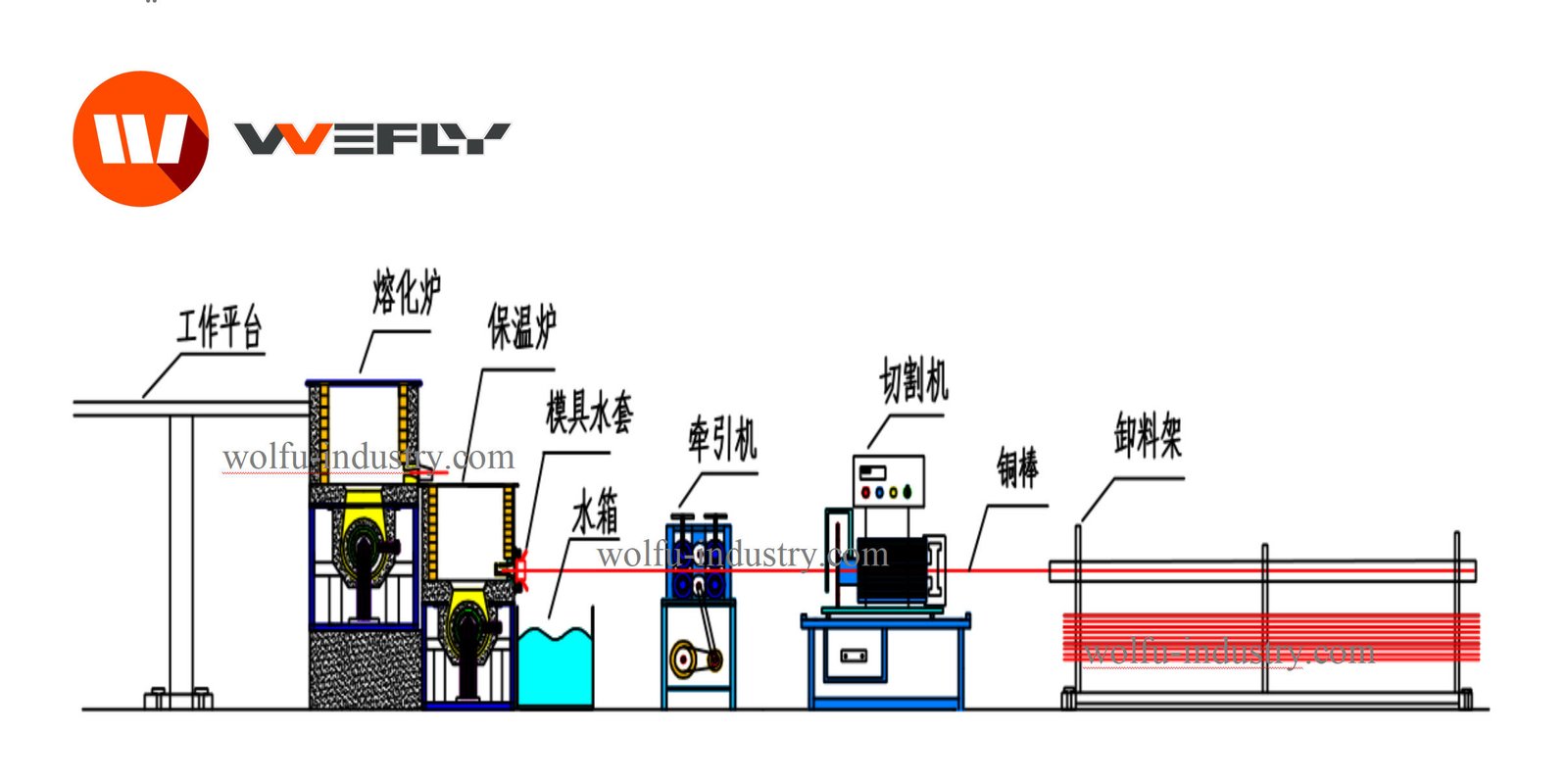
Whether you typed “brass rod continuous casting machine price” into Google or arrived from a recommendation, you have probably walked through the same seven-step mental checklist every plant owner does before signing off on a brass rod production line. We have collected the seven questions we hear most from buyers in Southeast Asia, the Middle East and Eastern Europe, and answered them the way we would answer them in person.
For the engineering overview of the line we keep referring to, see our continuous casting line product page.
If we have missed the question your team is wrestling with, drop us a line — the contact channel is at the bottom.
Q. — Vertical or horizontal: which is better for a new brass rod continuous casting machine?
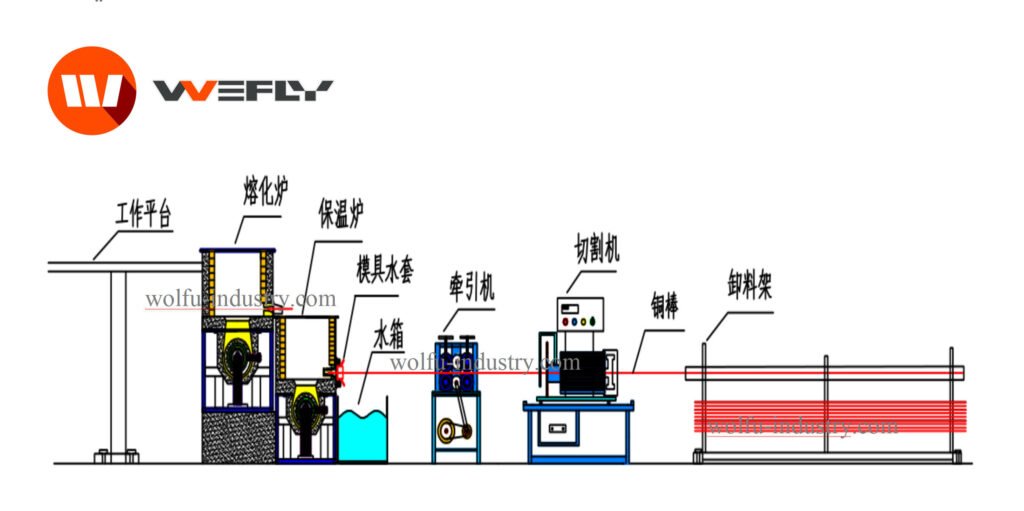
A. For a new plant targeting Ø5–Ø120 mm rod at under 25 t/day, horizontal wins on almost every variable. You need less headroom (3 m vs. 12–15 m), a flat workshop floor (no pits), easier operator access and — crucially — much less centreline porosity because the metal stays liquid only a few seconds before it enters the graphite crystallizer. The WOLFU 500X750 horizontal continuous casting machine is the default we recommend to most new entrants to the brass-rod market.
Q. — What alloys can I really run on a single brass-rod continuous casting machine?
A. Any copper alloy within reason: pure copper T2 / TP2, cartridge brass C26000, yellow brass C27000, free-machining brass C36000, naval brass C46400, forging brass C37700, phosphor bronze C51000 / C52100 / C54400, aluminium bronze C95400, and the standard Cu-Ni 90/10 & 70/30. The changeover between alloys is mostly a matter of recipe (line speed, traction torque, cooling water volume) — not hardware. If you specifically searched for a C36000 brass rod continuous casting machine for forging, you are squarely in our default configuration. For oxygen-free copper or beryllium copper we do recommend a dedicated run because of contamination risk.
→ See also: WOLFU continuous casting line product page
Q. — How much will my kWh per ton be on this brass rod making machine?
A. On the WOLFU 500X750 horizontal continuous casting machine, typical specific energy is 320–360 kWh/t for brass, and 380–420 kWh/t for phosphor bronze — bronze is harder to melt because of its higher liquidus. Customers switching from older vertical casting pits typically report a 11–17 % drop in kWh per ton. We publish kWh/t as a live KPI on the HMI, so your operator and your finance team read from the same dashboard.
Q. — Do I need any special building or civil works for an HCC brass rod production line?
A. Just a single-storey workshop with a 5-tonne overhead crane and a flat industrial floor. No pits, no deep foundations. The line typically occupies ≈ 18 × 4 × 3 m, so a 400 m² bay is comfortable. WOLFU issues a foundation drawing and anchor-bolt plan within two weeks of purchase order.
→ See also: WOLFU horizontal continuous casting line overview
Q. — Is the line hard to operate? Will I find trained staff?
A. Most WOLFU customers run the line with 1 operator + 1 helper per shift. The PLC interface is recipe-driven — an electrician who can read a schematic can learn it in a single shift. We supply a 200-page operator manual in Chinese and English and run 5 days of on-site training during commissioning. After that, your team is autonomous. This is one of the reasons buyers searching for a “China brass rod making machine” with limited local skill sets keep landing on WOLFU.
Q. — What is the brass rod continuous casting machine price, and what is actually included?
A. Most brass rod continuous casting machines in our size class sit in the USD 60 000 – 200 000 range depending on tonnage and alloy window. The WOLFU 500X750 quotation bundles mechanical equipment (furnace, traction, cutter, drawbar), electrical cabinet with PLC and HMI, one set of graphite crystallizers, a wear-parts spare kit, freight to your nearest Chinese port, mechanical erection, commissioning and operator training. Civil works, the cooling-water chiller and any import duties in your country are usually on your side — but we itemise them clearly so you can budget. For a side-by-side with another supplier’s brass rod continuous casting machine price, send their datasheet and we will fill in real numbers for you.
→ See also: WOLFU medium-frequency induction furnace
Q. — How long until I see payback on a 500X750 horizontal continuous casting machine?
A. For a mid-capacity brass-rod plant in a developing market, payback usually lands at 18–30 months depending on local electricity tariffs and rod sale price. The metallurgical envelope — and the standards the equipment has to meet — is described in the ASTM B249 / B249M standard. The chapter on continuous casting of non-ferrous alloys in the ASM Handbook Vol. 15 — Casting is a useful companion read:
- ASM Handbook Vol. 15 — Casting — buy the chapter, not the whole volume; it is the single best 30 pages on HCC.
Tell us — what’s your top concern with a horizontal continuous casting machine?
If you could pick ONE feature you want improved on the next generation of brass rod continuous casting machine, what would it be?
- Lower specific energy (< 300 kWh/t on brass)
- Wider alloy window (one line for both pure copper and C95400 bronze)
- Faster changeover (< 30 min between alloys)
- Smaller footprint (containerised / mobile brass rod production line)
- Stronger after-sales — local service engineers
Drop your vote (or add your own option) in the comments below, or email us at johnruan123@163.com. We pick three respondents every month for a free factory tour in Luoyang, China.
Find more, faster
If you want to compare WOLFU with another brass-rod continuous-casting-machine supplier before deciding, the most useful pages on the WOLFU site to open are these — they are the pages the rest of our customers read first:continuous casting line.