
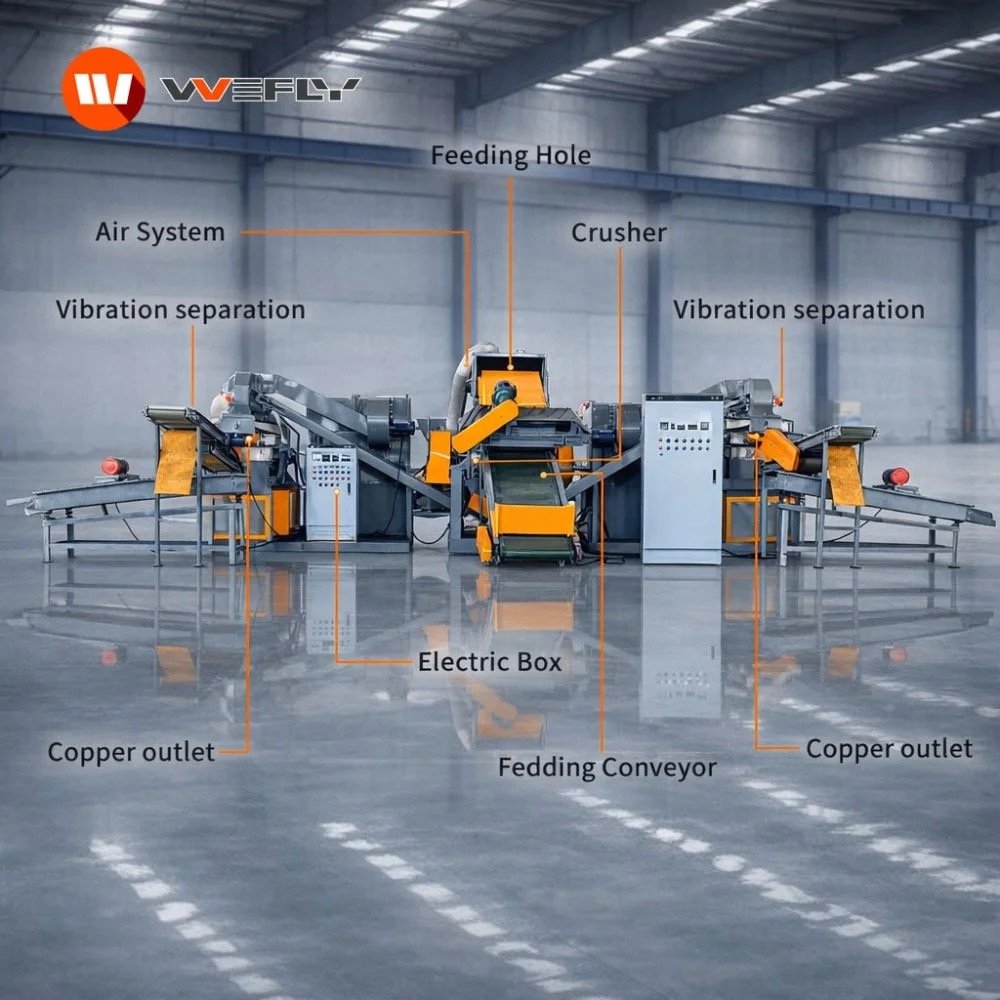
Scrap Copper Wire Recycling Separator Machine Guide
A Scrap Copper Wire Recycling Separator Machine is a practical solution for companies that want to recover copper from waste electrical wires, communication cables, automotive wiring harnesses, and mixed scrap cables. As copper remains one of the most valuable non-ferrous metals in recycling, efficient cable separation equipment can help recycling businesses improve material recovery and reduce manual labor.
Traditional cable recycling often depends on manual stripping or low-efficiency cutting methods. These methods are slow, labor-intensive, and difficult to scale. For industrial recycling plants, the better solution is an automatic copper cable granulator system that can crush, granulate, separate, and collect copper and plastic materials in a continuous process.
The WOLFU Scrap Copper Wire Recycling Separator Machine is designed for automatic copper cable recycling. It integrates crushing, granulating, airflow separation, vibration sorting, and dust collection to recover clean copper granules and recyclable plastic particles from waste cables.
What Is a Scrap Copper Wire Recycling Separator Machine?
A scrap copper wire recycling separator machine is industrial recycling equipment used to separate copper conductor material from plastic insulation. Instead of burning cables or manually stripping them, the machine uses a physical separation process to recover copper and plastic more efficiently.
The system first cuts and crushes waste cables into small particles. Then, through granulation and airflow gravity separation, copper and plastic are separated according to density difference. Since copper is much heavier than plastic insulation, the machine can separate both materials with high accuracy when properly configured.
This process is widely used in scrap metal recycling plants, electronic waste recycling facilities, cable recycling workshops, and copper recovery factories. It is especially useful for companies that handle large volumes of mixed waste wires and need stable output quality.
Why Copper Wire Recycling Is Valuable
Copper has strong electrical conductivity, thermal conductivity, ductility, and corrosion resistance. Because of these properties, it is widely used in power cables, household wires, motors, transformers, automotive wiring, communication cables, and industrial electrical systems.
When these cables reach the end of their service life, they still contain recoverable copper. If the copper is properly separated, it can be sold, remelted, or reused in downstream metal processing. This creates economic value while reducing waste.
At the same time, cable insulation materials can also be collected as plastic particles. Depending on material type and local recycling conditions, these plastic particles may be reused or sold to plastic recycling processors.
For recycling businesses, the key is not only recovering copper, but recovering it with high purity, stable output, and manageable operating cost. This is where automatic copper wire recycling equipment becomes important.
How the WOLFU Copper Wire Recycling Machine Works
Step 1: Feeding Waste Cables
The recycling process starts with feeding waste cables into the machine through a hopper or conveyor. The input materials may include household electrical wires, automotive wiring harnesses, industrial power cables, communication cables, and mixed scrap copper wires.
Before feeding, operators should remove large impurities, iron pieces, connectors, and materials that are not suitable for the equipment. A cleaner input stream helps protect the crusher and improves separation stability.
Step 2: Cable Crushing
After feeding, the cables enter the crushing section. The crusher cuts the cables into smaller pieces so that copper conductors and plastic insulation can be further processed.
This step prepares the material for granulation. Stable crushing is important because uneven material size may affect later separation accuracy.
Step 3: Granulating Copper and Plastic
The crushed cable pieces are then processed into smaller particles. During granulation, copper and plastic materials become loose and separated from each other.
The goal is to create a suitable particle size for airflow separation and vibration sorting. If the granulation is too coarse, copper and plastic may remain connected. If it is too fine, material loss and dust may increase.
Step 4: Airflow Gravity Separation
Airflow separation is one of the core steps in the process. Because copper and plastic have different densities, controlled airflow can separate heavier copper particles from lighter plastic insulation particles.
Proper airflow control helps improve purity. If airflow is too weak, plastic may remain mixed with copper. If airflow is too strong, copper particles may be carried away with plastic. A stable system design helps maintain separation performance.
Step 5: Vibration Sorting
Vibration sorting further improves separation quality. The vibration table helps classify materials according to weight, particle behavior, and movement pattern.
This step is especially useful for improving final copper purity and reducing plastic contamination in the copper granules.
Step 6: Final Collection
After separation, the machine collects copper granules and plastic particles separately. Copper granules can be sold to metal recycling companies, smelting plants, or copper processors. Plastic particles can be collected for further recycling or disposal according to local requirements.
Key Advantages of the WOLFU Scrap Copper Wire Recycling Separator Machine
High Copper Recovery Purity
The WOLFU system is designed to produce high-purity copper granules. With proper input material and correct machine adjustment, copper separation purity can reach 99% or higher.
High purity is important because cleaner copper granules usually have better market value. It also reduces the need for repeated processing.
Automatic Processing System
The machine integrates crushing, granulating, airflow separation, vibration sorting, and collection into one automatic system. This reduces the dependence on manual stripping and improves daily processing efficiency.
For recycling plants, automation can reduce labor intensity and make production more stable across different batches of cable materials.
Wide Wire Processing Range
The WOLFU copper wire recycling separator machine can process wire materials within a range of 0.1–30 mm. This allows recycling companies to handle different types of waste cables with one system.
This flexibility is useful for businesses that receive mixed scrap wire from multiple sources, such as construction sites, electrical contractors, appliance recycling, vehicle dismantling, and industrial maintenance.
Stable Industrial Capacity
The equipment is designed for industrial recycling work, with a processing capacity of 300–800 kg/h depending on configuration and input material condition.
This capacity range is suitable for small and medium-sized recycling plants as well as companies planning to upgrade from manual cable stripping to automatic cable granulation.
Dust Control for Cleaner Operation
Cable crushing and granulation can generate dust from plastic insulation and fine particles. A dust collection system helps keep the working environment cleaner and supports more stable machine operation.
For industrial users, dust control is not only about cleanliness. It also helps reduce material loss, protect equipment components, and improve workshop management.
Durable Structure for Long-Term Use
Recycling equipment must handle abrasive materials, irregular feedstock, and continuous operation. The WOLFU machine uses a heavy-duty industrial design to support stable operation and long service life.
Durable equipment structure is especially important for recycling businesses because downtime can directly affect daily output and profit.
What Materials Can the Machine Process?
The WOLFU scrap copper wire recycling separator machine is suitable for many common waste cable materials. These include household electrical wires, automotive wiring harnesses, communication cables, industrial power cables, and mixed scrap copper wires.
It is also suitable for many recycling scenarios where copper and plastic insulation need to be separated by physical methods. However, the exact processing result depends on cable type, copper content, insulation material, wire diameter, feed uniformity, and machine configuration.
For best results, operators should avoid feeding materials with excessive iron, large connectors, stones, rubber blocks, or non-cable waste. Pre-sorting improves machine protection and final output purity.
Final Products After Recycling
Copper Granules
The main final product is copper granules. These particles can be used for resale, smelting, copper recovery, or further metal processing.
Clean copper granules are valuable because they contain less plastic contamination and can be more easily handled by downstream buyers.
Plastic Particles
The second final product is plastic insulation particles. These materials are separated from copper during the airflow and vibration sorting process.
Depending on the insulation type and recycling conditions, plastic particles may be reused, sold, or processed further. Proper collection also helps reduce waste volume and improve workshop cleanliness.
How to Choose the Right Copper Cable Recycling Machine
Choosing the right machine should start with the type of scrap cable you process. Thin household wires, thick power cables, automotive harnesses, and mixed scrap wires may require different feeding, crushing, and separation settings.
Capacity is another major factor. A machine that is too small may limit business growth, while a machine that is too large may increase investment and energy use. For many recycling plants, a 300–800 kg/h system is a practical industrial range.
Power supply should also be checked before purchase. The WOLFU machine can be configured for 380V / 50Hz, and customers should confirm local electrical requirements before installation.
Buyers should also consider dust collection, spare parts availability, maintenance access, operator training, and installation support. These details affect long-term production stability more than the machine price alone.
Who Should Use This Equipment?
This equipment is suitable for scrap metal recycling plants that want to recover copper from waste wires more efficiently. It is also useful for electronic waste recycling facilities that process cable materials from appliances, electronics, and industrial equipment.
Cable recycling workshops can use this machine to replace manual stripping and increase daily output. Copper recovery factories can use it as a front-end processing system before smelting or further metal refining.
Companies that already operate other recycling systems may also use the machine as part of a broader resource recovery line. For example, businesses processing radiators, batteries, electronic waste, and cables can build a more complete non-ferrous metal recovery operation.
Related WOLFU Recycling Solutions
For companies handling different types of recyclable materials, WOLFU provides multiple industrial recycling solutions. The WOLFU Waste Radiator Crushing Recycling Line is designed for copper and aluminum separation from discarded radiators and heat exchanger scrap.
For battery recycling projects, the WOLFU Lead Acid Battery Recycling Machinesupports the processing and recovery of valuable materials from waste lead-acid batteries.
You can also read WOLFU’s related blog article, Lead Acid Battery Recycling Line for Efficient Recovery, to learn more about industrial recycling line design and material recovery workflow.
Why Work with WOLFU?
WOLFU focuses on recycling equipment, industrial furnace systems, and metal processing solutions. For cable recycling projects, customers often need more than a machine. They need correct equipment selection, capacity planning, installation support, operation guidance, and after-sales service.
WOLFU can provide customized recommendations based on your cable type, required capacity, workshop layout, final product expectations, and budget. This helps customers avoid mismatched equipment and improve project success.
For recycling businesses that want to increase copper recovery efficiency, reduce manual stripping, and produce cleaner copper granules, a properly configured copper wire recycling separator machine can be a strong long-term investment.
Conclusion
A Scrap Copper Wire Recycling Separator Machine helps recycling companies turn waste cables into valuable copper granules and recyclable plastic particles. By using crushing, granulating, airflow separation, vibration sorting, and dust collection, the system supports cleaner production and higher recovery efficiency.
Compared with manual stripping or low-efficiency cable treatment methods, automatic copper wire recycling equipment can improve production capacity, reduce labor needs, and deliver more consistent separation results.
If your company processes waste electrical wires, automotive wiring harnesses, industrial power cables, communication cables, or mixed scrap copper wires, WOLFU can provide a suitable machine configuration for your recycling business.
CTA: Contact WOLFU today to request a customized quotation for the Scrap Copper Wire Recycling Separator Machine.
FAQ
What materials can a scrap copper wire recycling separator machine process?
It can process household electrical wires, automotive wiring harnesses, communication cables, industrial power cables, and mixed scrap copper wires. For better performance, large impurities and non-cable waste should be removed before feeding.
What are the final products after copper wire recycling?
The final products are copper granules and plastic particles. Copper granules can be sold, smelted, or reused, while plastic particles can be collected for further recycling or proper handling.
What copper purity can the WOLFU machine achieve?
With suitable input material and correct machine adjustment, the WOLFU copper wire recycling separator machine can achieve copper separation purity of 99% or higher.