
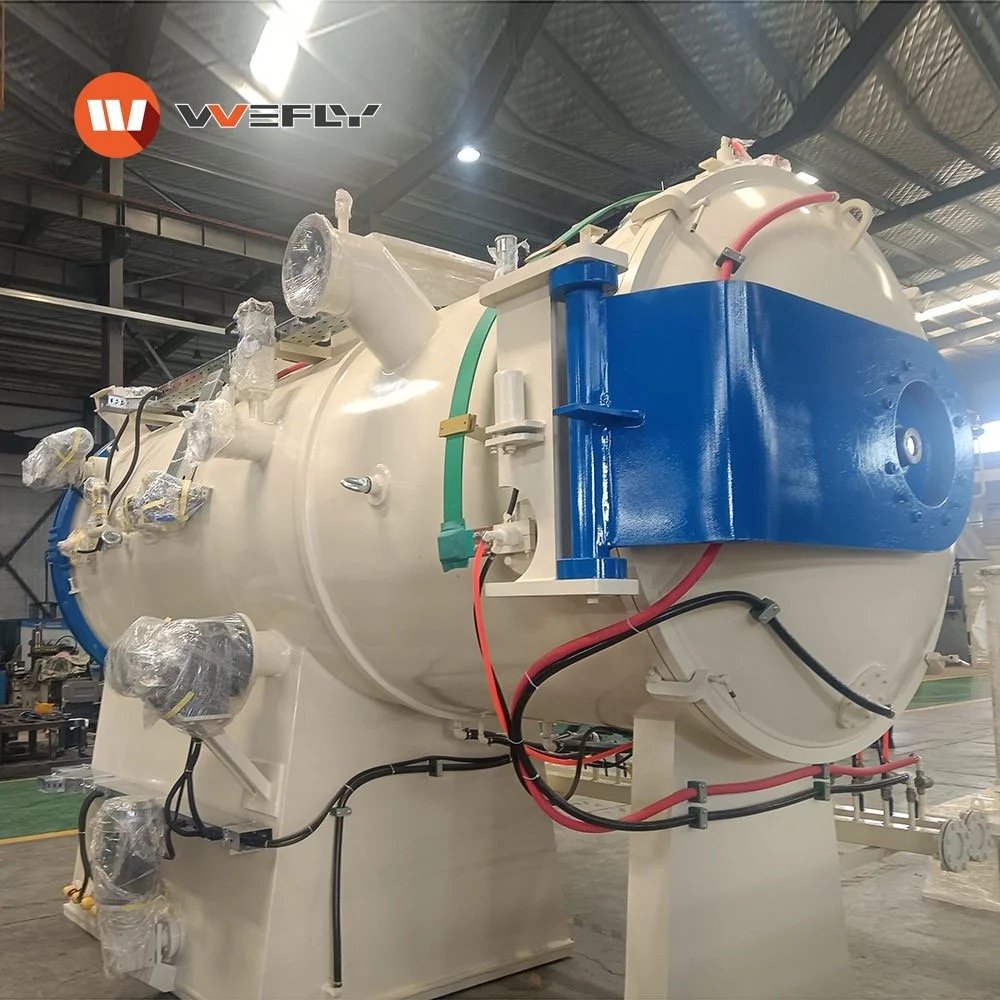
Vacuum Controlled Atmosphere Quenching Furnace for Heat Treatment
A Vacuum Controlled Atmosphere Quenching Furnace is an important heat treatment system for manufacturers that require clean processing, accurate temperature control, and stable cooling performance. In many industrial applications, ordinary heating and cooling methods are not enough because metal parts may oxidize, deform, or lose consistency during thermal processing.
For industries such as aerospace, automotive parts, machinery manufacturing, precision tooling, electronics, and advanced materials, the quality of heat treatment directly affects product strength, surface condition, dimensional stability, and service life. This is why more manufacturers are choosing vacuum and controlled atmosphere equipment instead of traditional open-air heat treatment methods.
The WOLFU High Temperature Vacuum Controlled Atmosphere Quenching Furnace is designed for quenching, annealing, tempering, brazing, and other precision heat treatment processes. It combines vacuum performance, controlled gas cooling, programmable control, and customizable chamber design for different industrial production needs.
What Is a Vacuum Controlled Atmosphere Quenching Furnace?
A vacuum controlled atmosphere quenching furnace is a high-temperature industrial furnace that heats workpieces under vacuum or controlled gas conditions, then cools them with high-purity gas such as nitrogen or argon. Compared with conventional heat treatment, this process helps reduce oxidation, improve surface cleanliness, and provide more controlled cooling.
The furnace usually includes a furnace shell, heating chamber, vacuum system, gas cooling system, water cooling system, workpiece platform, and automatic control system. In WOLFU’s furnace design, the heating chamber can use graphite heating elements and insulation materials to support stable high-temperature operation.
During operation, the furnace chamber is evacuated to remove air and moisture. The workpiece is then heated according to a programmed temperature curve. After the required holding time, high-purity cooling gas is introduced and circulated through the chamber to cool the workpiece evenly.
This controlled process makes the furnace suitable for applications where clean surface quality, repeatable hardness, controlled microstructure, and reduced deformation are important.
Why Vacuum Quenching Matters in Modern Heat Treatment
Heat treatment is not only about heating metal. It is a controlled process that changes the internal structure and final performance of the material. Poor heat treatment can lead to unstable hardness, cracking, warping, oxidation, surface scaling, or inconsistent mechanical properties.
Vacuum quenching helps solve many of these problems by providing a cleaner and more stable environment. Because the workpiece is processed under vacuum or controlled atmosphere, oxygen exposure is reduced. This helps maintain a brighter surface and reduces the need for heavy post-treatment cleaning.
Controlled gas cooling also improves repeatability. Instead of relying only on oil or water quenching, vacuum gas quenching uses high-purity gas flow to cool parts in a more controlled way. This is useful for parts that need strength and dimensional accuracy at the same time.
For manufacturers working with tool steel, alloy steel, high-strength components, precision molds, machine parts, and high-value industrial workpieces, vacuum quenching can help improve production consistency and reduce quality risks.
Key Features of the WOLFU Vacuum Controlled Atmosphere Quenching Furnace
High-Temperature Performance
The WOLFU vacuum controlled atmosphere quenching furnace is designed for high-temperature industrial processing. The working temperature in vacuum can reach 500–1250°C, while the maximum furnace temperature can reach 1320°C. This makes it suitable for many common quenching, annealing, tempering, and brazing requirements.
Stable temperature control is especially important for heat treatment because even small temperature variations can affect material hardness and final product quality. WOLFU’s system supports PID automatic control or PLC programmable control, helping operators manage heating curves, holding time, cooling steps, and process repeatability.
Vacuum and Controlled Atmosphere Operation
The furnace is designed to operate with a strong vacuum environment and controlled partial pressure range. This helps protect the workpiece from unwanted oxidation and supports cleaner thermal processing.
For gas quenching, high-purity nitrogen or argon can be introduced into the furnace. These gases help cool the workpiece while maintaining a cleaner atmosphere inside the chamber. This is particularly useful for manufacturers that need better surface quality and more stable heat treatment results.
Uniform Gas Cooling
Cooling performance is one of the most important factors in quenching. If cooling is uneven, parts may have inconsistent hardness, internal stress, or deformation. WOLFU’s furnace uses gas circulation and cooling system design to help improve cooling uniformity.
The system can cool from high temperature to lower temperature quickly under standard process conditions. This helps improve production efficiency while supporting controlled metallurgical transformation of the workpiece.
Customizable Chamber Configuration
Different customers often have different workpiece sizes, loading weights, temperature requirements, and process goals. A standard furnace may not always match the actual production requirement.
WOLFU can provide customized furnace chamber sizes, loading capacity, cooling configuration, and control options. This allows the equipment to better match the customer’s parts, workshop layout, production volume, and heat treatment process.
Automatic and Manual Control Options
The control system is a key part of modern furnace operation. WOLFU’s furnace can support programmable automatic control as well as manual operation when needed. This gives operators more flexibility during testing, process development, and regular production.
For factories that require repeatable heat treatment results, PLC-based process control can reduce manual errors and improve consistency between different production batches.
Common Applications of Vacuum Controlled Atmosphere Quenching
A vacuum controlled atmosphere quenching furnace can be used across several industrial fields. In machinery manufacturing, it can help process shafts, gears, molds, tooling parts, and precision mechanical components. These parts often require stable hardness, wear resistance, and dimensional reliability.
In the automotive industry, controlled heat treatment can support the production of high-strength components with better surface condition and repeatable performance. For aerospace and aviation applications, vacuum processing is valuable because component quality and stability are highly important.
The furnace can also be used for brazing, annealing, and tempering processes. This makes it more than a single-purpose quenching machine. It can support different thermal processing needs depending on the material, temperature range, vacuum level, and cooling method.
For companies working with advanced materials or precision components, this type of furnace can become a central part of the heat treatment workshop.
How the Furnace Works in a Typical Process
Step 1: Loading the Workpiece
The process begins by placing the workpiece on the furnace platform. The loading arrangement should consider part shape, weight, airflow direction, and required heating uniformity. Proper loading helps improve final heat treatment consistency.
Step 2: Vacuum Pumping
After the furnace door is closed and sealed, the vacuum system removes air from the chamber. This creates a cleaner processing environment and reduces oxygen exposure during heating.
Step 3: Controlled Heating
The furnace heats the workpiece according to the selected process curve. Operators can set heating rate, holding temperature, and holding time based on material type and treatment requirements.
Step 4: Temperature Holding
Once the target temperature is reached, the furnace holds the workpiece at that temperature for a specific period. This step allows the internal structure of the material to reach the required condition before cooling.
Step 5: Gas Quenching
After heating and holding, high-purity nitrogen or argon is introduced into the chamber. The gas cooling system circulates the cooling gas to remove heat from the workpiece. This controlled cooling step helps achieve the desired hardness and performance.
Step 6: Unloading and Inspection
After the workpiece cools to a safe temperature, it can be unloaded and inspected. Quality checks may include hardness testing, surface inspection, dimensional measurement, and metallurgical analysis depending on the application.
How to Choose the Right Vacuum Quenching Furnace
When selecting a vacuum quenching furnace, buyers should first define their material type and heat treatment process. Different steels, alloys, and components may require different temperature ranges, cooling rates, gas types, and vacuum levels.
Chamber size is another important factor. The furnace must be large enough for the workpiece and tooling, but oversized equipment may increase energy consumption and investment cost. A practical selection should balance capacity, efficiency, and future production growth.
Cooling performance should also be evaluated carefully. If the product requires fast cooling or strict uniformity, the gas circulation system, fan power, pressure range, and heat exchanger design become very important.
Control system configuration is also worth considering. For simple production, PID control may be enough. For more complex heat treatment recipes, PLC programmable control may offer better process management and repeatability.
WOLFU can help customers evaluate these factors and recommend a suitable furnace configuration based on chamber size, loading capacity, temperature range, cooling requirements, and production goals.
Related WOLFU Equipment for Industrial Production
For customers working in metallurgical processing, melting, or downstream production, WOLFU also provides related industrial furnace and casting equipment. For example, the WOLFU Industrial Vacuum Induction Melting Furnace is designed for high-temperature metal melting and vacuum smelting applications.
For copper processing plants, the WOLFU Horizontal Copper Rod Continuous Casting Machine with Melting Furnace provides a complete production solution from copper melting to continuous rod casting.
If you want to learn more about the actual working process of vacuum gas quenching equipment, you can also read WOLFU’s related blog: High Temperature Vacuum Gas Quenching Furnace Working Process.
Why Work with WOLFU?
WOLFU focuses on industrial furnace systems, recycling equipment, and metallurgical processing solutions. Instead of only supplying standard machines, WOLFU can provide customized equipment recommendations according to customer requirements.
For vacuum heat treatment projects, customers often need more than a furnace body. They may also need technical advice about vacuum systems, cooling gas selection, chamber size, loading method, control configuration, cooling water conditions, and workshop installation.
WOLFU supports customers with equipment selection, furnace design, process configuration, installation guidance, commissioning support, spare parts assistance, and long-term technical service. This is important for industrial buyers who need stable production rather than one-time equipment delivery.
For companies planning to upgrade heat treatment capacity, improve product quality, reduce oxidation, or process higher-value workpieces, a customized vacuum controlled atmosphere quenching furnace can be a practical investment.
Conclusion
A Vacuum Controlled Atmosphere Quenching Furnace is a valuable solution for manufacturers that need clean heat treatment, accurate temperature control, stable vacuum performance, and uniform gas cooling. It helps improve surface quality, process repeatability, and final workpiece performance in demanding industrial applications.
From quenching and annealing to tempering and brazing, this type of furnace can support multiple heat treatment processes while reducing common risks such as oxidation, uneven cooling, and poor batch consistency.
If your factory needs a reliable vacuum heat treatment system for precision metal parts, WOLFU can provide a customized furnace solution based on your chamber size, loading capacity, temperature range, cooling gas, and production requirements.
CTA: Contact WOLFU today to request a customized solution for the High Temperature Vacuum Controlled Atmosphere Quenching Furnace.
FAQ
What is a vacuum controlled atmosphere quenching furnace used for?
It is used for precision heat treatment processes such as quenching, annealing, tempering, and brazing. It helps reduce oxidation and improve process consistency by heating and cooling parts under vacuum or controlled gas conditions.
What cooling gas can be used in the furnace?
High-purity nitrogen or argon can be used for gas cooling. The choice depends on the material, process requirements, cooling rate, and production conditions.
Can the furnace chamber size be customized?
Yes. WOLFU can customize the chamber size, loading capacity, control system, and cooling configuration according to the customer’s workpiece size and heat treatment process.