
Induction Furnace PV Recycling: Complete Application Guide
If you handle end-of-life photovoltaic (PV) modules, you already know the hard part is not taking the panel apart — it is what happens to the recovered silicon and metals after separation. That is exactly where an induction furnace PV recycling earns its place.
This guide explains the working principle of induction melting PV recycling: what is an induction furnace used for in PV recycling, why medium-frequency and vacuum induction configurations dominate silicon recovery, and how WOLFU designs its Industrial Silicon Melting Induction Furnace for solar-grade output.
Why PV Recycling Needs Induction Melting at All
A typical crystalline silicon PV module is roughly 70% tempered glass, aluminum frame, EVA encapsulant, copper ribbon, junction box, back sheet, and a few grams of high-purity silicon per watt of output. According to IRENA, cumulative end-of-life PV panel waste could reach 1.7–8 million tonnes by 2030 and 60–78 million tonnes by 2050.
That number matters because silicon is energy-intensive to produce from raw quartz: carbothermic reduction of metallurgical-grade silicon alone consumes 12,000–13,000 kWh per ton. Recycling just 1 ton of silicon PV panels can save up to 1,200 kg of CO₂-equivalent versus virgin production (see the Springer study on EOL PV ferrosilicon).
But the recovered feedstock is messy: broken wafers, kerf powder, cell fragments with residual silver paste and aluminum. You cannot simply re-cast it. You need controlled, high-temperature, electromagnetically stirred melting.
An induction furnace PV recycling is the most practical tool for that job in a recycling plant.
What Exactly Is an Induction Furnace in a PV Recycling Context?
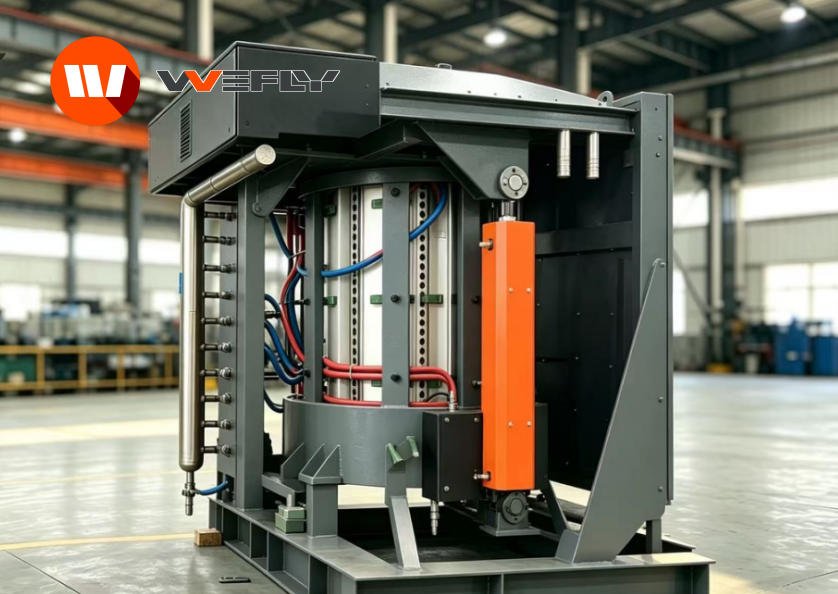
An induction furnace PV recycling is an electrical furnace that melts conductive material through electromagnetic induction. A medium-frequency alternating current flows through a copper coil, generating an alternating magnetic field. That field induces eddy currents inside the metal/ silicon charge, which then heat — and melt — the material from within.
Induction furnace PV recycling sits after the physical separation stages (frame removal, glass delamination, crushing, electrostatic separation) and before the casting / directional solidification stages. It is the bridge that turns a pile of mixed silicon-rich fines into a clean molten bath ready for ingot casting or Czochralski pullers.
The two configurations you will see most often in PV recycling are:
- Medium-frequency induction melting furnace (MF): workhorse for silicon, copper, aluminum, and alloy recovery. Typical operating range 500 Hz–10 kHz; commercial systems reach 3.8 t/h silicon melting capacity with 1,750 °C maximum temperature.
- Vacuum induction melting furnace (VIM): used when the goal is solar- or semiconductor-grade purity. Operating under low pressure enhances deoxidation through SiO gas formation and removes volatile impurities more efficiently — confirmed by the NTNU research on silicon kerf agglomerates.
The Four Jobs an Induction Furnace PV Recycling Performs
1. Melting and Purifying Recovered Silicon
This is the headline use case. The induction furnace PV recycling takes recovered silicon feedstock — broken wafers, kerf powder (after briquetting), cell fragments, mixed fines — and produces a homogeneous molten silicon bath. The natural electromagnetic stirring drives impurities toward the slag layer, where they can be skimmed off.
For silicon kerf specifically, vacuum induction melting has been shown to be the most effective route because vacuum promotes SiO gas formation, enhancing deoxidation and producing a single, oxide-free melt. Under inert atmosphere at sub-1,800 °C, a homogeneous single melt is harder to achieve.
This is the exact role that WOLFU’s Industrial Silicon Melting Induction Furnace is engineered for: 2,000 kW medium-frequency power supply, dual furnace bodies for continuous operation, 1,750 °C ceiling, 3.8 t/h melting capacity, and PLC-based automation with overcurrent, overvoltage, and water-pressure safety interlocks.
2. Smelting Recovered Aluminum and Copper
Every PV module contains an aluminum frame and copper ribbon. After frame removal in the upstream line, those metal streams still need to be remelted and cast into ingots for sale or downstream use.
WOLFU’s Medium Frequency Induction Melting Furnace (500 kg–1,000 kg, 1,800 °C, 400 kW, thyristor inverter) handles copper, brass, iron, steel, aluminum, zinc, lead, and nickel. The companion Medium Frequency Furnace Copper & Aluminum Ingot Casting Production Line integrates tilting, mould conveying, and automatic demoulding into one continuous workflow.
3. Producing Ferrosilicon (FeSi) from Recycled Silicon
A simpler, lower-capex route uses recovered silicon plus iron in an induction furnace to make ferrosilicon — no carbothermic reduction needed. The recent Springer study on FeSi from EOL PV panels showed that recovered-Si FeSi can match samples made from metallurgical-grade silicon, opening a practical commercial pathway that skips the carbon-emission-heavy reduction step.
4. Feeding Downstream Casting and Refining
Once the induction furnace PV recycling delivers clean molten silicon, the molten bath can move directly to:
- A polysilicon ingot casting furnace for polycrystalline ingot production
- A directional solidification furnace (WOLFU’s reaches 6.67×10⁻³ Pa vacuum, 5–25 mm/h solidification control) for monocrystalline-equivalent solar ingots
- A Czochralski puller for monocrystalline silicon growth
How Induction Melting Fits into the Larger PV Recycling Line
An induction furnace PV recycling never operates alone. Here is a typical integrated workflow that WOLFU build into complete turnkey lines:
- Pre-processing — frame and J-box removal, glass delamination (see WOLFU’s Solar PV Panel Recycling Plant)
- Shredding & grinding — multi-shaft shredders, hammer mills, 15–20 mesh output
- Airflow + electrostatic separation — separates metals from non-metals
- Pyrolysis (optional, for double-glass modules) — WOLFU’s WDL-T continuous mesh-belt pyrolysis furnace removes EVA cleanly and boosts downstream silver recovery above 99.7%
- Induction melting — the focus of this article
- Ingot casting / directional solidification / CZ pulling — finished silicon ready for the solar cell line
Why Choose an Induction Furnace PV Recycling Over Other Heating Methods?
| Heating Method | Pros | Cons | PV Recycling Fit |
|---|---|---|---|
| Induction (MF / VIM) | Direct internal heating, fast, precise, clean, scalable | Higher capex than fuel-fired | ★★★★★ (industry default) |
| Vacuum induction (VIM) | Best for Si kerf deoxidation, removes volatiles | Slower batch cycle, vacuum complexity | ★★★★★ (kerf / SoG-Si) |
| Resistance furnace | Simple, low capex | Slow, uneven heating, contamination risk | ★★ |
| Fuel-fired (gas / oil) | Lowest capex | Combustion emissions, poor temperature control | ★ |
| Arc furnace | Very high temperatures, large batch | High electrode wear, less suitable for Si | ★★★ (FeSi only) |
For PV recycling specifically, the combination of fast batch turnover, repeatable melt quality, low emissions, and PLC-driven process control makes induction melting the only credible choice for solar-grade silicon output at scale.
What to Look for When Buying an Induction Furnace PV Recycling
Whether you go with WOLFU or another manufacturer, evaluate the furnace on these seven factors:
- Capacity range — 0.5 T to 5 T typical; match to your hourly feedstock volume
- Maximum temperature — at least 1,750 °C for silicon; 1,800 °C for general metals
- Power supply configuration — medium-frequency thyristor inverter is standard; confirm voltage matches your plant
- Vacuum / inert gas capability — required if you target solar- or semiconductor-grade silicon
- Dual furnace bodies — allows continuous melting while the other pours
- Automation & safety — PLC, hydraulic tilting, overcurrent/overvoltage/water-pressure interlocks
- Manufacturer support — installation, commissioning, operator training, spare parts, lifetime technical assistance
How WOLFU Designs Induction Furnaces PV Recovery
WOLFU (Luoyang) Furnace Industry Co., Ltd. is an engineering-driven manufacturer of recycling and metallurgical equipment. The company’s Industrial Silicon Melting Induction Furnace for Solar Grade ships with:
- 2,000 kW medium-frequency power supply cabinet
- Six-phase 660 V electrical configuration
- 1,750 °C maximum operating temperature
- 3.8 tons/hour melting capacity
- Dual steel-shell furnace bodies for alternating operation
- Hydraulic tilting system for controlled pouring
- PLC-based automation with full fault detection
- 0.5 T to 5 T capacity options
The companion Industrial Silicon Melting Induction Furnace (silicon recovery focus) is configured specifically for kerf, broken wafer, and cell fragment feedstock, with optional vacuum operation for higher-purity output.
Frequently Asked Questions
Is induction melting safe for recovered silicon? Yes. Modern systems include monitoring for overcurrent, overvoltage, water pressure loss, and crucible leak detection. WOLFU’s silicon furnace ships with all four interlocks as standard.
What purity can I expect from a single induction melt? A single melt typically produces silicon suitable for solar-grade applications. Semiconductor-grade purity (6N+) requires additional refining steps, often including acid leaching and directional solidification under vacuum.
Can the induction furnace PV recycling handle kerf powder directly? Fine kerf powder should first be agglomerated into pellets (as demonstrated by the EU SIKELOR project). Once pelletized, it can be melted efficiently using the same induction process.
What capacity do I need? Match induction furnace PV recycling size to your hourly feedstock volume. WOLFU offers 0.5 T to 5 T models. Plants targeting 1,500–2,000 kg/h total throughput typically pair a 3 T silicon furnace with a separate metal melting line.
Does WOLFU provide complete plant design? Yes — process consultation, equipment selection, installation, commissioning, operator training, and lifetime technical support.
Conclusion
An induction furnace PV recycling is the thermal heart of any modern solar panel recycling plant. It melts and purifies recovered silicon, smelts recovered aluminum and copper, can produce ferrosilicon without carbothermic reduction, and feeds clean molten metal to downstream casting and crystal-growth equipment.
If you are sizing a new solar panel recycling line — or upgrading an existing crush-and-sort operation — start with the induction furnace PV recycling. Pair a medium-frequency or vacuum induction melting system with a complete upstream line (frame removal, pyrolysis, separation) and a downstream casting station, and you have a circular silicon supply chain that turns retired panels into new solar ingots.
Ready to plan your PV recycling project? Contact WOLFU to discuss your feedstock, capacity, and target purity.