
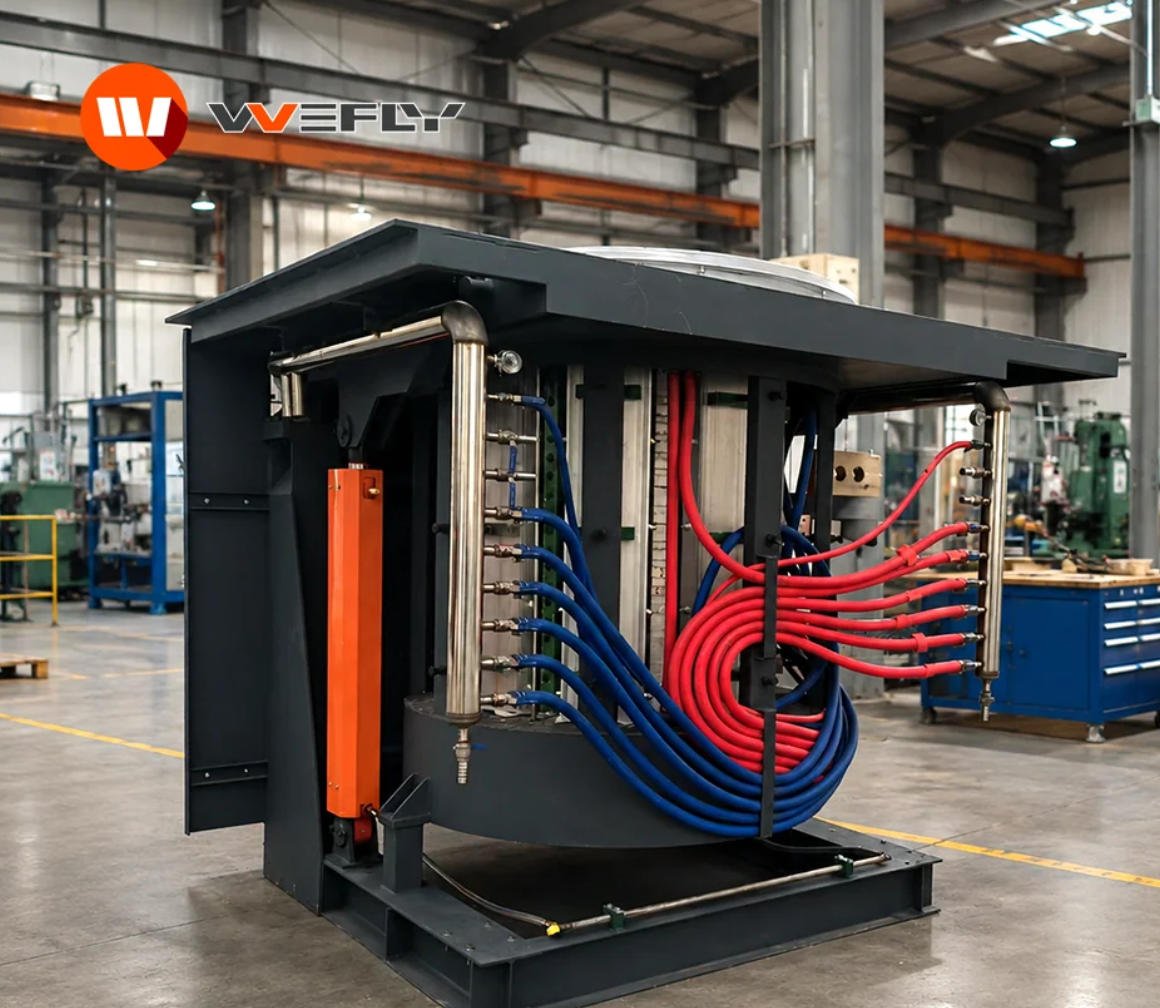
Silicon Recovery – Industrial Silicon Melting Induction Furnace
As more and more retired photovoltaic (PV) modules come into the renewable energy sector, reusable silicon is no simple task. It requires controlled thermal processing, intelligent separation, and — at the heart of the operation — a reliable Industrial Silicon Melting Induction Furnace.
Here WOLFU walks you through the complete journey of recovered silicon: how end-of-life solar panels are dismantled, how silicon is separated and refined, and how an Industrial Silicon Melting Induction Furnace turns that recovered feedstock into molten metal ready for new solar cells, semiconductors, and advanced silicon materials.
Why Silicon Recovery from Solar Panels Matters
A single crystalline silicon solar panel may contain 4–6 grams of high-purity silicon per watt of output. According to the International Renewable Energy Agency (IRENA), end-of-life PV management is one of the defining sustainability challenges for the next decade.
Recovering silicon rather than refining new quartz achieves several strategic benefits:
- Lower embodied energy. Recycled silicon skips the energy-intensive carbothermic reduction step that consumes 12,000–13,000 kWh per ton of metallurgical-grade silicon.
- Material circularity. A single 30,000-ton polysilicon plant can save hundreds of millions of kWh by integrating recovered feedstock.
- Reduced waste and toxic byproducts. Proper recycling avoids sending EVA, lead solder, and broken glass to landfill.
- Stable supply. Recovered silicon smooths out supply chain shocks affecting polysilicon production.
The catch is that recovered silicon rarely arrives as clean chunks. It typically comes as broken cells, mixed fragments, or layered composites — all of which must be melted and refined before they can re-enter the photovoltaic value chain.
Step 1: Pre-Processing the Retired Solar Panels
Before any silicon can be melted, the panel itself must be taken apart. A typical crystalline silicon module contains tempered glass (~70%), EVA encapsulant, aluminum frame, copper ribbon, junction box, back sheet, and the silicon cells themselves.
WOLFU’s Solar Panel Recycling Line handles this stage through:
- Frame and junction-box removal — Aluminum frames are stripped and collected; junction boxes are separated for downstream precious-metal recovery.
- Glass delamination — A controlled thermal or mechanical step separates the front glass while preserving the silicon wafer intactness.
- Shredding and crushing — Multi-shaft shredders reduce the panel to strips and granules.
- Airflow and electrostatic separation — Mixed material is sorted into glass, metal, plastic, and silicon-containing fractions.
After this stage, operators are left with a stream of silicon-rich material — broken wafers, kerf, and cell fragments — that is ready to enter the melting phase.
Step 2: Preparing the Silicon Feedstock for Melting
Recovered silicon include:
- Broken silicon wafers from cracked or damaged modules
- Silicon kerf powder lost during wafer slicing (often 30–50% of the original ingot)
- Cell fragments carrying residual silver paste and aluminum
- Mixed fragments with trace glass, plastic, and metal contamination
To prepare this feedstock for the Industrial Silicon Melting Induction Furnace, WOLFU recommends:
- Drying to remove moisture
- Agglomeration or briquetting for fine kerf powder, as demonstrated by the EU SIKELOR project
- Flux addition to bind non-metallic impurities into a removable slag
- Impurity pre-screening to remove obvious metal contamination
This pre-treatment dramatically improves the efficiency of the melting furnace and the purity of the recovered silicon.
Step 3: How the Industrial Silicon Melting Induction Furnace Works
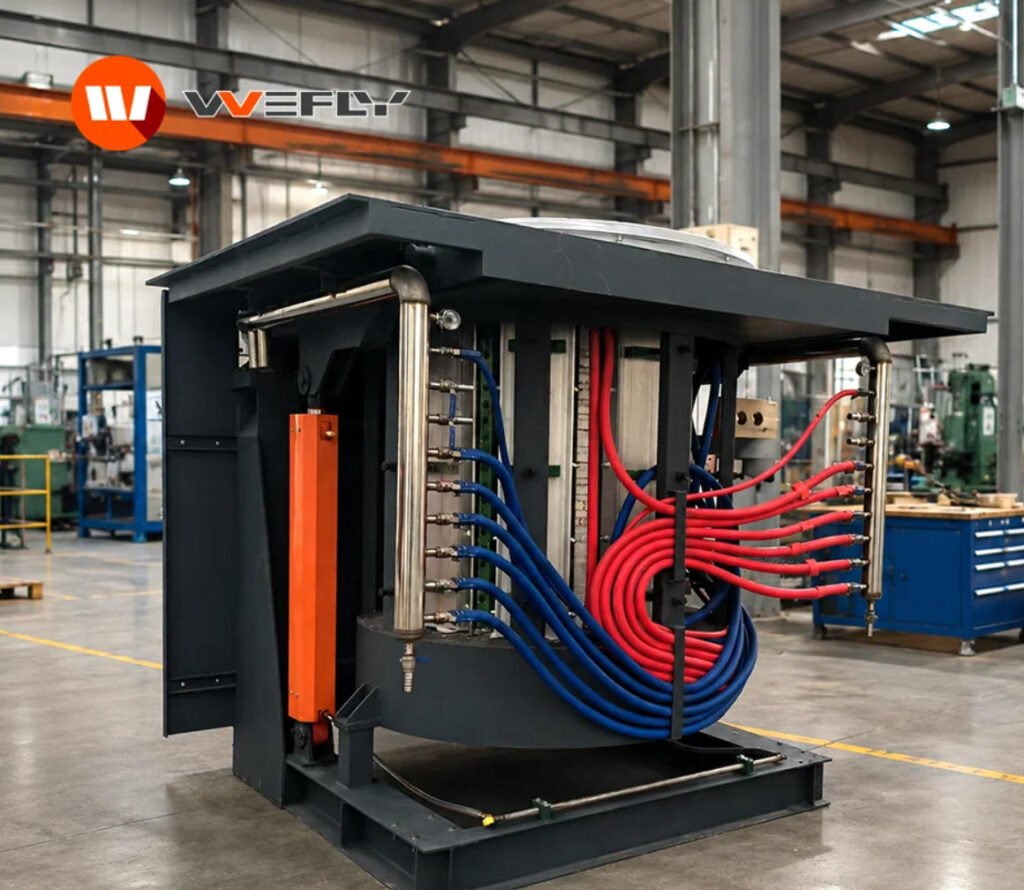
This is the heart of the silicon recovery process. WOLFU’s Industrial Silicon Melting Induction Furnace is a medium-frequency induction system designed specifically for melting industrial silicon, polysilicon, and high-purity recovered silicon feedstock.
Key Technical Specifications
| Parameter | Specification |
| Product Name | Industrial Silicon Melting Induction Furnace |
| Application | Solar-grade and semiconductor silicon production |
| Furnace Type | Medium-frequency induction furnace |
| Power Supply Cabinet | 2000 KW |
| Maximum Temperature | 1750 °C |
| Melting Capacity | Up to 3.8 tons/hour |
| Heating Method | Electromagnetic induction |
| Cooling Method | Water cooling system |
| Control System | PLC-based temperature control |
The Melting Workflow
- Material loading — Prepared silicon feedstock is loaded into the crucible.
- Electromagnetic induction heating — The medium-frequency power supply generates an alternating magnetic field. Eddy currents concentrated in the surface layer of the silicon charge produce intense Joule heat, melting the material from within.
- Temperature stabilization — The PLC control system holds the molten bath at the target temperature with high precision, ensuring uniform melt quality.
- Vacuum or inert gas protection — For higher-purity outputs, the furnace can operate under vacuum or argon atmosphere.
- Hydraulic tilting and pouring — The hydraulic system pours the molten silicon into a casting mold or downstream ingot-casting station.
Why Induction Heating Is Ideal for Recovered Silicon
Research published by NTNU confirms that vacuum induction melting is the most effective route for purifying silicon kerf — it enhances deoxidation through SiO gas formation, expels volatile impurities, and produces a homogeneous single melt.
WOLFU’s system offers several advantages specifically for recovered silicon:
- High melting capacity (3.8 t/h) handles industrial volumes of recovered feedstock.
- 1750 °C maximum temperature is more than sufficient for full silicon melting and refining.
- Dual furnace bodies allow continuous operation — one furnace melts while the other pours, eliminating downtime.
- Electromagnetic stirring helps impurities migrate to the slag layer, simplifying downstream refining.
- PLC-based automation ensures repeatability across batches, which is critical when feedstock composition varies.
For a deeper look at the design philosophy, see WOLFU’s article on Industrial Silicon Melting Induction Furnace for Solar Grade.
Step 4: Refining and Slag Removal
Pure melting is not enough — the molten silicon must be purified to solar-grade or semiconductor-grade specifications.
Inside the Industrial Silicon Melting Induction Furnace, the electromagnetic field creates a natural stirring effect that drives impurities toward the slag layer. Operators then add refining fluxes (often a CaO–SiO₂ blend, as described in the patent published by China MCC) to absorb non-metallic inclusions.
After holding at 1600–1750 °C for a defined period, the slag is poured off first, leaving cleaner silicon underneath. The molten silicon is then transferred to a secondary furnace or casting station for directional solidification.
For plants aiming for the highest purity, a follow-up step uses WOLFU’s Polysilicon Directional Solidification Furnace, which can reach 6.67×10⁻³ Pa vacuum and control solidification at 5–25 mm/hour for solar silicon ingot casting.
Step 5: From Molten Silicon to Reusable Ingots
Once the silicon is clean and molten, it can be cast into ingots, granular feedstock, or directly fed into a Czochralski puller for monocrystalline growth. WOLFU offers complementary equipment for each of these paths:
- WOLFU Polysilicon Ingot Casting Furnace — for polycrystalline silicon ingot production.
- WOLFU Polysilicon Directional Solidification Furnace — for solar-grade ingot casting with controlled crystallization.
- WOLFU Solar PV Panel Recycling Plant — for the upstream dismantling and separation stages.
Together, these systems form a complete circular silicon supply chain: from retired panel → to recovered silicon powder → to molten metal → to new solar ingot.
Common Questions About Silicon Recovery from Solar Panels
Is induction melting safe for recovered silicon?
Yes. WOLFU’s Industrial Silicon Melting Induction Furnace includes monitoring for overcurrent, overvoltage, and water pressure loss, plus a leak-detection alarm for the crucible.
What purity can I expect from a single induction melt?
A single melt typically produces silicon with purity suitable for solar-grade applications. Higher semiconductor-grade purity requires additional refining steps.
Can the furnace handle kerf powder directly?
Fine powder should first be agglomerated into pellets. Once pelletized, it can be melted efficiently using the same induction process.
What capacity do I need?
WOLFU offers furnace models from 0.5 T to 5 T to match different plant sizes and feedstock volumes.
Does WOLFU provide complete plant design?
Yes. WOLFU delivers process consultation, equipment selection, installation, commissioning, operator training, and lifetime technical support.
Why WOLFU for Your Silicon Recovery Project
WOLFU is a specialist manufacturer of industrial thermal processing equipment, with a complete portfolio spanning induction melting furnaces, polysilicon ingot casting systems, directional solidification furnaces, vacuum furnaces, and complete PV recycling lines. For silicon recovery projects, WOLFU provides:
- Customized furnace capacity, voltage, and crucible configuration
- Complete plant design for silicon melting and casting
- A 12-month warranty plus lifetime technical assistance
- Remote troubleshooting and spare-parts support
If your company is planning a solar panel recycling plant, a silicon refining facility, or a complete circular silicon supply chain, contact WOLFU today to discuss your project requirements.
Learn more: WOLFU Industrial Silicon Melting Induction Furnace | Request a Customized Quote