
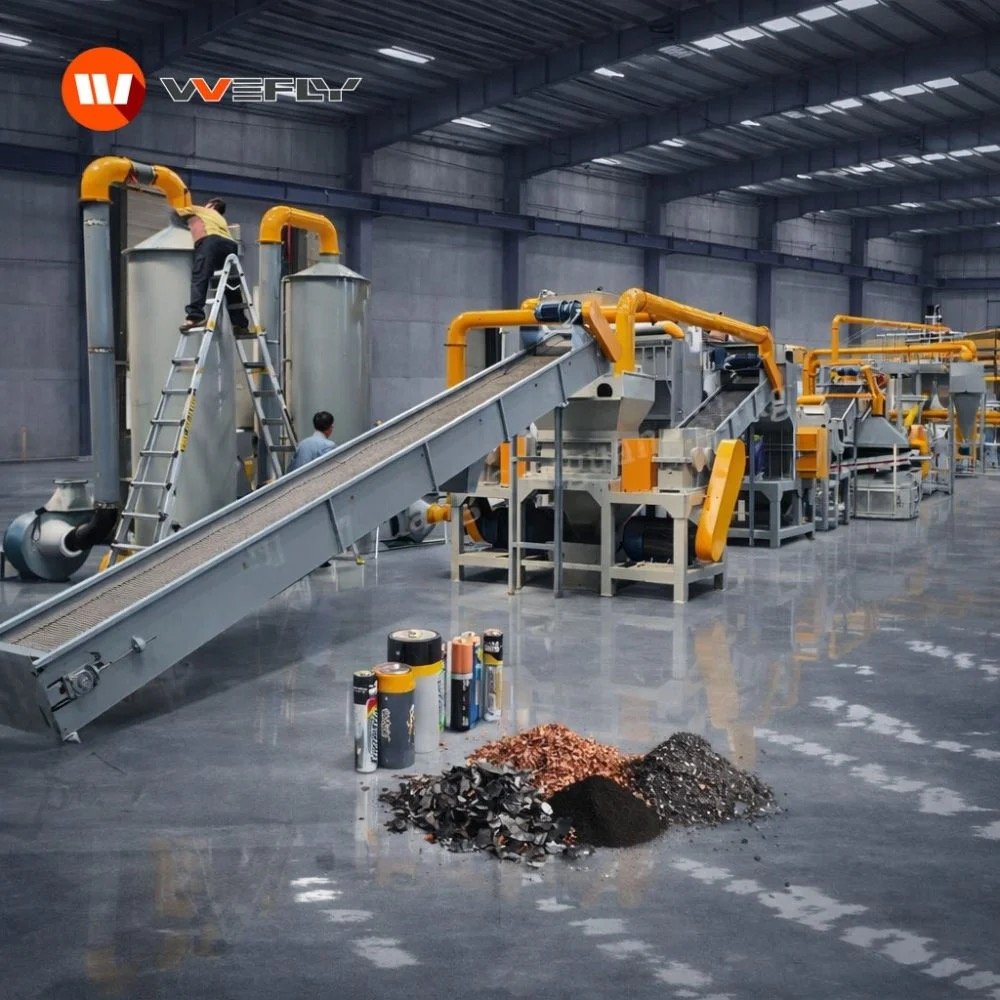
Lithium Battery Recycling Plant for Black Mass Recovery
A Lithium Battery Recycling Plant is an industrial solution for recovering valuable materials from waste lithium-ion batteries.
With the rapid growth of electric vehicles, energy storage systems, and electronic devices, efficient battery recycling has become increasingly important. A professional recycling line helps recover black mass, copper, aluminum, steel shells, and other reusable materials.
🔵 View WOLFU Lithium Battery Recycling Plant
The WOLFU Lithium Battery Recycling Plant uses physical crushing and separation technology to process different types of lithium-ion battery waste.
Key Specifications
| Feature | Specification | Benefit |
|---|---|---|
| Product Name | Lithium Battery Recycling Plant | Complete battery recycling solution |
| Application | Lithium-ion battery waste recycling | Industrial material recovery |
| Models | WOLFU-LDC-500 / WOLFU-LDC-1000 | Flexible capacity options |
| Capacity | 500 kg/h – 1000 kg/h | Suitable for different recycling scales |
| Recovered Materials | Black mass, copper, aluminum, steel shells, plastics | High-value material recovery |
| Main Process | Crushing, grinding, screening, separation | Complete recycling workflow |
| Dust Control | Negative pressure dust collection | Cleaner production environment |
| Automation | Fully integrated production line | Reduces manual operation |
| Applications | EV batteries, electronic waste, energy storage batteries | Wide material compatibility |
Recycling Process
Step 1: Battery Feeding
Waste lithium-ion batteries are safely fed into the recycling system for processing.
Step 2: Crushing and Shredding
The batteries are crushed into smaller pieces to release internal materials.
Step 3: Grinding and Screening
The material is further processed and classified into different particle sizes.
Step 4: Magnetic Separation
Magnetic materials such as steel components are separated from the mixed materials.
Step 5: Airflow and Gravity Separation
Copper, aluminum, black mass, and plastic materials are separated according to physical characteristics.
Step 6: Final Material Collection
Recovered materials are collected separately for further refining or reuse.
🔵 Request a Quote for WOLFU Lithium Battery Recycling Plant
Main Advantages
High Material Recovery Efficiency
The system is designed to recover valuable materials including black mass, copper, aluminum, steel shells, and plastics.
Multiple Battery Type Processing
The plant can process:
- Cylindrical lithium batteries
- Prismatic lithium batteries
- Pouch batteries
- Mobile phone batteries
- Battery shells
- Cathode materials
- Anode materials
Fully Automated Operation
The integrated production line reduces manual handling and improves process stability.
Negative Pressure Dust Control
The dust collection system helps reduce dust leakage and supports a cleaner recycling environment.
Flexible Capacity Options
WOLFU provides different configurations based on production requirements, plant size, and battery supply volume.
Suitable Applications
The WOLFU Lithium Battery Recycling Plant is suitable for:
- EV battery recycling plants
- Energy storage battery recycling
- Electronic waste recycling companies
- Battery manufacturers
- Renewable energy recycling projects
- Industrial waste treatment facilities
Related WOLFU Solutions
For lead battery recycling, review:
🔵 WOLFU Lead Acid Battery Recycling Machine
For precious metal recovery from electronic waste, review:
🔵 WOLFU Precious Metal Refining Plant
For copper wire recycling, review:
🔵 WOLFU Scrap Copper Wire Recycling Separator Machine
Why Choose WOLFU?
WOLFU provides lithium battery recycling systems, metal recovery equipment, industrial furnaces, and customized recycling plant solutions.
For lithium battery recycling projects, WOLFU can provide equipment selection, plant layout design, capacity planning, installation guidance, operator training, and long-term technical support.
Conclusion
A Lithium Battery Recycling Plant is a practical solution for recovering valuable materials from waste lithium-ion batteries.
The WOLFU system integrates crushing, grinding, magnetic separation, screening, gravity separation, airflow separation, and dust collection to recover black mass, copper, aluminum, steel shells, and plastics.
If your company needs a reliable lithium battery recycling solution for EV batteries, energy storage batteries, or electronic waste, WOLFU can provide a customized recycling line based on your project requirements.
🔵 Get a Quote for WOLFU Lithium Battery Recycling Plant
FAQ
What batteries can this recycling plant process?
It can process cylindrical batteries, prismatic batteries, pouch batteries, mobile phone batteries, and other lithium-ion battery waste.
What materials can be recovered?
The system can recover black mass, copper granules, aluminum granules, steel shells, separator plastics, and plastic particles.
What are the standard capacities?
WOLFU provides standard configurations of 500 kg/h and 1000 kg/h.
Is the recycling process automated?
Yes. The plant integrates multiple machines into an automated recycling production line.
Does the system include dust control?
Yes. The plant uses negative pressure operation and dust collection systems to improve the working environment.