
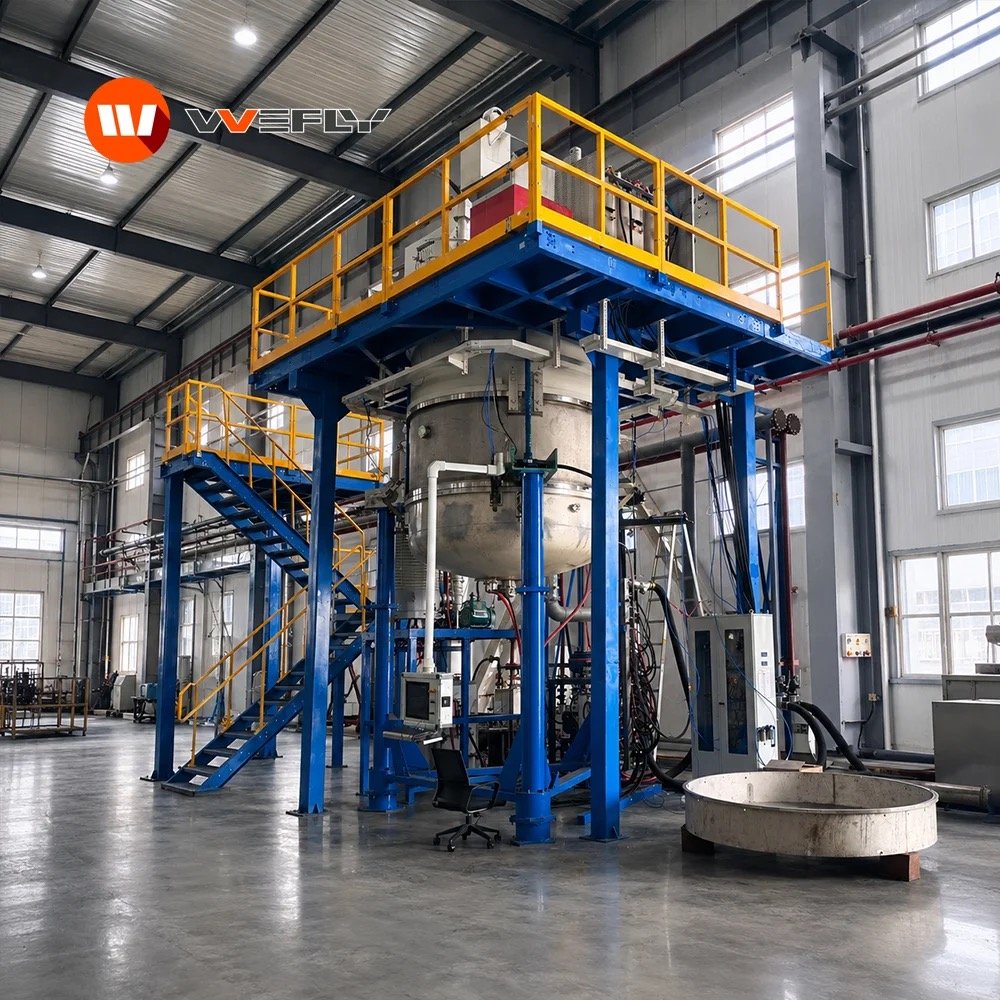
Polysilicon Ingot Casting Furnace for Solar Materials
A Polysilicon Ingot Casting Furnace is a specialized industrial furnace used for melting, purification, and directional solidification of polycrystalline silicon materials. It is an important piece of equipment for photovoltaic silicon processing and solar material production.
Producing a stable silicon ingot requires more than simply heating polysilicon above its melting point. Manufacturers must control vacuum conditions, inert gas protection, temperature gradients, crystallization speed, cooling steps, and furnace automation throughout the process.
View WOLFU Polysilicon Ingot Casting Furnace
The WOLFU Polysilicon Ingot Casting Furnace is designed for high-temperature silicon melting and controlled directional solidification. With high vacuum performance, PLC and HMI automatic control, a maximum temperature of 1600°C, and a stable solidification speed of 5–25 mm/hour, it supports efficient silicon ingot production for photovoltaic material applications.
What Is a Polysilicon Ingot Casting Furnace?
A polysilicon ingot casting furnace is an industrial thermal processing system used to melt polysilicon raw material and solidify it into a polycrystalline silicon ingot. The resulting ingot can be processed further for downstream photovoltaic material applications.
The furnace usually includes a high-temperature chamber, crucible, heating system, vacuum system, inert gas protection system, temperature control system, cooling system, and automated process controls.
Unlike a general-purpose metal melting furnace, this equipment must manage the thermal field carefully. The goal is not only to melt the silicon, but also to control the direction and speed of crystallization.
The WOLFU furnace uses a vertical structure designed for silicon melting, vacuum processing, purification, directional solidification, tempering, and cooling. The full process can be controlled through a PLC and HMI system.
Why Directional Solidification Matters
Directional solidification is one of the most important steps in polysilicon ingot casting. During this process, molten silicon gradually solidifies in a controlled direction, typically from the lower region of the crucible toward the upper region.
A carefully managed temperature gradient helps control crystal formation and material quality. If the temperature field is unstable, the ingot may develop inconsistent crystallization, impurities, internal stress, or quality problems.
The WOLFU furnace is designed to support a directional solidification speed of 5–25 mm/hour. This controlled speed helps manufacturers manage crystallization quality and improve batch stability.
The furnace also uses a structured thermal field to create a larger temperature gradient from top to bottom. Under suitable process conditions, this design can support silicon purification during ingot production.
How the WOLFU Polysilicon Ingot Casting Furnace Works
Step 1: Loading Polysilicon Raw Material
The process begins by loading polysilicon raw material into the crucible. Raw material preparation affects the stability of the entire production cycle.
Operators should check the purity, particle size, moisture level, and loading arrangement before starting the furnace. Proper loading helps improve melting efficiency and reduces process variation.
Step 2: Creating a Vacuum Environment
After loading, the furnace chamber is sealed and evacuated. The WOLFU furnace can achieve a cold ultimate vacuum of 6.67×10⁻³ Pa.
A stable vacuum environment helps reduce unwanted contamination and supports better process control during high-temperature silicon melting.
Step 3: Adding Inert Gas Protection
The furnace can use inert gas protection to create a controlled processing atmosphere. This helps protect the silicon material during melting and crystallization.
Atmosphere control is especially important in photovoltaic silicon production because contamination can affect downstream material quality.
Step 4: Heating and Melting
The furnace heats the polysilicon raw material until it becomes molten silicon. The maximum operating temperature can reach 1600°C.
During this stage, the system must maintain stable heat distribution. Uneven heating may increase energy consumption or affect the later solidification process.
Step 5: Controlled Directional Solidification
After melting is complete, the furnace begins directional solidification. The molten silicon gradually solidifies according to the programmed temperature curve and thermal field design.
The WOLFU system supports a controlled solidification speed of 5–25 mm/hour. Operators can adjust the process according to raw material condition, ingot requirements, and production goals.
Step 6: Tempering and Cooling
After crystallization, the silicon ingot enters the tempering and cooling stages. Controlled cooling helps reduce thermal stress and supports stable ingot quality.
The PLC and HMI system manages the full workflow, including heating, melting, crystallization, tempering, and cooling.
Step 7: Ingot Unloading and Inspection
After the ingot has cooled to a safe temperature, it can be unloaded and inspected. Quality checks may include dimensions, surface condition, crystallization consistency, purity, and downstream process suitability.
Key Advantages of the WOLFU Polysilicon Ingot Casting Furnace
High-Temperature Melting up to 1600°C
The furnace supports a maximum temperature of 1600°C. This makes it suitable for polysilicon melting and controlled ingot casting applications.
Stable high-temperature performance is essential because the quality of the solidification process depends on accurate melting and thermal management.
High Vacuum Performance
The cold ultimate vacuum can reach 6.67×10⁻³ Pa. This supports a cleaner furnace atmosphere and helps improve process control.
A reliable vacuum system is important for photovoltaic silicon processing because the furnace environment can influence material purity and ingot quality.
Controlled Solidification Speed
The directed solidification speed is adjustable within a range of 5–25 mm/hour. This allows operators to control the crystallization process according to production requirements.
Controlled solidification supports better ingot consistency and helps reduce quality variation between batches.
PLC and HMI Automation
The furnace uses PLC and HMI automatic control. This allows one system to manage heating, melting, crystallization, tempering, and cooling.
Automation helps reduce manual operation errors, improve process repeatability, and make long production cycles easier to manage.
Vertical Furnace Structure
The vertical furnace design supports high-temperature melting and directional solidification. It also helps create the required thermal gradient during crystallization.
A properly designed vertical structure is important for stable silicon ingot casting and purification.
Purification Capability
The furnace is designed to support silicon purification during directional solidification. Under suitable process conditions, WOLFU states that 4N raw material can produce polysilicon with purity above 5N.
Actual results depend on raw material condition, process settings, furnace configuration, and production management.
Customizable Furnace Configuration
Different photovoltaic material manufacturers have different production requirements. WOLFU can customize crucible capacity, thermal field structure, vacuum system, heating process, automation configuration, and plant layout.
Request a Customized Polysilicon Ingot Casting Furnace Solution
Technical Parameters of the WOLFU Furnace
The standard WOLFU Polysilicon Ingot Casting Furnace is designed for photovoltaic silicon material production. Its standard voltage is 380V, and the listed power is 100kW.
The maximum furnace temperature is 1600°C. The crucible capacity of the listed model is 3kg. The directed solidification speed is 5–25 mm/hour.
The cold ultimate vacuum is 6.67×10⁻³ Pa. The furnace uses PLC control and has a listed machine weight of approximately 8 tons.
WOLFU can also provide customized configurations according to production scale, crucible capacity, vacuum requirements, and workshop conditions.
Applications of Polysilicon Ingot Casting Furnaces
Photovoltaic Silicon Material Production
The main application is solar silicon material production. Polysilicon ingots can be processed for downstream photovoltaic manufacturing.
Stable ingot casting is important because silicon material quality affects the later production process.
Silicon Purification Projects
The furnace can support silicon purification through controlled directional solidification. This makes it suitable for projects that need to improve the purity of silicon raw material under suitable process conditions.
Solar Material Research and Pilot Production
Research institutions and advanced material companies can use smaller furnace configurations for process development, testing, and pilot production.
A 3kg crucible capacity is practical for customers that need controlled experimental or small-scale production batches.
Customized Photovoltaic Manufacturing Projects
WOLFU can configure the furnace for different crucible capacities and production goals. This allows customers to scale the system according to project requirements.
How to Choose the Right Silicon Ingot Casting Furnace
The first factor is crucible capacity. A 3kg model may be suitable for testing, research, or small-batch production, while larger manufacturing projects may require a higher-capacity furnace.
The second factor is vacuum performance. Buyers should confirm whether the vacuum system matches their material quality and process control requirements.
The third factor is temperature control. Silicon melting and crystallization require stable thermal management, not only a high maximum temperature.
The fourth factor is solidification speed. Adjustable solidification speed is important because different raw materials and ingot requirements may need different process curves.
The fifth factor is thermal field structure. The furnace should create a stable temperature gradient to support directional solidification and purification.
The sixth factor is automation. PLC and HMI control can help manage long production cycles and reduce manual operation risk.
The seventh factor is plant layout. Customers should reserve enough space for the furnace body, vacuum system, cooling equipment, electrical controls, loading area, unloading area, and maintenance access.
Related WOLFU Equipment and Resources
For customers who need a higher-capacity directional solidification solution, WOLFU also provides the WOLFU Polysilicon Directional Solidification Furnace , which supports high-purity silicon melting and solar silicon ingot casting.
For customers producing single crystal silicon ingots, the WOLFU Monocrystalline Silicon Growth Furnace is designed for CZ method silicon crystal growth.
You can also read WOLFU’s related blog article, Monocrystalline Silicon Growth Furnace for CZ Ingots , to learn more about silicon crystal growth equipment and photovoltaic material production.
Why Choose WOLFU?
WOLFU provides industrial furnace systems, metal processing equipment, recycling lines, and customized engineering support. For polysilicon ingot casting projects, customers often need more than a standard furnace.
WOLFU can help evaluate crucible capacity, production scale, vacuum requirements, solidification speed, thermal field design, automation level, and workshop layout.
The company also provides equipment selection, process configuration, installation guidance, technical assistance, spare parts support, machinery test reports, video outgoing inspection, and long-term after-sales service.
For solar silicon material manufacturers, research institutions, and photovoltaic processing projects, a properly configured polysilicon ingot casting furnace can improve process stability and reduce production risk.
Conclusion
A Polysilicon Ingot Casting Furnace is an important industrial system for melting, purification, and directional solidification of polycrystalline silicon materials. It helps manufacturers control temperature, vacuum conditions, crystallization speed, cooling, and production automation.
The WOLFU furnace supports a maximum temperature of 1600°C, a directional solidification speed of 5–25 mm/hour, a cold ultimate vacuum of 6.67×10⁻³ Pa, and PLC + HMI automatic control.
If your project requires a reliable polysilicon ingot casting furnace for solar silicon production, photovoltaic material processing, silicon purification, or pilot manufacturing, WOLFU can recommend a customized configuration based on your raw material, crucible capacity, plant layout, and production goals.
CTA:
Get a Quote for WOLFU Polysilicon Ingot Casting Furnace
FAQ
What is a polysilicon ingot casting furnace used for?
It is used for high-temperature melting, purification, and directional solidification of polycrystalline silicon materials for photovoltaic and solar material applications.
What is the maximum temperature of the WOLFU furnace?
The maximum temperature is 1600°C. This supports stable melting and controlled directional solidification of polysilicon materials.
What is the directional solidification speed?
The directed solidification speed is 5–25 mm/hour. The process can be adjusted according to raw material condition, ingot quality requirements, and production goals.
1 comment on “Polysilicon Ingot Casting Furnace for Solar Materials”