
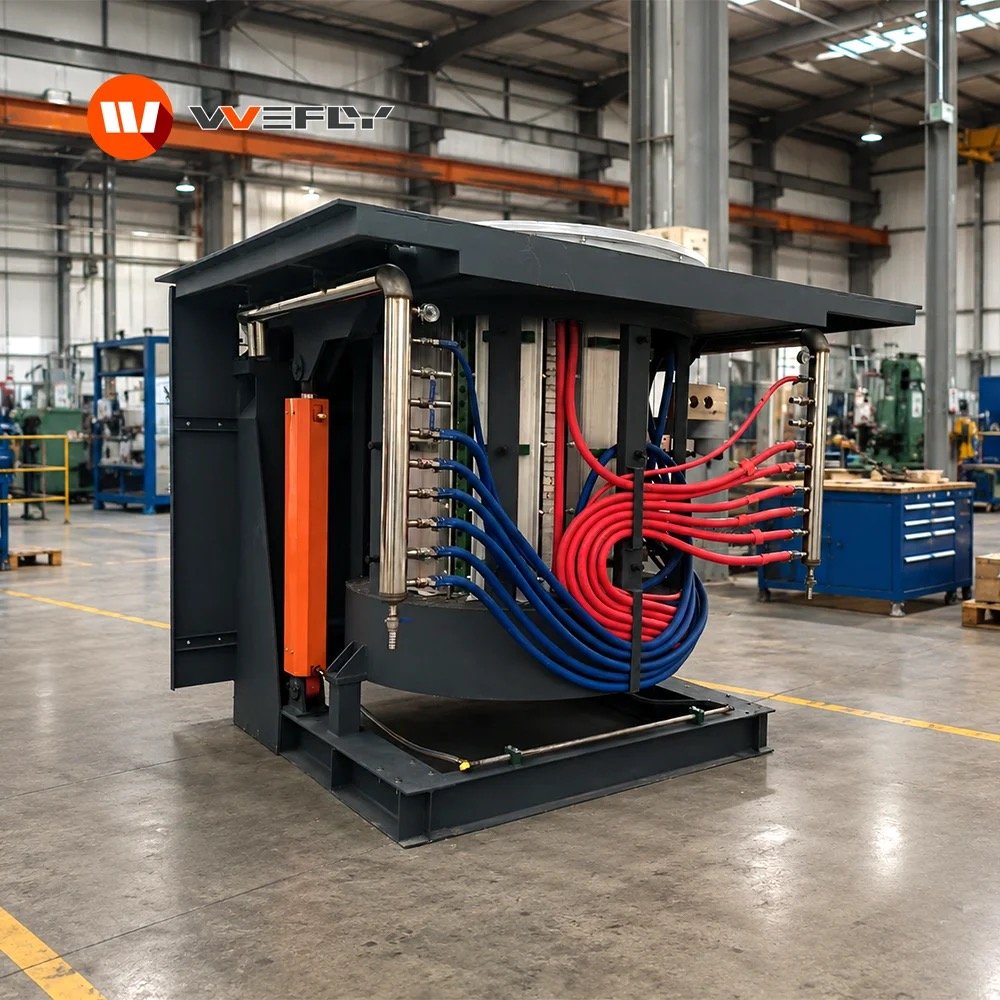
Industrial Silicon Melting Induction Furnace for Solar Grade
An Industrial Silicon Melting Induction Furnace is a high-capacity thermal processing system designed for melting industrial silicon, refined silicon feedstock, and high-purity silicon materials. It is widely used in photovoltaic material production, solar-grade silicon manufacturing, semiconductor processing, silicon ingot casting, and advanced silicon refining projects.
Silicon melting requires more than a high operating temperature. Manufacturers also need stable power output, uniform heating, accurate temperature control, reliable cooling, clean molten silicon, efficient pouring, and continuous production capability.
View WOLFU Industrial Silicon Melting Induction Furnace
The WOLFU Industrial Silicon Melting Induction Furnace is engineered for large-scale silicon smelting operations. With a maximum temperature of 1750°C, a melting capacity of up to 3.8 tons per hour, a 2000kW power supply cabinet, dual steel-shell furnace bodies, hydraulic tilting, water cooling, and PLC-based control, it supports efficient silicon melting for solar and semiconductor material production.
What Is an Industrial Silicon Melting Induction Furnace?
An industrial silicon melting induction furnace is a medium-frequency induction heating system used to melt silicon chunks, refined silicon materials, and selected high-purity silicon feedstock.
The furnace uses electromagnetic induction to transfer energy into the silicon material. Instead of heating only the external furnace chamber, the induction system generates rapid and controlled heating around the crucible and melting zone.
This design helps manufacturers improve melting speed, temperature stability, and energy efficiency. It also supports more consistent molten silicon quality for downstream directional solidification, silicon ingot casting, photovoltaic material processing, and semiconductor applications.
The WOLFU system includes two steel-shell furnace bodies, a 2000kW medium-frequency power supply cabinet, a hydraulic pouring system, water-cooled cables, capacitor banks, magnetic shielding, crucibles, and PLC-based temperature control.
Why Silicon Melting Quality Matters
Silicon is an important raw material for photovoltaic cells, solar panels, semiconductor devices, and advanced electronic materials. The quality of molten silicon directly affects downstream production.
If heating is unstable, the molten silicon may not remain sufficiently uniform. If temperature control is inaccurate, production efficiency may decline and downstream casting quality may become inconsistent.
For solar-grade and semiconductor-grade material production, manufacturers need a furnace that can support stable melting, controlled pouring, and repeatable batch performance.
A properly configured induction furnace helps maintain melt homogeneity, reduce unnecessary production delays, and create a more reliable foundation for silicon ingot casting and crystal growth.
How the WOLFU Silicon Melting Furnace Works
Step 1: Preparing the Silicon Feedstock
The production cycle begins with the preparation of industrial silicon, refined silicon chunks, or selected high-purity silicon feedstock.
Operators should check material size, cleanliness, moisture level, impurity content, and batch weight before loading. Consistent raw material preparation helps improve furnace performance and reduce process variation.
Step 2: Loading the Crucible
The prepared silicon material is loaded into the crucible. The correct crucible configuration should match the intended capacity, thermal conditions, and production requirements.
Loading must be controlled carefully. Overloading may affect heating efficiency and operational safety. Uneven loading may also slow the melting process.
Step 3: Medium-Frequency Induction Heating
The induction power supply sends electrical energy through the induction system. The electromagnetic field generates rapid and uniform heating around the silicon charge.
The standard WOLFU system uses a 2000kW power supply cabinet and can reach a maximum temperature of 1750°C. This supports efficient silicon melting for industrial-scale production.
Step 4: Temperature Monitoring and PLC Control
During melting, the PLC-based control system helps operators monitor and manage furnace conditions. Stable control is important because molten silicon quality depends on consistent heating performance.
The furnace also includes monitoring functions for operational safety. These can help detect issues such as overcurrent, overvoltage, and water pressure loss.
Step 5: Alternating Dual-Furnace Operation
The WOLFU furnace includes two furnace bodies. This allows one furnace to melt silicon while the other furnace prepares for pouring or the next production stage.
Alternating operation reduces downtime and supports a more continuous production workflow. This is especially useful for high-capacity photovoltaic silicon processing plants.
Step 6: Hydraulic Pouring
After the silicon is fully molten, the hydraulic tilting system supports controlled pouring. The molten silicon can then move to downstream processing equipment.
Depending on the factory workflow, molten silicon may be transferred for directional solidification, ingot casting, refining, or other silicon material production steps.
Step 7: Cooling and Equipment Protection
The furnace uses a water cooling system and water-cooled cables to protect key components during operation.
Reliable cooling is essential for induction melting equipment because the furnace operates under high thermal load. Stable cooling helps protect the power system, furnace body, cables, and related components.
Key Advantages of the WOLFU Industrial Silicon Melting Induction Furnace
High Melting Capacity
The standard WOLFU system can melt up to 3.8 tons of silicon per hour. This makes it suitable for large-scale industrial silicon processing and photovoltaic material production.
High melting capacity helps manufacturers improve daily output and reduce production bottlenecks.
Maximum Temperature of 1750°C
The furnace can reach a maximum operating temperature of 1750°C. This temperature level supports complete silicon melting and selected silicon refining operations.
Stable high-temperature performance is important because silicon production requires consistent thermal control throughout the melting cycle.
Dual Steel-Shell Furnace Bodies
The dual-furnace design supports alternating operation. While one furnace body melts silicon, the other can pour molten material or prepare for the next batch.
This structure improves productivity and reduces unnecessary downtime.
2000kW Medium-Frequency Power Supply
The WOLFU system includes a 2000kW medium-frequency power supply cabinet. The induction heating system provides fast and uniform heating for industrial silicon feedstock.
Constant power control helps stabilize the melting process and improve molten silicon consistency.
Hydraulic Tilting System
The hydraulic tilting system supports controlled molten silicon pouring. This makes the discharge process easier to manage and improves production workflow.
Reliable pouring is important when the furnace is connected to downstream silicon ingot casting or directional solidification equipment.
PLC-Based Automation
The PLC control system helps operators manage furnace performance, temperature monitoring, and operational safety.
Automation can reduce manual operating errors and improve repeatability between production batches.
Water Cooling System
The furnace includes a water cooling system and water-cooled cables. These components help protect the equipment during high-temperature operation.
A stable cooling system is essential for long-term industrial use and lower maintenance risk.
Flexible Furnace Capacity Options
WOLFU can provide furnace models ranging from 0.5T to 5T according to customer production requirements.
This allows customers to select a configuration based on silicon batch size, hourly output, workshop layout, power supply, and downstream processing equipment.
Request a Customized Industrial Silicon Melting Furnace Solution
Technical Parameters of the WOLFU Silicon Melting Furnace
The WOLFU Industrial Silicon Melting Induction Furnace is a medium-frequency induction furnace designed for semiconductor and solar-grade silicon production.
The standard system uses a 2000kW power supply cabinet and a six-phase 660V electrical configuration. The maximum operating temperature is 1750°C.
The listed melting capacity is 3.8 tons per hour. The furnace includes two furnace bodies for alternating production, PLC control, electromagnetic induction heating, and a water cooling system.
The listed weight is approximately 15 tons, and the listed dimensions are 950 × 950 × 1750 mm. WOLFU provides a 12-month warranty and can customize furnace capacity, voltage, crucible size, and automation level.
Applications of Industrial Silicon Melting Furnaces
Solar-Grade Silicon Manufacturing
The furnace can melt silicon feedstock used in solar-grade silicon production. Stable melting supports downstream photovoltaic material processing.
For solar material manufacturers, reliable molten silicon quality is important for ingot casting and wafer-related production processes.
Semiconductor Silicon Production
The WOLFU furnace can support silicon melting for semiconductor material production. Semiconductor-related applications require controlled processing and stable furnace performance.
The exact production workflow should be configured according to feedstock purity, downstream process requirements, and quality targets.
Polysilicon and Industrial Silicon Refining
The furnace can process industrial silicon and refined silicon materials for further production steps. It can be used in selected silicon refining operations where high-capacity melting is required.
Silicon Ingot Casting Plants
Molten silicon from the induction furnace can move to downstream ingot casting equipment. A stable melting furnace helps improve the reliability of the complete production line.
Photovoltaic Material Processing
Photovoltaic manufacturers can use the furnace as part of a broader solar material production plant. It supports high-capacity silicon melting before directional solidification and ingot formation.
How to Choose the Right Silicon Melting Furnace
The first factor is production capacity. Buyers should calculate the required hourly output, batch size, working hours, and expected future growth.
The second factor is silicon feedstock. Industrial silicon, refined silicon chunks, polysilicon, and higher-purity materials may require different process configurations.
The third factor is power supply. The standard WOLFU system uses a 2000kW cabinet and six-phase 660V electrical configuration. Customers should confirm local plant conditions before ordering.
The fourth factor is furnace body size. WOLFU can provide furnace models from 0.5T to 5T depending on production requirements.
The fifth factor is downstream processing. Customers should confirm whether the molten silicon will move to directional solidification, ingot casting, refining, or crystal growth equipment.
The sixth factor is cooling. Industrial induction furnaces need a stable water cooling system to protect cables, electrical components, and furnace structures.
The seventh factor is automation. PLC control, fault monitoring, hydraulic tilting, and alternating furnace operation help improve production stability.
Related WOLFU Equipment and Resources
For customers who need downstream silicon ingot production equipment, WOLFU also provides the Polysilicon Ingot Casting Furnace, which supports silicon melting, purification, and directional solidification for solar materials.
For customers who need a metal melting and ingot casting production line, the Medium Frequency Furnace and Ingot Casting Line supports scrap steel, copper, aluminum, and alloy melting applications.
You can also read WOLFU’s related blog article, Polysilicon Ingot Casting Furnace for Solar Materials, to learn more about directional solidification and downstream silicon ingot production.
Why Choose WOLFU?
WOLFU provides industrial melting furnaces, silicon processing equipment, ingot casting systems, recycling production lines, and customized plant solutions.
For industrial silicon melting projects, customers often need more than a furnace body. They need equipment selection, power configuration, plant layout planning, cooling system design, installation support, PLC programming, and operator training.
WOLFU can provide customized furnace capacity and power configurations, complete plant design for silicon melting and casting, equipment installation, commissioning, spare parts supply, preventive maintenance, and remote troubleshooting.
For photovoltaic silicon plants, semiconductor material manufacturers, silicon ingot casting factories, and advanced material processors, a properly configured induction furnace can improve melting efficiency and production stability.
Conclusion
An Industrial Silicon Melting Induction Furnace is a high-capacity solution for melting industrial silicon, refined silicon feedstock, and selected high-purity silicon materials used in photovoltaic and semiconductor production.
The WOLFU system combines a maximum temperature of 1750°C, a melting capacity of up to 3.8 tons per hour, a 2000kW medium-frequency power supply, dual steel-shell furnace bodies, hydraulic tilting, water cooling, and PLC-based control.
If your factory needs a reliable silicon melting furnace for solar-grade silicon production, semiconductor material processing, silicon ingot casting, or advanced refining operations, WOLFU can recommend a customized configuration based on your production capacity, feedstock, voltage, crucible size, and plant layout.
Get a Quote for WOLFU Industrial Silicon Melting Induction Furnace
FAQ
What materials can the industrial silicon melting induction furnace process?
The WOLFU furnace is designed for industrial silicon, polysilicon, refined silicon chunks, and selected high-purity silicon feedstock used in photovoltaic and semiconductor industries.
What is the maximum melting capacity?
The standard WOLFU system can melt up to 3.8 tons of silicon per hour. The final configuration can be customized according to production requirements.
Why does the WOLFU system use two furnace bodies?
Dual furnace bodies allow one furnace to melt silicon while the other furnace pours molten material or prepares for the next production step. This improves productivity and reduces downtime.