
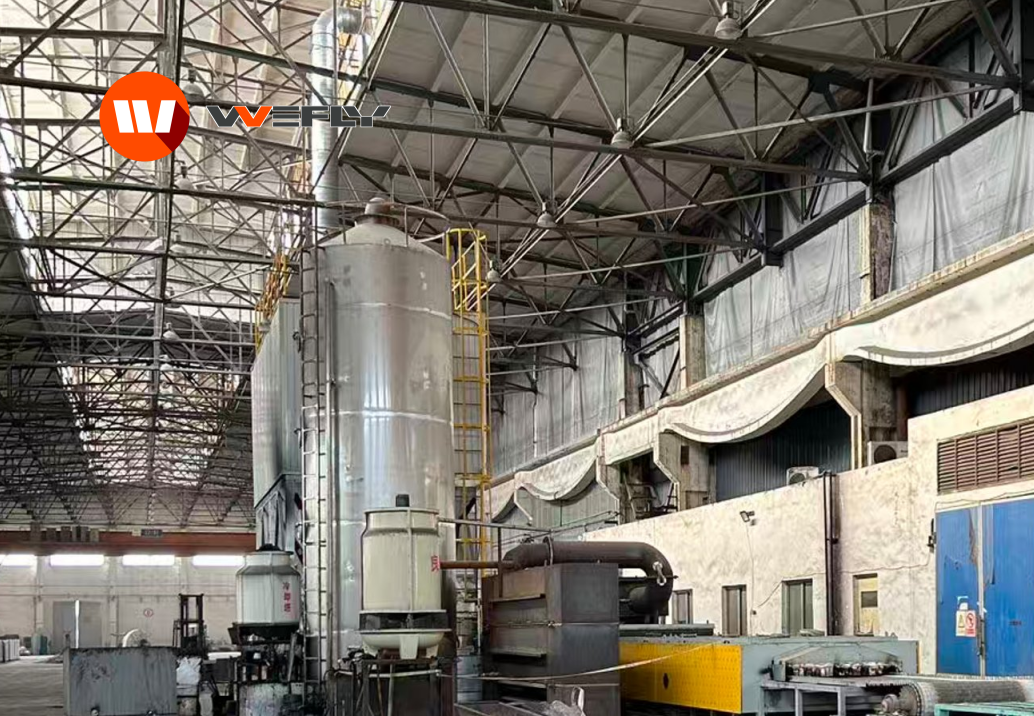
Pyrolysis Off-Gas Treatment System: The Compliance Backbone of PV Recycling
Pyrolysis is the technology that finally made large-scale PV panel recycling possible — it strips EVA encapsulant and backsheet away from glass, silicon and metal so downstream separation actually works. But every tonne of panels that enters a pyrolysis furnace leaves as two products: recovered materials, and exhaust gas.
That exhaust gas is where most pyrolysis projects die. Not at the technical level — at the permitting level. Regulators do not judge a recycling plant by how clean its output is; they judge it by what comes out of the stack. An pyrolysis off-gas treatment system is therefore not an accessory bolted onto a furnace. It is the licence to operate.
WOLFU designs and manufactures the complete pyrolysis off-gas treatment system as an integrated part of the recycling line, engineered together with the furnace rather than retrofitted after a failed emission test.
What Is Actually in PV Pyrolysis Off-Gas?
Solar panel pyrolysis exhaust is not simple smoke. It is a cocktail that varies with feedstock and temperature:
| Component | Typical Source | Why It Matters |
|---|---|---|
| VOCs & tar | EVA decomposition | Odour, condensable deposits, fire risk in ducting |
| HCl | Backsheet / cable insulation | Acid corrosion, stack emission limits |
| HF | Fluoropolymer backsheets (PVDF/PVF) | Highly corrosive, strictly regulated |
| CO, CH₄, H₂ | Incomplete combustion | Combustible, energy value if handled correctly |
| Particulates & heavy metals | Silicon fines, glass dust, dopants | Ash disposal and PM limits |
Two design consequences follow immediately: complete destruction of organics (you cannot filter dioxins away, you must destroy their precursors and prevent re-formation), and acid-resistant materials everywhere downstream.
The Pyrolysis Off-gas Treatment System, Stage by Stage
1. Secondary Combustion Chamber
Raw pyrolysis gas passes into a high-temperature secondary combustion chamber in a turbulent, oxygen-controlled environment. This is the destruction stage: tars, VOCs and dioxin precursors are oxidised to CO₂ and H₂O. Temperature and residence time are continuously monitored.
2. Rapid Quench
The hot gas is then cooled rapidly. This is the anti-dioxin design rule: de novo synthesis of PCDD/F happens precisely in that temperature band. Heat recovered here can be routed back to preheat the furnace charge, cutting fuel consumption.
3. Cyclone & Bag Filter Dust Removal
A cyclone knocks out coarse particulates, followed by a filter capturing fine dust and the heavy metals bound to it. Collected ash is discharged through a sealed system.
4. Spray Tower Scrubbing
Gas enters a vertical spray tower. This tower is the tall stainless column you see at the centre of most installed lines.
5. Activated Carbon Adsorption
A final polishing stage injects or beds activated carbon to adsorb residual dioxins, furans and trace heavy metals (including mercury) that survive the wet stage. Spent carbon is handled as hazardous waste under a defined disposal route.
6. Induced Draft Fan & Stack
An induced draft fan maintains the entire furnace and gas train under slight negative pressure, which is a safety feature as much as a flow feature. Gas is then discharged from the stack in compliance with local standards.
Where the Exhaust Meets the Chemistry
On integrated PV lines, pyrolysis off-gas treatment system and hydrometallurgy are designed as one water system, not two.
PLC-Controlled, Monitored, Auditable
The whole pyrolysis off-gas treatment system is integrated into the line’s linked PLC control system. That data is not only for operation — it is the evidence base for environmental inspection and for the emission guarantees we write into contracts.
Why Buy the Furnace and the Pyrolysis Off-gas Treatment System from One Supplier
- Interface risk removed — gas volume, temperature and composition from the furnace are known inputs at the design stage, not guesses
- One emission guarantee — the stack is the boundary of our responsibility, not the furnace outlet
- No retrofit premium — bolt-on abatement typically costs far more than integrated design, and often still fails the first compliance test
- Global service — commissioning, operator training and remote diagnostics
FAQ
Q: Are dioxins really a risk in solar panel pyrolysis?
A: They can be, because backsheets contain chlorinated and fluorinated polymers.
Q: How much does the pyrolysis off-gas treatment system add to a project?
A: It is a meaningful share of total capex — and skipping it means the plant cannot be licensed, so the true comparison is not “with or without”, it is “compliant or idle”.
Q: Can our existing furnace be retrofitted?
A: Often yes, subject to a gas-volume survey.
Q: Does the pyrolysis off-gas treatment system handle both single-glass and double-glass panels?
A: Yes. Feedstock composition shifts the gas profile.
Building a pyrolysis off-gas treatment system that will pass inspection the first time?
Contact WOLFU for a gas-profile survey and a designed pyrolysis off-gas treatment system matched to your furnace.
📧 johnruan123@163.com | 💬 WhatsApp: +86 151 0379 2578 | 🌐 wolfu-industry.com
Related reading: Waste Solar Panel Recycling Machine: Pyrolysis for Single & Double-Glass PV · PV Silver Recovery Equipment: The Complete Hydrometallurgy Line · Silicon Recovery – Industrial Silicon Melting Induction Furnace · Solar PV Panel Recycling Line Solutions · Solar Panel Recycling Equipment FAQ
*External references: Stockholm Convention on Persistent Organic Pollutants – Dioxins & Furans · IEA PVPS Task 12 – PV Sustainability · IRENA & IEA-PVPS – End-of-Life Management: Solar Photovoltaic Panels