
Solar PV Panel Aluminum Frame Rmoving Machine: The Complete 2026 Buyer’s Guide
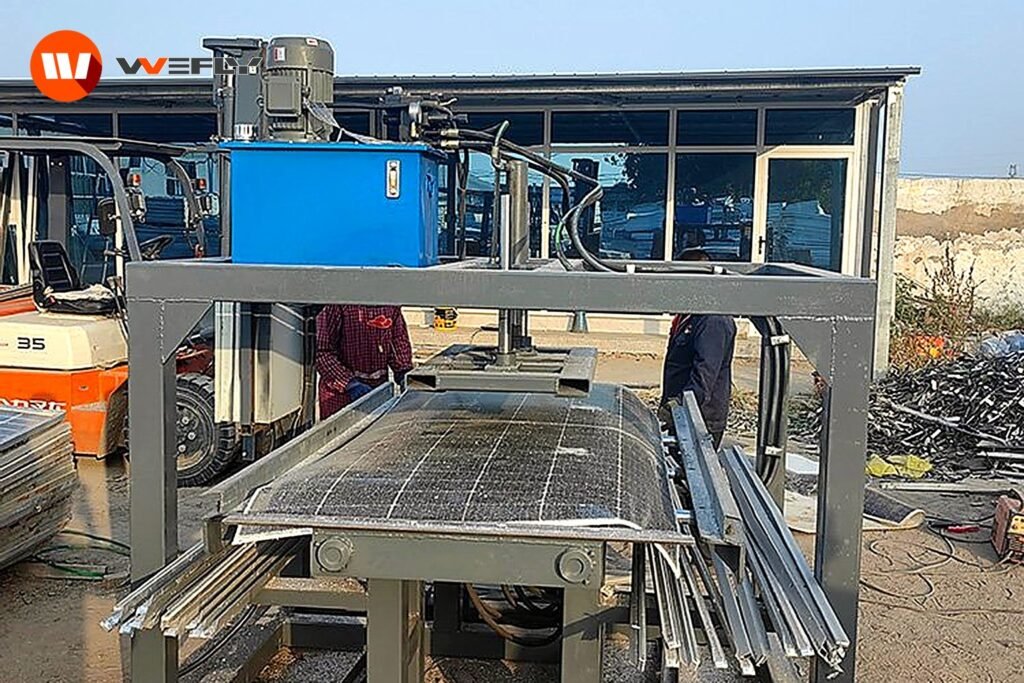
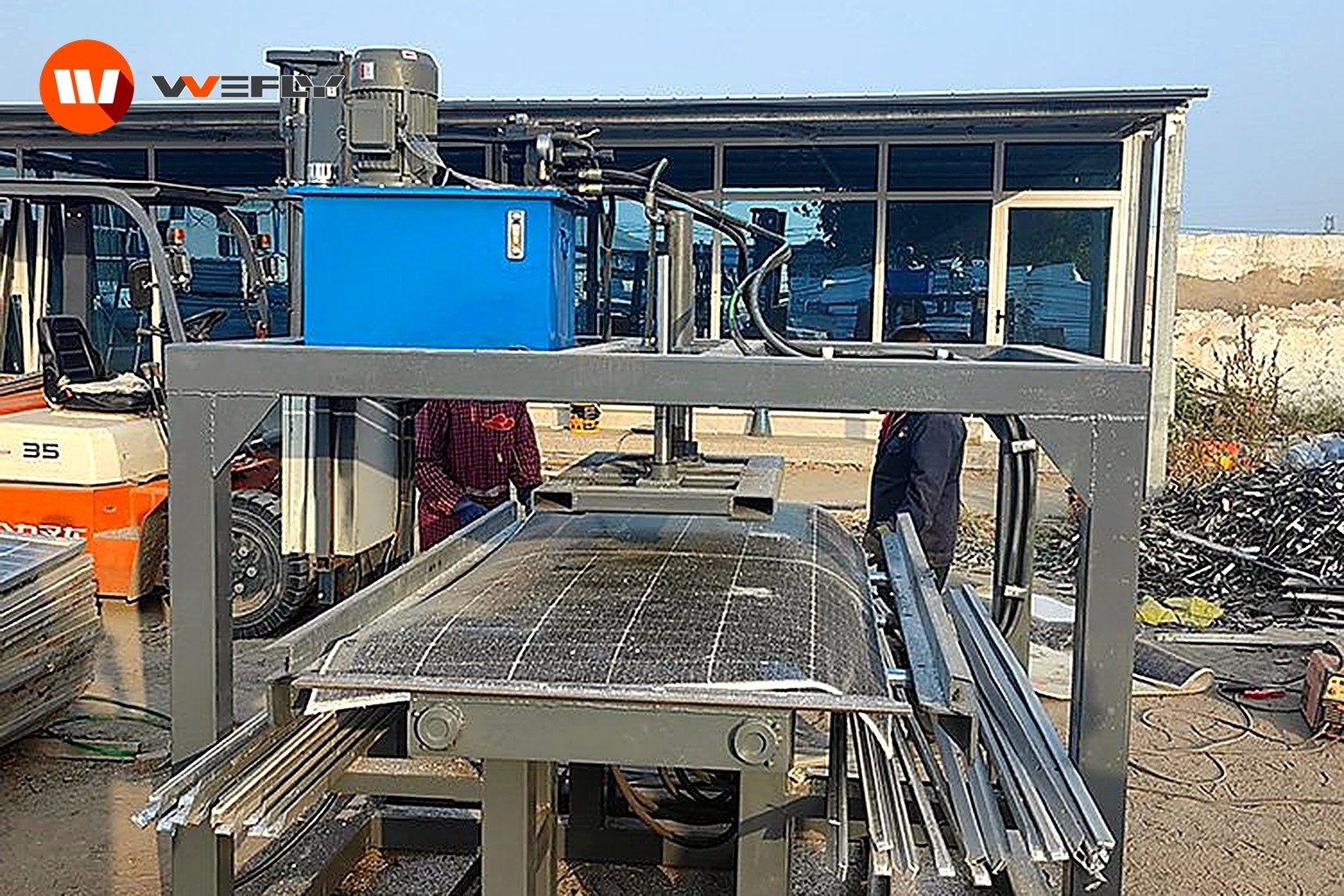
If you are planning a new photovoltaic (PV) recycling plant or upgrading an existing line, the first machine you will install is rarely the shredder or the electrostatic separator. It is the solar PV panel aluminum frame removing machine which sits at the head of the line.
In this guide, we will answer the most-asked questions buyers search for, with the exact specifications, ROI math, and integration logic you need to spec the right machine.
If you missed our previous deep dive into the complete recycling line itself, read it first: WOLFU Solar Panel Recycling Line FAQ.
What you will learn
- What is a solar PV panel aluminum frame removing machine, exactly?
- How does a hydraulic frame removal machine work, step by step?
- Why is frame removal the first step in any PV recycling line?
- What is the aluminum recovery rate, and how much is it worth?
- What specifications should I compare when buying a solar PV panel aluminum frame removing machine?
- Models 160 / 190 / 200 — which one fits my panel mix?
- Can the machine be integrated with glass removal and downstream lines?
- What does the aluminum frame become after removal?
- How do I get a quote or arrange a factory audit?
Q1. What is a solar PV panel aluminum frame removing machine?
A solar PV panel aluminum frame removing machine — sometimes called a deframing machine or PV module dismantling machine — separates the aluminum border from the glass-laminate body of a spent photovoltaic module.
Although the aluminum frame accounts only 8–18% of a panel’s total weight (depending on manufacturer and design), it is the most accessible, highest-purity, and easiest-to-sell material in the module. Four immediate benefits:
- Immediate revenue: 99%+ recovery rate and a well-established downstream buyer market.
- Cleaner downstream: Prevents aluminum from contaminating glass cullet and silicon powder downstream.
- Higher throughput: Manual removal takes 4–8 minutes per panel. A hydraulic machine does it in 30–60 seconds.
- Safer downstream handling: Much easier to handle without sharp aluminum edges, improving operator safety.
For a complete technical definition, see the product specification page: WOLFU Solar Panel Aluminum Frame Removing Machine.
Q2. How does a hydraulic solar PV panel aluminum frame removing machine work, step by step?
Although machine designs vary, a modern hydraulic deframing machine follows a five-step process. The WOLFU HN-FR series solar PV panel aluminum frame removing machine— 5.5 kW, 1800 kg, models 160/190/200 — illustrates the standard workflow:
- Panel loading — The waste solar panel is placed on the working table either manually by an operator or automatically by a robotic arm, depending on your line configuration.
- Hydraulic compression — The upper hydraulic pressure plate descends and fixes the panel firmly in position, ready for removal.
- Short-side frame removal — The short-side mold engages first and shears the aluminum frame from the two shorter edges of the panel.
- Long-side frame removal — The long-side mold then removes the remaining frame on the two longer edges.
- Output routing — The separated aluminum frame drops into a collection bin. The de-framed panel exits onto the next machine.
Q3. Why is frame removal the first step in any PV recycling line?
The order of operations in a PV recycling line follows the physics of material density, size, and contamination tolerance:
- Economic logic: Aluminum is the most valuable material you can remove first. Skipping this step means contaminating your glass stream.
- Material purity: If you shred first, aluminum gets caught in glass cullet and silicon powder. They cannot be cleanly eddy-current separated.
- Thermal compatibility: If you heat-treat first, the aluminum frame expands at a different rate than the glass and may crack the glass or bond to it permanently.
- Regulatory logic: Many jurisdictions (including the EU under WEEE) classify end-of-life PV modules as potentially hazardous waste due to lead solder. Frames are not — separating them first reduces the tonnage of hazardous waste you must report.
For the broader logic of full-line sequencing, see our overview: WOLFU Solar Panel Recycling Line.
Q4. What is the aluminum recovery rate, and how much is it worth?
Modern hydraulic solar PV panel aluminum frame removing machine achieve a 95–99% aluminum recovery rate, depending on panel age, frame design, and operator skill.
Here is the unit economics, using the WOLFU solar panel recycling line at typical European market prices in 2026:
- Glass: Glass accounts for 67.5% of a panel’s weight but only ~39 EUR of value.
- Aluminum frame: Aluminum frame is 12.7% of weight but ~229 EUR of value.
- Silicon: Silicon cells, at 2.7% of weight, yield only ~38 EUR.
- Silver: Silver, at 0.03% of weight, is worth ~600 EUR per module — the highest-value material in the panel.
Aluminum is the second most valuable material in every solar panel, after silver. A single recycling line processing 1,500 kg/hour of panels recovers roughly 270 kg/hour of clean aluminum frame. At 2026 European scrap prices, that is 400–600 EUR per hour of revenue from the deframing step alone — even before you process the rest of the panel.
Source: Silver drives PV recycling economics as module waste wave approaches — pv magazine International.
Q5. What specifications should I compare when buying a solar PV panel aluminum frame removing machine?
When evaluating machines, we recommend buyers compare the following eight parameters — not just price. A cheaper machine with weak hydraulics will cost you far more in broken glass and operator injuries than the savings:
- Motor power: 5.5 kW is the practical industrial benchmark. Under 4 kW cannot reliably press through the silicone adhesive on aged panels; over 8 kW risks breaking the glass.
- Machine weight: 1800 kg is a stable industrial baseline. Lighter machines vibrate under load, increasing breakage rates and operator fatigue.
- Mold replaceability: Replaceable molds are essential. Solar panel sizes vary (M6, M10, M12, G1; bifacial and monofacial; 60-cell and 72-cell).
- Control mode: Manual + Automatic (PLC-controlled) gives you flexibility. Manual for R&D and small batches; automatic for continuous production.
- Panel width range: Adaptive to 800–2000 mm panel widths covers all standard c-Si modules in production today.
- Cycle time: Per-piece cycle time, including loading and unloading, should be under 90 seconds for production-scale use.
- Pressure plate: Hydraulic pressure plate, not pneumatic.
- Warranty: 1 year warranty minimum on the whole machine; 3 years on PLC and motor is preferred.
Q6. Models 160 / 190 / 200 — which one fits my panel mix?
WOLFU’s solar PV panel aluminum frame removing machine comes in three working-width sizes to match the panel dimensions most common in your region’s waste stream. The 160/190/200 number refers to the maximum working width in centimeters.
- Model 160: Model 160 — Best for residential and small commercial panels (typically 1,000–1,600 mm wide).
- Model 190: Model 190 — Best for large commercial and utility-scale panels (1,650–1,900 mm wide). The most common model in M10/M12 production.
- Model 200: Model 200 — Best for oversized bifacial and emerging large-format panels (1,900–2,000 mm wide). Recommended for plants that anticipate future panel size growth.
If your plant processes mixed panel sizes, we recommend choosing the largest model that fits your workshop — the replaceable mold system allows you to adapt down to smaller panels, but the reverse is not true.
Q7. Can the machine be integrated with glass removal and downstream lines?
Yes — and it should be. A standalone deframing machine delivers the lowest ROI in your recycling line. The real economic unlock comes from integration:
- Step 1: Glass removal (thermal) — After frame removal, the de-framed panel enters a thermal glass-removal furnace. The glass can then be separated for resale.
- Step 2: Cell processing — The de-framed, de-glassed silicon cell is then shredded and processed through a crushing, screening, and electrostatic separation system to recover silicon powder, copper, and silver.
- Step 3: Aluminum re-entry — The aluminum frame is collected separately and can be fed directly into an induction melting furnace for ingot casting.
WOLFU provides the complete integrated system — from the HN-FR frame remover, through the pyrolysis furnace, to aluminum induction melting and ingot casting. See the full upstream + downstream range: WOLFU Solar Panel Recycling Line.
Q8. What does the aluminum frame become after removal?
A removed aluminum frame has four main downstream pathways, in decreasing order of value:
- Direct remelting into extrusion billets for new solar frames. The 6063-T5 alloy used in solar frames is a standard extrusion alloy with an established buyer market — including WOLFU’s own induction melting furnaces.
- Sale to secondary aluminum smelters for general aluminum products (automotive, construction, packaging).
- Refurbishment for second-life solar module refurbishment projects, where frames are re-used on refurbished panels.
- In-house casting into ingots for trade or further processing — WOLFU’s aluminum can recycling machine and ingot casting line are designed for this.
Learn more about WOLFU’s aluminum melting and ingot casting line: WOLFU Aluminum Can Recycling Machine.
Q9. How do I get a quote or arrange a factory audit?
If you are evaluating a solar PV panel aluminum frame removing machine for a new or existing PV recycling line, the most efficient path is:
- Send us your panel size range (M6 / M10 / M12 / bifacial?), expected daily throughput, and target automation level.
- We will recommend a model (160 / 190 / 200), the mold set, and an optional upstream robotic loader.
- We provide a detailed FOB quote, lead time, and layout drawing for your workshop.
Start the conversation here: WOLFU Solar PV Panel Aluminum Frame Removing Machine — Request a Quote.
Closing thought: the upstream choice sets the ceiling
In PV recycling, the first machine sets the ceiling for the entire line. A 99% aluminum recovery rate, with zero glass breakage, is what enables every downstream separator to do its job cleanly. Choose the frame remover with the same rigor you will apply to choosing the shredder, the electrostatic separator, and the pyrolysis furnace — because in a tightly integrated line, every machine is only as good as the material that enters it.
References and further reading
WOLFU Solar Panel Aluminum Frame Removing Machine (HN-FR 160/190/200)
WOLFU Solar Panel Recycling Line — Complete FAQ Buyer’s Guide
WOLFU Solar Panel Recycling Line — Market Outlook and Process Guide
WOLFU Solar PV Panel Recycling Plant (200 kg/h model)
Silver drives PV recycling economics as module waste wave approaches — pv magazine International
Solar Panel Recycling & Disposal Compliance Guide — CapSolar (2026)
Solar Panel Recycling Europe 2026: WEEE Directive & Recovery Rates — SurgePV
Solar Panel Frame Removal Machine technical data — Ooitech (public competitor spec)
GB/T 43752-2024 晶体硅光伏组件回收处理方法 物理法 (Chinese national standard)