
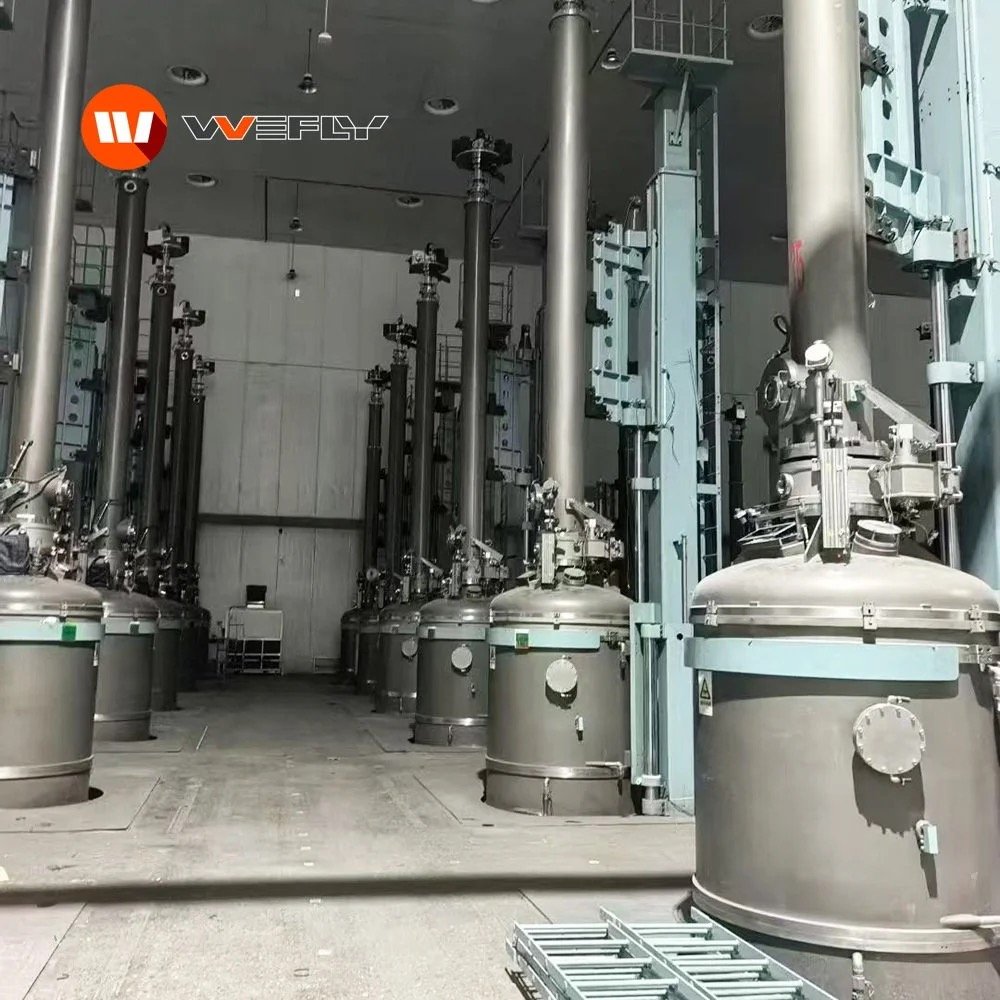
Why a Monocrystalline Silicon Growth Furnace Matters for CZ Silicon Ingot Production
A monocrystalline silicon growth furnace is one of the most important pieces of equipment in modern silicon crystal manufacturing. For producers of photovoltaic wafers, semiconductor materials, and advanced electronic substrates, the furnace must deliver stable thermal control, reliable pulling accuracy, and a protected crystal growth environment. WOLFU presents this equipment as a dedicated solution for CZ method silicon crystal growth and single crystal silicon ingot production, with precise temperature control, pulling control, rotation control, and vacuum or argon atmosphere protection.
In monocrystalline silicon manufacturing, the furnace does far more than melt raw material. Its real value lies in how precisely it manages the crystal growth process. The WOLFU product page explains that high-purity polysilicon is melted in a quartz crucible, then a seed crystal is dipped into the molten silicon and slowly pulled upward while rotating, allowing a cylindrical silicon ingot to grow under controlled conditions. This matches standard descriptions of the Czochralski method, which is widely recognized as a dominant crystal growth process for bulk single crystals such as silicon.
What Is a Monocrystalline Silicon Growth Furnace?
A monocrystalline silicon growth furnace is a specialized crystal growth system used to produce single crystal silicon ingots from molten polysilicon. According to WOLFU, the furnace is designed specifically for Czochralski crystal growth, with customizable chamber size, controlled heating, pulling, seed rotation, crucible rotation, and protective atmosphere management. The page also states that the final product is a monocrystalline silicon ingot, with ingot diameter customized according to customer requirements.
This matters because the CZ process depends on coordinated control of several variables at the same time. General technical references explain that, after the material is melted, a seed crystal is dipped into the melt and slowly withdrawn while rotating; the crystal diameter is then controlled through heating power, pulling rate, and rotation rate. In other words, the furnace is not just a hot chamber. It is a controlled growth platform that determines whether the final ingot meets quality and dimensional targets.
Why the CZ Method Matters in Silicon Ingot Production
Precise Pulling Control Supports Stable Ingot Growth
One of the biggest benefits of a monocrystalline silicon growth furnace is precise pulling control. WOLFU explicitly lists precision pulling speed control as a key specification and notes that heating power, pulling speed, and rotation speed directly affect ingot diameter, crystal quality, and production stability. That is a major practical point because even small variation in pulling conditions can affect the geometry and internal quality of the final silicon ingot.
This aligns closely with broader crystal growth references. Technical overviews of the CZ method state that the shape and especially the diameter of the crystal are controlled by carefully adjusting heating power, withdrawal speed, and crystal rotation. That is why modern CZ production lines commonly depend on automated diameter and growth control. WOLFU’s emphasis on PLC and HMI automation fits this process need well.
Rotation Control Improves Process Consistency
WOLFU also highlights seed crystal and crucible rotation control, which is an important part of stable single crystal growth. In the CZ process, rotation helps manage heat transfer and melt behavior around the growing crystal. On the product page, WOLFU positions this feature as one of the core mechanisms supporting stable ingot growth and more reliable production.
This is consistent with public CZ process descriptions. Crystal growth references explain that the seed is withdrawn while rotating and that the crucible or melt environment may also be controlled to stabilize growth behavior. In real manufacturing, this matters because crystal uniformity depends on the interaction between temperature field, melt flow, and pulling conditions rather than on temperature alone.
Controlled Atmosphere Helps Protect Crystal Quality
Another important feature of a monocrystalline silicon growth furnace is atmosphere protection. WOLFU states that the process is carried out under vacuum or argon inert gas protection, and further explains that crystal growth is usually performed in an inert atmosphere such as argon to reduce contamination and maintain crystal quality. In high-value silicon production, atmosphere management is a central part of process cleanliness and ingot stability.
That process logic is widely recognized. CZ crystal growth is used because it offers strong process control and supports high-quality monocrystalline silicon production at industrial scale. A protected environment is part of that control strategy, especially when the goal is large-diameter ingots for photovoltaic or semiconductor use. WOLFU’s furnace is clearly designed around this requirement.
Why the WOLFU Monocrystalline Silicon Growth Furnace Is Practical
The WOLFU Monocrystalline Silicon Growth Furnace is designed for single crystal silicon ingot production using the CZ method. According to the product page, its raw material is high-purity polysilicon, and the system can be configured with resistance heating or induction heating, vacuum or argon inert gas protection, PLC + HMI automatic control, water cooling, and a full safety system covering temperature, vacuum, water cooling, pressure, and electrical protection.
The product page also makes clear that WOLFU can customize the furnace based on ingot size, production capacity, thermal field design, and process requirements. That is important for B2B buyers because silicon ingot production lines often differ in target diameter, throughput, thermal field preference, and automation level. WOLFU further states that it can support furnace configuration, thermal field design, control system selection, and production line planning.
Another practical advantage is process integration. WOLFU says the furnace can be configured with a vacuum system, argon gas protection system, water cooling system, crystal pulling mechanism, crucible rotation mechanism, and safety protection system. For buyers building or upgrading a silicon ingot line, this matters because crystal growth performance depends on how well these subsystems work together rather than on the chamber alone.
Main Applications of This Furnace
Monocrystalline Silicon Ingot Production
The main application is monocrystalline silicon ingot production. WOLFU states this directly in the technical parameter table and throughout the product description. The final product is listed as a monocrystalline silicon ingot, which is the standard upstream material for slicing into wafers for photovoltaic or semiconductor use.
This is consistent with the broader role of the Czochralski process. Technical references describe CZ as one of the most important industrial methods for producing bulk single crystals, especially silicon. That makes a dedicated CZ furnace essential for manufacturers targeting stable single crystal output rather than polycrystalline casting.
Photovoltaic Silicon Material Production
WOLFU specifically states that the furnace is suitable for photovoltaic silicon material production. This is a logical application because mono-Si remains a major material route for solar wafers, and the CZ method is widely used where high-quality single crystal ingots are needed for photovoltaic performance.
For solar manufacturers, the quality of the ingot matters at every later step, including wafer slicing and cell processing. A furnace that supports more stable crystal growth can therefore influence not only the ingot stage but also downstream production consistency. WOLFU’s focus on thermal field optimization and automation is relevant here.
Semiconductor and Advanced Material Applications
The product page also lists semiconductor substrate material preparation and advanced crystal growth researchamong the target uses. That suggests the furnace is suitable not only for photovoltaic production but also for higher-specification crystal growth work where process stability and ingot quality are especially important.
Public references also note that Czochralski-grown silicon is fundamental to electronics manufacturing and is widely used across semiconductor applications. This broader technical background strengthens the case for using a dedicated monocrystalline silicon growth furnace in advanced materials production.
What Buyers Should Check Before Choosing a Monocrystalline Silicon Growth Furnace
1. Growth Method Compatibility
The first thing to confirm is the process route. WOLFU’s furnace is built for the Czochralski method, so buyers should be sure their production plan is based on CZ crystal pulling rather than another silicon ingot route. If the project depends on seed pulling, ingot diameter control, and inert atmosphere growth, this type of furnace is appropriate.
2. Ingot Diameter and Chamber Customization
WOLFU states that both chamber size and ingot diameter can be customized according to customer requirements. Buyers should therefore define target ingot dimensions, batch planning, and plant layout early in the purchasing process. This helps match the furnace structure to the intended production scale.
3. Heating and Thermal Field Design
The product page notes that the furnace can use resistance heating or induction heating, and WOLFU also offers thermal field optimization support. Buyers should evaluate whether the selected heating structure and thermal field design match their target crystal size, pulling strategy, and quality goals. In crystal growth, thermal field design is not a small detail. It is one of the main factors affecting ingot stability.
4. Pulling and Rotation Control Accuracy
WOLFU repeatedly emphasizes precision pulling speed control and rotation control. Buyers should pay close attention to these capabilities because they directly influence diameter control, growth stability, and repeatability. Technical CZ references likewise identify pulling rate and rotation as key process parameters in single crystal growth.
5. Atmosphere, Cooling, and Safety Systems
The furnace is designed to operate with vacuum or argon inert gas protection, plus a water cooling system and a full safety system covering pressure, temperature, vacuum, water cooling, and electrical conditions. Buyers should confirm that their utilities, safety expectations, and process environment match these requirements. This is especially important in high-value silicon production, where stable operation matters as much as nominal heating capability.
Why Supporting Equipment Matters
A monocrystalline silicon growth furnace performs best when it is part of a complete crystal-growth production solution. On the same WOLFU site, related equipment includes the Polysilicon Directional Solidification Furnace, the Vacuum Induction Melting Furnace, and other crystal growth or vacuum furnace products shown in related categories. WOLFU also states that it supports production line planning, process solutions for CZ silicon crystal growth, and long-term technical service.
This matters because single crystal growth quality depends on more than the pulling chamber alone. Thermal field design, gas protection, cooling conditions, automation, and upstream raw material preparation all influence the final ingot. WOLFU’s product description clearly frames the furnace as part of a broader industrial solution rather than a stand-alone heating device.
Final Thoughts
A monocrystalline silicon growth furnace is a strong investment for manufacturers that need stable CZ silicon ingot production, precise pulling control, and reliable atmosphere protection for high-quality crystal growth. WOLFU’s product page shows that this furnace is designed specifically for single crystal silicon ingot production using the Czochralski method, with PLC + HMI control, vacuum or argon protection, precision pulling speed control, seed and crucible rotation control, and customizable furnace size and ingot diameter.
If your business needs a reliable solution for monocrystalline silicon ingot growth, the WOLFU Monocrystalline Silicon Growth Furnace is a strong option to consider. It is built for controlled crystal pulling, stable thermal processing, flexible customization, and practical industrial operation. Explore the product here: Monocrystalline Silicon Growth Furnace by WOLFU.